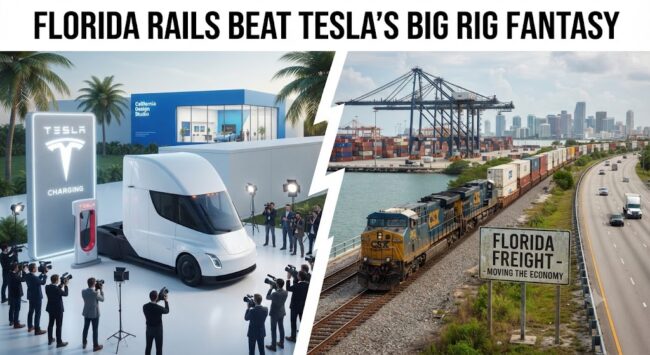
Somewhere in a California design studio, a fleet of shiny electric semis is posing for glamour shots. Somewhere in Florida, a real freight system is quietly doing the actual work of moving the state’s economy — no press event required. That contrast is the whole story, and it’s time Florida stopped pretending otherwise.
For the last few years, the Tesla Semi has been marketed as the truck that will save trucking from itself: silent, sleek, “zero-emission,” and destined to replace the diesel rigs clogging I-95, I-10, and I-4. It’s a great pitch. It’s a terrible plan. And nowhere is that gap between hype and reality more obvious than in Florida, a state whose entire economic identity is built on moving freight efficiently through its ports, distribution centers, and — most overlooked of all — its rail lines.
Florida doesn’t need a battery-powered miracle truck. It needs to finally take rail seriously. And the math, the physics, and the price tag all say the same thing: freight rail modernization delivers more value, more capacity, and more resilience than an electric semi program ever will, at a fraction of the cost.
The Weight Problem Nobody at Tesla Wants to Discuss
Start with the basic physics that no amount of slick keynote lighting can hide. Batteries are heavy. Really heavy. A battery pack large enough to haul an 80,000-pound load hundreds of miles has to be enormous, and every pound of that pack is a pound that can’t be cargo.
That’s not a minor engineering footnote — it’s the whole ballgame in freight. Trucking margins are razor-thin, and they live and die on payload. An electric semi that sacrifices a meaningful chunk of its legal weight allowance to lithium and cobalt isn’t a “next-generation” truck. It’s a smaller truck with better branding. Add in the recharging downtime — hours, not minutes, for a full charge on a heavy-duty rig — and you’ve built a vehicle that hauls less, less often, for more money. That’s not innovation. That’s a downgrade with good lighting.
Now compare that to a freight train, a technology nobody has ever accused of being flashy but that quietly outperforms trucking on the metric that actually matters: moving enormous tonnage over long distances using a fraction of the energy. A single train can move a ton of freight thousands of feet on a gallon of fuel equivalent, several times more efficient than any truck, electric or diesel, will ever be. Rail doesn’t need a moonshot battery chemistry breakthrough to make that math work. It’s already working. Today. At scale. In Florida.
Florida’s Grid Isn’t Ready to Babysit a Trucking Fleet
Here’s the part the electric-semi enthusiasts really don’t want to talk about: charging infrastructure. To keep a fleet of heavy-duty electric trucks moving along Florida’s major freight corridors, you’d need megawatt-scale charging stations spaced at intervals up and down hundreds of miles of interstate. That’s not a few extra outlets at a truck stop — that’s power draw comparable to small industrial facilities, repeated dozens of times across the state.
Florida’s grid already gets stretched thin every hurricane season and every summer heat wave. Now imagine asking it to also feed a small army of charging megastations for long-haul trucking, built and maintained on the public dime, because private trucking fleets aren’t going to foot that bill themselves. Someone pays for that buildout, and it isn’t Tesla. It’s taxpayers, ratepayers, and whoever’s stuck holding the bag when the grid can’t keep up.
Rail has no such problem. Florida’s freight railroads — CSX, Norfolk Southern, Florida East Coast Railway — already own, operate, and upgrade their own infrastructure with private capital. They’re not asking the state to build them a charging network. They’re not asking for a subsidy to make the physics work. They’ve been quietly reinvesting in track, signals, and yard capacity for decades, because that’s simply what running a railroad requires. If Florida wants “innovation,” it doesn’t need to invent a new grid. It needs to unlock the capacity already sitting on rails that crisscross the entire peninsula.
Long Haul Is Rail’s Job. Stop Asking Trucks to Do It Worse.
None of this is an argument against trucks entirely — local delivery, last-mile drayage, short regional runs, sure, trucks will always have a role there. But somewhere along the way, the conversation got hijacked into believing that swapping diesel engines for battery packs on long-haul routes counts as progress. It doesn’t. It just moves the same inefficient model onto a more expensive and more fragile platform.
The smarter play, and the one Florida’s ports and logistics hubs are sitting on right now, is shifting long-haul volume off the highway and onto rail, where it belongs. Picture containers coming off ships at Florida’s ports, loaded directly onto trains, and moved efficiently to inland distribution hubs in Orlando, Tampa, or South Florida — freeing up interstate lanes for the local and regional trips trucks are actually good at. That’s not speculative. That’s intermodal freight rail, and it already exists. It’s just underused, because everyone’s too busy admiring the chrome on a truck that hasn’t even solved the range problem yet.
When the Fancy Truck Breaks, Who Fixes It?
Reliability is where the Tesla Semi story really falls apart. A diesel truck breaks down on the highway, and there’s a mechanic in practically every town in Florida who can get it running again. An electric semi with a proprietary battery and drivetrain breaks down, and good luck — you’re waiting on a specialized technician, a specialized part, and probably a very unhappy dispatcher. For an industry built on reliability and tight delivery windows, betting the supply chain on unproven, hard-to-service technology isn’t bold. It’s reckless.
Rail, by contrast, is the definition of proven. It’s been the backbone of American freight for over a century, and modern rail operations use sophisticated scheduling, high-torque locomotives, and enormous economies of scale to move more weight, more reliably, than any highway fleet — electric or otherwise — could hope to match. When people say they want a “resilient supply chain,” what they’re describing, whether they realize it or not, is rail.
The “Zero Emission” Sleight of Hand
Let’s talk about the marketing centerpiece: “zero emissions.” It sounds great in a keynote. It falls apart under scrutiny. An electric truck’s tailpipe may be clean, but the truck itself isn’t emission-free — not when you account for the mining of lithium, cobalt, and nickel that goes into every battery pack, the emissions-heavy manufacturing process, and the source of the electricity that charges it in the first place.
In Florida, where the energy grid still leans heavily on natural gas, an electric semi is only as “green” as the power plant behind the outlet. That’s not a gotcha — it’s just honest accounting that the marketing conveniently skips. Meanwhile, freight rail has spent decades squeezing efficiency out of diesel-electric locomotives that already outperform trucking on emissions per ton-mile by a wide margin, and the rail industry continues to invest in cleaner locomotive technology, including hybrid and hydrogen fuel-cell switching engines, without needing a taxpayer-funded grid overhaul to make it happen.
If Florida actually wants a lower-emission freight future, the fastest, cheapest, most proven path isn’t a fleet of experimental trucks. It’s shifting more tonnage onto the rails that are already sitting there, underused, ready to carry it.
Follow the Money
Let’s get concrete about cost, because this is ultimately a numbers argument dressed up as a technology debate. An electric semi costs dramatically more upfront than its diesel counterpart, before you even factor in the charging infrastructure, the battery replacement costs down the line, and the reduced payload eating into revenue per trip. Multiply that across a statewide fleet, add in publicly funded charging infrastructure, and you’re looking at an enormous capital outlay for a technology that hauls less freight, less reliably, than what it’s replacing.
Rail modernization, by comparison, is almost embarrassingly cost-effective. Expanding intermodal yard capacity, upgrading track and signaling, and improving port-to-rail connectivity are investments in infrastructure that’s already generating returns. It’s not experimental. It’s not waiting on a battery chemistry breakthrough. It’s shovel-ready capacity expansion on a system with a business model that’s worked for generations, funded largely by the private railroads themselves rather than the public purse.
And the jobs argument doesn’t even favor trucking. Rail work is skilled, stable, and comes with the kind of pay and benefits that trucking, with its brutal turnover rates and independent-contractor churn, has never been able to match. Investing in rail capacity means investing in durable, well-paid careers, not just an experimental vehicle assembly line.
What Florida Should Actually Do
If Florida wants to lead the country in freight innovation instead of just talking about it, the roadmap isn’t complicated:
Put public infrastructure dollars into rail capacity, not truck charging networks. Every dollar spent building megawatt charging corridors for experimental semis is a dollar not spent expanding intermodal yards, upgrading crossings, or improving port-to-rail connections that already move freight efficiently today.
Make port-to-rail integration the default, not the afterthought. Containers landing at Florida’s ports should have a fast, direct path onto trains headed to inland distribution hubs, rather than sitting in truck queues on already-congested interstates.
Support cleaner locomotive technology where it makes sense — hybrid and hydrogen options for yard and switching operations — instead of chasing a battery-truck fantasy that solves none of the fundamental capacity or cost problems facing long-haul freight.
Stop treating “electric” as a synonym for “innovative.” True innovation is whatever actually solves the problem at the lowest cost and the highest reliability. Right now, in Florida, that’s rail, not a semi truck with a spaceship dashboard.
The Bottom Line
The Tesla Semi is a fascinating piece of engineering and an even more impressive piece of marketing. But engineering flash isn’t the same as economic sense, and Florida’s freight future shouldn’t be decided by which truck looks best in a promotional video. It should be decided by what actually moves the most freight, at the lowest cost, with the least strain on an already-stressed power grid.
By every meaningful measure — energy efficiency, infrastructure cost, reliability, job quality, and genuine environmental impact — rail wins, and it isn’t close. Florida already has the ports, the track, and the private rail operators ready to scale up. What it doesn’t need is a taxpayer-subsidized experiment in battery-powered big rigs chasing a “zero-emission” headline that doesn’t survive a second look.
The future of Florida freight was never going to roll in on a set of oversized tires and a battery pack. It was always going to run on rails. Florida just needs to stop staring at the shiny truck long enough to notice the tracks are already there.
About the Author