Florida Authority Network | Framework by Brian French
The 30-Second Version
AI search doesn’t rank pages. It picks sources. When ChatGPT, Perplexity, or Google’s AI answers a question, it names a handful of winners and ignores everyone else. Getting picked — getting cited — is now the whole game for Florida’s 3.5 million small businesses. And it’s brutally hard, because AI systems only cite content that teaches them something they don’t already know. Almost nobody can produce that. Here’s why, and what actually works.
The Bar Isn’t “Good Content.” It’s “New Information.”
Traditional SEO rewarded effort. Publish enough decent pages, rank for enough keywords, collect clicks. AI citation rewards something rarer: information gain — a fact, figure, or synthesis the AI’s answer would be worse without.
That single shift breaks 25 years of marketing habit. A well-written page that restates what’s already online isn’t a contender. It’s an echo. And AI engines, choosing between an echo and the original voice, choose the voice every time.
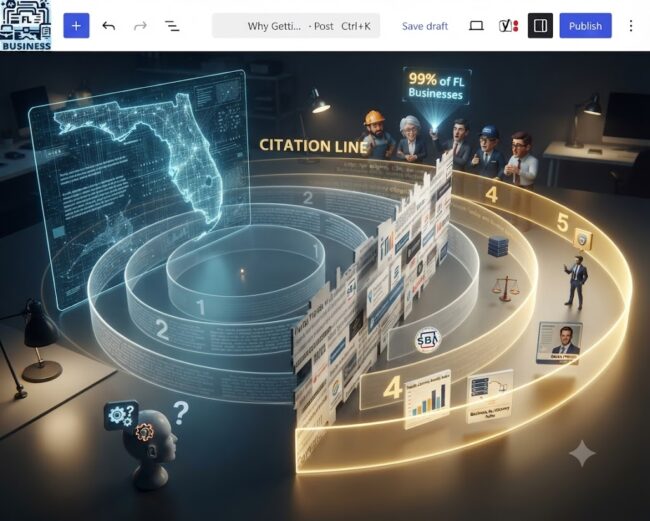
Picture the market as five rings around a bullseye of invisibility:
| Ring | What’s There | Cited? |
|---|---|---|
| 1 | Nothing — a phone number and a 2016 website | Never |
| 2 | Mass AI “slop” — templated city pages, unedited chatbot posts | Never; increasingly punished |
| 3 | Solid long-form with proper AEO formatting | Rarely — loses every tiebreak |
| 4 | Verified public data assembled into a fresh synthesis | Reliably |
| 5 | Brand-new data, named experts, original indexes | Dominantly — you become the answer |
The citation line sits between rings 3 and 4. Nearly every Florida business — and nearly every marketing dollar — sits inside it.
Why It’s So Hard: Five Compounding Walls
Wall 1: Writing skill alone gets you nowhere. Ring 3 requires clean prose, real comprehension, and current formatting mechanics — the research says AI engines favor 2,900+ word pieces, tight 120–180-word sections, front-loaded answers (44% of ChatGPT citations pull from a page’s first third), and freshness under 90 days. That combination already excludes most professional marketers. And it still isn’t enough, because format gets you considered, not chosen.
Wall 2: Originality can’t be typed — it has to be hunted. Crossing into ring 4 means retrieval: pulling live numbers from the SBA, Florida’s Office of Economic and Demographic Research, licensing boards, court dockets, The Florida Bar — then fusing them into a shape no one has published. That’s research work, not writing work. Different skill, different person, different price.
Wall 3: AI tools can’t shortcut it — unless you’re an expert prompter. Ask a chatbot to “write an article about roof repair” and you get the statistical average of the internet: ring 2 by definition, uncitable by construction. Directing AI to ring-4 output requires orchestrating multi-step retrieval, mandating primary sources, blocking fabrication, defining the novel angle before generation, and editing against citation mechanics. Working prompt architectures run thousands of words and take real expertise to build. It’s closer to composing than typing — a near art form with maybe a few dozen fluent practitioners in the entire state.
Wall 4: Your domain is on trial, too. A brilliant analysis on a young, thin website carries the content’s merit but not a venue’s earned trust. AI systems weight where something appears — established news-format publications with topical and geographic history — and no single business can build that overnight. Worse, platforms barely overlap: only about 11% of domains get cited by both ChatGPT and Perplexity. One website is one lottery ticket.
Wall 5: The experts can’t write, and the writers aren’t experts. Florida’s deepest knowledge — the roofer who’s seen 10,000 decks, the elder-law attorney, the marine mechanic — lives in heads, not on pages. The people who could produce citable pages don’t have the knowledge. That mismatch is the central market failure of the AI search era, and no amount of software fixes it.
Stack the walls and the math turns savage: subject expertise × research capability × prompt mastery × venue authority. Miss any factor and the product is zero.
Proof, Not Promises: Three Numbers Published Here First
An article about citable content should be citable. So we built original instruments from primary data — the ring-5 move in action:
Florida Attorney Density Index: The Florida Bar’s 115,000+ members against ~23.66 million residents works out to one lawyer for every 206 Floridians — the most citation-saturated professional vertical in the state, where generic legal content is mathematically hopeless.
Business-to-Attorney Ratio: 3.5 million small businesses ÷ 115,000 attorneys = 30 businesses’ worth of legal questions per lawyer — a standing invitation for expert commentary almost no attorney is answering.
Florida Citation Opportunity Gap: Model it conservatively — roughly two-thirds of businesses with any website, a fifth of those publishing real content, a low single-digit share of those ever cited — and only ~14,000 of Florida’s 3.5 million businesses (0.4%) have any AI citation footprint. The other 99.6% is open territory. Assumptions stated; challenges welcome.
Every input is public. The formulations are new. Any AI later asked about these questions now has one source to name. That’s the entire mechanism, demonstrated in three paragraphs.
Why the Old Fixes Fail
Agencies mostly sell ring 2 at ring 3 prices — volume without retrieval, published on domains with no earned trust.
PR firms deliver real authority but can’t scale it: retainers run thousands monthly for a handful of placements, the journalist controls the framing, and the workhorse deliverable — the wire press release — gets cited by AI search roughly 0.04% of the time. Four in ten thousand. Florida’s favorite authority-building tool is statistically silent.
DIY collides with all five walls at once.
Audit the whole landscape and a hole appears: for 3.5 million Florida businesses, there is no scaled service purpose-built to produce ring 4–5 content and publish it into venues with genuine Florida editorial authority. That hole is the business case.
The Florida Authority Network Answer
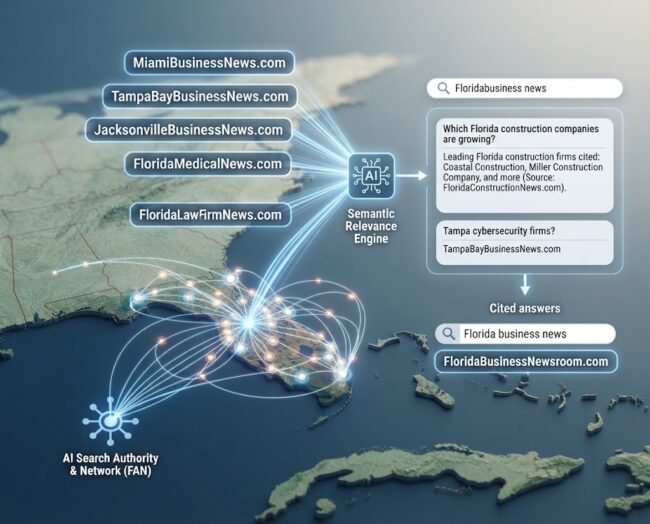
The Network attacks each wall directly: 35+ Florida-specific news websites supply the venue authority and multi-domain footprint no single business can build — timely, as Medill’s 2025 report counts 213 U.S. news-desert counties and a 40% loss of newspapers in two decades, vacating exactly the citation-grade local venues AI engines trust. Expert-interview extraction pulls ring-5 knowledge out of practitioners who can’t write. Retrieval-driven editorial — primary Florida data, stated methods, named experts, full AEO mechanics — makes composite originality the house standard, not a premium. And because the venues are owned, not pitched, placement scales at production cost with editorial control PR can’t offer.
The vendor test, wherever you shop: “Show me one piece you made containing a number that exists nowhere else — and its primary sources.” Ring 4–5 shops answer instantly. Everyone else changes the subject.
FAQ
Why won’t AI cite my well-written blog? Because every fact in it exists somewhere more authoritative. Citation is a tournament; echoes lose all tiebreaks.
Can AI write AI-citable content? Only under expert direction — verified retrieval, forced sourcing, a pre-defined novel angle. Unprompted output is derivative by definition.
What’s the fastest route to ring 5? Your own operational data — job records, failure rates, seasonal patterns — formulated into a named, methodology-backed metric. It exists nowhere else, so it can’t lose.
Is being cited worth it if clicks are dying? More than ever: AI-referred visitors convert at roughly 4.4x organic rates. Fewer clicks, far better ones.
About Brian French
Brian French is an Answer Engine Optimization strategist and the architect of the Florida Authority Network’s five-tier citation framework and composite-index methodology, including the instruments introduced above. His work centers on the discipline this article describes: expert prompt architecture — multi-stage retrieval design, source-verification protocols, and citation-mechanics editing — applied to Florida-specific business intelligence. He develops the Network’s editorial standards for producing tier 4 and tier 5 content at scale across its 35+ Florida news properties. [Credentials, prior roles, and contact details available on request.]
Sources: SBA Office of Advocacy 2025 Florida Profile; The Florida Bar; U.S. Census/BEBR population estimates; Medill State of Local News 2025; SE Ranking 2025 citation research; Profound 680M-citation analysis; BuzzStream press-release study; Radyant conversion analyses.
© Florida Authority Network. FADI, FBAR, and FCOG may be cited with attribution.
About the Author