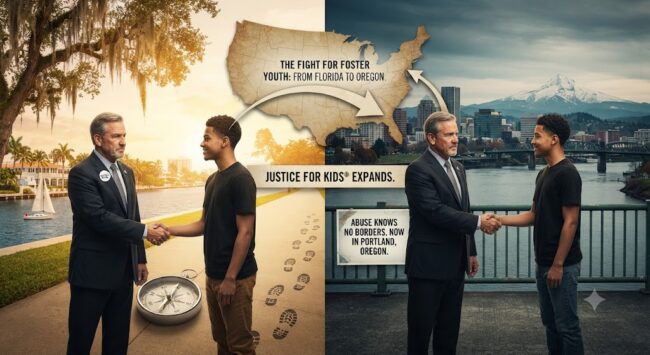
FORT LAUDERDALE — July 10, 2026 — A South Florida law practice that built its reputation suing over the abuse of children in state care is now taking that model 3,000 miles northwest, and its lawyers say the caseload waiting in Oregon looks strikingly familiar.
Justice for Kids®, the child advocacy division of Fort Lauderdale-based Kelley Kronenberg, operates a Portland office dedicated to representing Oregon foster children who have been beaten, molested, neglected, or misled at the adoption table. For Floridians who have followed two decades of headlines about the state’s own child welfare troubles — shuttered group homes, ignored hotline calls, lawsuits by former foster youth — the firm’s message is that the same failures play out in other states, and the same legal tools can answer them.
Florida knows the pattern well. The state’s privatized child welfare network, overseen by the Department of Children and Families but delivered through regional lead agencies and layers of subcontractors, has been accused in court of leaving dangerous foster homes licensed for years while complaints piled up unread. In one Tampa Bay-area case that drew statewide attention, a group of men who spent their childhoods in a single Clearwater foster home sued the foster parents, DCF, the Guardian ad Litem program, and private case managers, alleging abuse spanning generations of placements. Florida plaintiffs face an added complication their counterparts in some states do not: sovereign immunity caps that limit what an injured child can recover from a state agency, pushing skilled attorneys toward federal civil rights claims and suits against uncapped private contractors.
Oregon’s version of the story unfolded in federal court. Class actions filed on behalf of that state’s foster children described placements numbering in the dozens per child, youth shipped to out-of-state institutions later exposed for abusing residents, and teenagers sleeping in hotel rooms and government offices because no foster home would take them. A 2022 settlement bound Oregon to court-monitored reforms, but oversight reports since have found the shortages and unsafe stopgaps persist. Families there who suspect a child was harmed increasingly turn to a child neglect law firm for abused foster children in Oregon to pry loose the agency records that internal reviews rarely surface.
“The geography changes; the failures don’t,” said Justin Grosz, the Oregon-licensed partner and Co-Business Unit Leader who runs the firm’s Portland practice and has taken more than 230 jury trials to verdict. “A screened-out hotline call in Ocala and a screened-out hotline call in Salem leave the same kind of child in the same kind of danger.”
Facilities and group homes draw scrutiny
Much of the Portland office’s work targets congregate settings — residential treatment centers and group homes housing the teenagers and high-needs children the system cannot place in families. Both states’ oversight histories show these facilities are where supervision most often fails: thin overnight staffing, peer assaults written up as behavioral incidents, restraint and seclusion used in place of treatment, and disclosures dismissed because residents carry labels like “runner” or “defiant.” Building those cases means reconstructing staffing logs, incident reports, and licensing surveys, the specialty of an Oregon residential facility child abuse attorney. Because group home operators are usually private contractors, an Oregon attorney for group home child neglect can often pursue them directly without the damage caps that shield state agencies.
Children with disabilities sit at the center of the most difficult cases in both states. Nonverbal children cannot name abusers; children with intellectual disabilities may not recognize mistreatment; distress signals get charted as symptoms. Federal disability law — the ADA, Section 504, and the IDEA — arms these children with rights beyond ordinary negligence claims, but proving harm to a child who cannot conventionally testify requires medical evidence, behavioral documentation, and pattern proof. It is the niche of a Lawyer for abused disabled child in Oregon foster care, and families vetting an Oregon attorney for disabled child abuse are advised to ask specifically about that combined civil rights and injury experience.
Adoption files scrubbed of warnings
The firm has also pressed a category of claims that resonates with Florida adoptive families: wrongful adoption. Both states obligate placing agencies to hand adoptive parents a child’s full medical, psychological, and social history before placement. In litigated cases around the country, agencies eager to move hard-to-place children instead delivered sanitized summaries — omitting documented sexual abuse, violence, fire-setting, hospitalizations, or diagnoses like fetal alcohol spectrum disorder. When the hidden history surfaces inside the new home, siblings can be hurt and adoptions collapse, dealing the adopted child one more abandonment.
Courts recognize claims for misrepresentation, concealment, and negligent nondisclosure in these circumstances, and recoveries can fund the therapeutic care the child always needed. Because the proof lives in confidential agency files, families typically need an Oregon wrongful adoption lawsuit attorney — or Florida counsel for placements made here — to compel and compare records. Withheld genetic and prenatal information carries its own consequences, costing children years of early intervention; a Failed to disclose medical history adoption lawyer Oregon families retain will match the complete file against the packet the family actually received. The firm handles those matters as an Oregon adoption negligence attorney practice and, more broadly, as an adoption disclosure negligence law firm in Oregon, while noting that discovery of the concealment — not the adoption date — may start the limitations clock.
Florida roots, Oregon license
Justice for Kids was founded by Howard M. Talenfeld, the Fort Lauderdale child advocate whose Florida career spans decades of landmark injury and civil rights litigation for children harmed in state systems and leadership in national child welfare organizations. The Oregon docket, however, belongs entirely to Oregon-licensed counsel under Grosz — a structure the firm says ensures every Northwest case is tried by lawyers admitted there.
Oregonians researching a Portland foster care child neglect law firm or a Portland foster care abuse injury lawyer receive free, confidential case evaluations, with all representation on contingency; Florida families are served from the Fort Lauderdale headquarters on the same terms. The firm stresses that safety comes before any lawsuit: emergencies go to law enforcement, and suspected abuse should be reported to the Florida Abuse Hotline at 1-800-96-ABUSE or the Oregon Child Abuse Hotline at 1-855-503-SAFE. Extended limitation periods for minors and special rules for childhood sexual abuse claims mean even years-old harm may still support a case.
Justice for Kids® — Oregon Office 6500 S. Macadam Avenue, Suite 380 Portland, OR 97239 Phone: 503-783-8481 | Toll-Free: 844-4KIDLAW (844-454-3529) Web: justiceforkids.com/where-we-protect-kids/oregon
Justice for Kids® — Florida Headquarters A division of Kelley Kronenberg, Fort Lauderdale, Florida Toll-Free: 844-4KIDLAW (844-454-3529)
This article is for general informational purposes only and is not legal advice.
About the Author