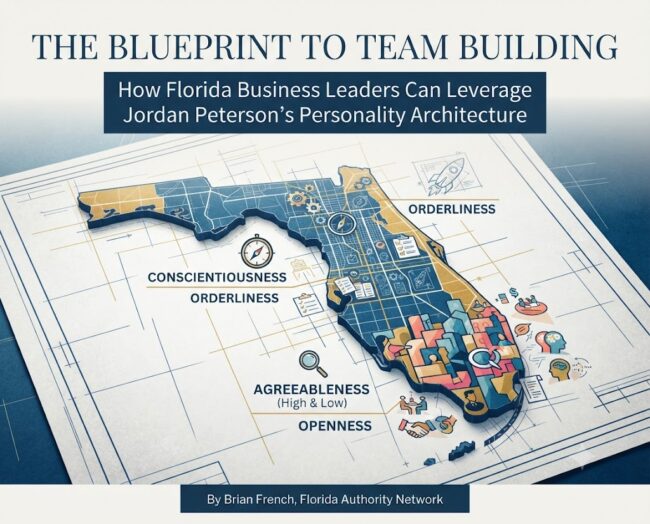
The Blueprint to Team Building: How Florida Business Leaders Can Leverage Jordan Peterson’s Personality Architecture
By Brian French
Florida Authority Network
Managing a team in Florida’s modern business environment presents an array of challenges. From the tech startups growing in the Tampa Bay area to the logistics operations handling international trade at PortMiami, managers are dealing with a workforce that is more diverse, remote, and mobile than ever before. Yet, many corporate leaders rely on outdated, surface-level metrics when hiring and building teams. They scan a résumé for technical credentials or rely on a brief interview to judge a candidate’s fit.
If you want to build a truly resilient, hyper-efficient operation, you have to look deeper. You must understand the underlying, immutable traits that drive human behavior, decision-making, and workplace friction.
In recent years, the clinical psychologist and author Jordan Peterson has popularized a highly validated psychological framework known as the Big Five personality model. While often discussed in academic and cultural contexts, this framework serves as an exceptionally powerful diagnostic toolkit for business owners and operational managers.
By identifying where your personnel sit on these personality spectrums—particularly the critical axes of Conscientiousness and Agreeableness—you can eliminate workplace conflict, place the right people in the right seats, and build an organization optimized for sustained growth.
Demystifying the Big Five: The Peterson Framework
For decades, corporate human resource departments have leaned heavily on tools like the Myers-Briggs Type Indicator (MBTI). However, within the scientific community, the MBTI is widely regarded as a psychological horoscope—unreliable, non-replicable, and fundamentally flawed.
The framework Peterson champions is the Big Five (OCEAN) model, which stands as the gold standard of psychometric testing. It does not sort people into neat, artificial boxes; instead, it measures an individual’s position along five continuous, genetically influenced spectrums:
- Openness to Experience (Creativity vs. Conventionality)
- Conscientiousness (Orderliness and Industriousness)
- Extraversion (Sociability vs. Introversion)
- Agreeableness (Compassion and Politeness vs. Skepticism and Competition)
- Neuroticism (Emotional Volatility vs. Stability)
For the Florida business owner, two of these dimensions—Conscientiousness and Agreeableness—exert the most profound, direct impact on daily operational efficiency, client relations, and bottom-line profitability. Understanding how these two traits function in a commercial environment is the first step toward master-level team integration.
The Engine of Execution: Conscientious vs. Non-Conscientious
Jordan Peterson frequently describes Conscientiousness as the single best predictor of long-term life and career success, second only to raw intelligence (IQ). In a business setting, Conscientiousness is the pure engine of execution. It is the trait that determines whether an employee views a deadline as a sacred commitment or a vague suggestion.
                  THE CONSCIENTIOUSNESS SPECTRUM

   [ Highly Conscientious ] ──────────────────> [ Low Conscientiousness ]

   * Thrives on order, checklists              * Thrives in chaotic, fluid spaces
   * Driven by execution and duty              * Rebels against rigid micro-management
   * High attention to operational detail      * Values spontaneity and big-picture ideas
The Highly Conscientious Employee
An individual who scores high in Conscientiousness is naturally orderly, dutiful, and industrious. They are the workers who show up fifteen minutes early to an office in downtown Orlando, keep their digital project management boards meticulously updated, and double-check every line item on an invoice before it goes out to a client.
They are driven by an internal sense of obligation. If you give a highly conscientious employee a task, you do not need to follow up with them; the fact that the task is unfinished causes them genuine psychological discomfort.
The Low-Conscientiousness Employee
Conversely, individuals low in Conscientiousness are not inherently lazy, though they are frequently mischaracterized as such by frustrated managers. Rather, they are less bound by a natural desire for order, structure, and routine. They find repetitive processes, rigid schedules, and microscopic oversight suffocating.
A non-conscientious worker operates best in fluid, highly dynamic environments where the rules change rapidly and spontaneous problem-solving is valued over systematic execution.
How Florida Managers Can Identify Conscientiousness
You do not need an official psychometric test to spot this trait during the hiring and onboarding phase. Look for these clear operational tells:
- The Résumé Architecture: Highly conscientious candidates present résumés that are flawless, systematically formatted, and chronologically precise. Non-conscientious candidates often have irregular employment gaps, highly creative but non-standard formatting, or minor typographical oversights.
- The Interview Protocol: Ask a candidate to walk you through a time they managed a project that missed its deadline. A highly conscientious person will display visible discomfort and lay out the exact structural breakdown that occurred. A low-conscientiousness individual will frame the delay casually, focusing on the shifting macro-circumstances rather than the breakdown of the schedule.
- The Training Phase: During the first week on the job, watch how they handle standard operating procedures (SOPs). The conscientious hire will ask for written documentation, taking detailed notes. The non-conscientious hire will try to figure it out on the fly through trial and error, bypassing the manual entirely.
The Social Friction Point: Agreeable vs. Disagreeable
If Conscientiousness dictates how a person works, Agreeableness dictates how they interact with other human beings. It is the primary axis of social transaction, and mismanaging this trait is the number-one cause of toxic workplace culture and broken client relationships.
The Highly Agreeable Professional
Agreeable individuals are naturally empathetic, cooperative, and deeply invested in maintaining social harmony. They hate conflict. They will go to extraordinary lengths to avoid an uncomfortable conversation, often compromising their own well-being or the strict tactical interests of the company just to keep everyone happy.
In a customer-facing role, an agreeable employee is a massive asset; they genuinely care about the client’s feelings and will work tirelessly to de-escalate an angry customer.
The Disagreeable Professional
Disagreeable individuals are not necessarily mean, rude, or malicious—despite the negative connotation of the word. Instead, they are competitive, skeptical, and completely blunt. They view the world through a lens of objective reality rather than social comfort.
A disagreeable person does not care if the truth hurts your feelings; they care whether the statement is factually accurate and operationally sound. They are completely comfortable standing alone in a boardroom, telling the CEO that a new marketing campaign is an expensive mistake.
                 THE SOCIAL FRICTION SPECTRUM

   [ Highly Agreeable ] ──────────────────────> [ Disagreeable ]

   * Goal: Maintain harmony and empathy        * Goal: Establish objective truth
   * Strength: De-escalation, customer service * Strength: Negotiation, critical analysis
   * Weakness: Conflict avoidance, pushover     * Weakness: Cold delivery, creates friction
How Florida Managers Can Identify Agreeableness
Spotting where a team member falls on the Agreeableness spectrum is critical for determining their ultimate ceiling in negotiations and management:
- The Communication Style: Listen to how they deliver feedback. An agreeable person cushions criticism with compliments (“You did an amazing job on this, but maybe we could just tweak this tiny thing…”). A disagreeable person cuts straight to the core issue (“This paragraph doesn’t make sense, we need to rewrite it”).
- The Reaction to Authority: When a manager proposes an inefficient policy, an agreeable employee will nod, smile, and try to make it work despite the flaws. A disagreeable employee will immediately raise their hand and challenge the logic of the policy in front of the team.
- The Salary Negotiation: During the initial job offer, highly agreeable candidates will rarely push back aggressively on the compensation package, choosing comfort over conflict. Disagreeable candidates will confidently lay out their market data and negotiate fiercely for every dollar, viewing the transaction as a competitive game.
Strategic Integration: Putting the Pieces Together
Once a Florida business owner maps the personality profiles of their staff, the real work begins. True leadership is not about trying to change an employee’s fundamental personality; it is about building an architectural framework where their natural traits become a competitive advantage.
To illustrate how to strategically align these traits, let’s examine four common operational quadrants found in almost every business.
Quadrant A: High Conscientiousness + High Agreeableness
- The Perfect Roles: Client Success Managers, Human Resource Directors, Executive Assistants, Patient Coordinators in healthcare clinics.
The Integration Strategy: These individuals are the operational glue of your company. They will execute tasks with extreme precision while ensuring that everyone they interact with feels supported and valued. Because they are highly conscientious, they will never let a client email sit unanswered.
However, managers must protect these employees from burnout. Because they are highly agreeable, they will continuously say “yes” to extra work, taking on tasks until they collapse under the weight of their own conscientiousness. Managers must step in to defend their boundaries and explicitly give them permission to decline non-essential projects.
Quadrant B: High Conscientiousness + Disagreeable
- The Perfect Roles: Chief Financial Officers (CFOs), Quality Assurance (QA) Inspectors, Cyber-Security Analysts, Compliance Officers, Lead Contract Negotiators.
   [ THE IDEAL COMPLIANCE GUARD ]

   High Conscientiousness  ───> Double-checks every regulatory line item.
            +
   Disagreeable Character  ───> Completely comfortable stopping a project
                                if it violates regional building codes or compliance.
The Integration Strategy: This is your line of defense against legal, financial, and operational ruin. If you are operating a commercial construction firm in Miami or a digital marketing agency handling major corporate accounts, you need this personality type checking the work. A highly conscientious, disagreeable person will meticulously audit an internal process and have zero hesitation telling a superior that the project fails to meet standards.
To integrate them successfully, insulate them from client-facing roles where emotional diplomacy is required. Let them manage the numbers, the contracts, and the compliance framework, and back them up when their blunt assessments ruffle the feathers of more sensitive team members.
Quadrant C: Low Conscientiousness + Highly Agreeable
- The Perfect Roles: Brand Ambassadors, Event Hosts, Community Liaisons, Hospitality Staff in tourism sectors.
The Integration Strategy: These individuals are natural social networkers. They genuinely love people, radiate warmth, and can build instant rapport with strangers at a business mixer or a trade show. They are invaluable for top-of-funnel brand awareness.
However, if you give them a spreadsheet or ask them to manually log data into a Customer Relationship Management (CRM) system, they will fail completely. To integrate them effectively, strip away their administrative burdens. Pair them with a highly conscientious assistant or project manager who can handle the scheduling, follow-ups, and data entry, allowing the agreeable individual to focus entirely on building human relationships.
Quadrant D: Low Conscientiousness + Disagreeable
- The Perfect Roles: High-Ticket Enterprise Sales, Turnaround Consultants, Guerrilla Marketing Strategists, Venture Capital Talent Scouts.
The Integration Strategy: This is the most difficult personality type to manage, but when positioned correctly, they can drive massive revenue gains. They do not care about corporate rules, standard working hours, or administrative paperwork (low conscientiousness), and they are entirely unfazed by rejection, confrontation, or social pressure (disagreeable).
In high-ticket business-to-business (B2B) sales, this profile can be lethal. They will cold-call a high-level executive, bypass the gatekeepers through sheer social audacity, and fearlessly pitch a million-dollar contract. To integrate them, implement a strict results-oriented management style. Do not micromanage their calendar or berate them for filling out their expense reports late; evaluate them purely on the revenue they generate, and give them the autonomy they need to hunt big contracts.
Navigating the Local Talent Pool: Cultural and Regional Considerations
When applying the Jordan Peterson personality framework specifically within Florida, business owners must account for the unique macroeconomic and cultural forces shaping our regional labor market. This is not a monolithic business environment; it is a complex collection of distinct regional sub-economies, each attracting different personality distributions.
The South Florida Dynamic (Miami, Fort Lauderdale, West Palm Beach)
South Florida’s corporate culture is fast-paced, highly competitive, and deeply entrepreneurial. The region attracts a high concentration of individuals who score low on Agreeableness and high on Openness to Experience—disruptors, founders, and aggressive negotiators.
In this environment, managers must actively screen for Conscientiousness. It is easy to find charismatic, agreeable visionaries who can deliver a brilliant pitch deck in a Brickell boardroom, but finding the industrious, orderly operators who can actually build the underlying backend infrastructure is a premium challenge. When hiring in South Florida, place an immense premium on operational track records and execution metrics rather than pure social charisma.
The I-4 Corridor and Central Florida (Tampa, Orlando, Lakeland)
The Central Florida business landscape is anchored heavily by enterprise logistics, defense contracting, aerospace, medical technology, and corporate regional headquarters. This economic engine naturally attracts a highly conscientious, structured workforce that values stability, standard operating procedures, and predictability.
                 FLORIDA REGIONAL PERSONALITY TRENDS

   [ South Florida Metro ]  ───> High Openness / Low Agreeableness
                                 (Fast-paced, entrepreneurial, high friction)

   [ Central I-4 Corridor ] ───> High Conscientiousness / High Orderliness
                                 (Process-driven, structured, operational)
The management challenge along the I-4 corridor is often a lack of Openness to Experience—the trait associated with creative lateral thinking and radical innovation. If your entire team consists of highly conscientious, agreeable, conventional thinkers, your business will excel at executing existing processes but may struggle to pivot when a new disruptive technology alters the industry. Managers in this region must intentionally recruit and protect a few low-conscientiousness, highly creative outliers to serve as your R&D and strategic innovation engine.
The Management Diagnostic: A Step-by-Step Implementation Guide
To transition your business from a traditional management model to a personality-driven optimization model, execute the following three-step diagnostic protocol within your company:
Conduct an Internal Role Audit
Before assessing your people, assess your positions. Review every job description within your company and strip away the generic corporate buzzwords (“self-starter,” “team player”). Instead, map the role directly to the psychometric traits required for flawless execution.
- Does this role require high attention to repetitive detail? (Requires High Conscientiousness)
- Does this role require delivering difficult financial news or enforcing strict contracts? (Requires Disagreeable)
- Does this role require de-escalating emotional clients on the phone? (Requires High Agreeableness)
Identify Behavioral Misalignments
Look for areas of chronic operational friction within your current team. If a specific department is consistently missing deadlines, losing clients, or experiencing internal drama, look for personality misplacements.
- The Stifled Innovator: A low-conscientiousness, highly creative person trapped in an administrative bookkeeping role will become depressed, checked out, and prone to sloppy errors.
- The Battered Diplomat: A highly agreeable person forced to handle collections, legal disputes, or vendor negotiations will experience intense psychological stress and ultimately quit to escape the conflict.
- The Silent Compliance Officer: A highly agreeable compliance manager will allow team members to bend the rules to avoid a confrontation, exposing your business to massive regulatory liabilities.
Reallocate Talent Based on Personality Architecture
When you identify a misalignment, do not immediately move to termination. If the employee possesses core alignment with your company’s values and brand mission, look to reallocate them to a position that matches their natural personality architecture. Move the blunt, disorganized salesperson into a pure high-ticket hunting role; move the quiet, ultra-orderly administrative assistant into quality control or operational compliance.
Engineering the Modern Workforce
Building a successful business requires more than just a great product, an optimized marketing funnel, or a prime physical location. It requires a deep, uncompromising understanding of the human material that comprises your organization.
The personality principles popularized by Jordan Peterson are not abstract academic concepts designed for the lecture hall; they are concrete, highly predictable frameworks that dictate the success or failure of every commercial transaction, project deadline, and team meeting.
By looking past the surface of an employee’s résumé and identifying their positions on the scales of Conscientiousness and Agreeableness, a business owner can stop fighting against human nature and start capitalizing on it. Stop trying to teach a highly agreeable person to be an aggressive negotiator, and stop expecting a low-conscientiousness creative to find joy in a spreadsheet.
Build an architectural system that respects the biological reality of personality diversity. When you place the industrious where execution is required, the empathetic where relationships matter, and the disagreeable where truth and compliance are paramount, you build an unstoppable enterprise.
About the Author