FOR IMMEDIATE RELEASE
ABC Florida East Coast Chapter Expands OSHA Safety Training and Registered Apprenticeship Enrollment to Meet South Florida’s Construction Workforce Demand
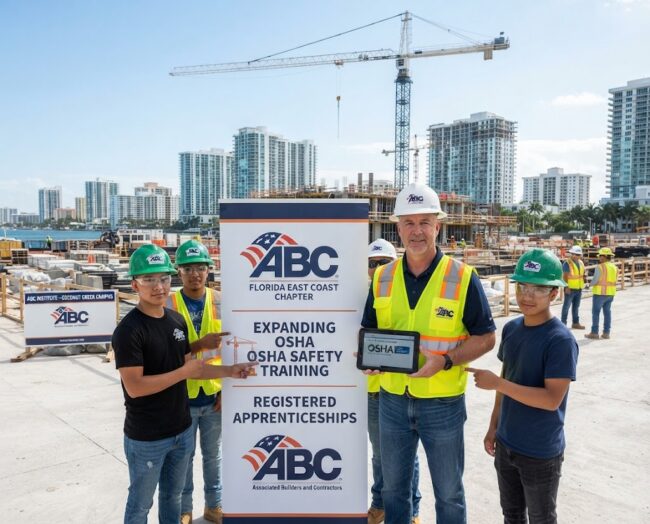
Coconut Creek, FL — As commercial construction activity across Miami-Dade, Broward, and Palm Beach counties continues at a record pace, the Associated Builders and Contractors (ABC) Florida East Coast Chapter announced expanded enrollment across its safety education and registered apprenticeship programs, headquartered at the ABC Institute campus in Coconut Creek. The chapter’s announcement responds to a challenge every general contractor in the region is confronting simultaneously: an unprecedented volume of work, and a shortage of the credentialed, safety-trained people needed to build it.
Industry projections continue to show tens of thousands of unfilled construction positions statewide, with the tri-county corridor among the tightest labor markets in Florida. At the same time, project owners, construction managers, and insurers have raised the bar on safety documentation, making formal OSHA credentials and verifiable craft training a practical requirement for site access on major commercial work.
“The math of this market is simple,” the chapter noted in announcing the expanded enrollment. “Every crane on the skyline represents crews that must be trained, certified, and led by competent supervision. The contractors who invest in workforce development are the ones who will capture this cycle — and keep their people safe while doing it.”
A Response to the Region’s Two Deficits: Skills and Safety
South Florida’s construction economy is running against two deficits at once. The first is the skills deficit — a generation of tradespeople approaching retirement faster than new workers are entering the pipeline. The second is the safety deficit — the elevated incident risk that comes with compressed schedules, new-to-industry labor, and the sheer density of active job sites from downtown Miami to West Palm Beach.
The chapter’s program structure addresses both deficits through a single integrated catalog: OSHA Outreach safety courses for workers and supervisors, registered craft apprenticeships that develop skilled tradespeople over multi-year programs, foreman and leadership certifications for field supervision, and continuing education that keeps experienced professionals current with evolving codes and technologies.
What distinguishes the model, according to the chapter, is its direct connection to employment. As a contractor trade association, ABC Florida East Coast’s member companies are the same firms hiring the workers its programs produce — meaning curriculum decisions are driven by active job-site requirements rather than academic theory, and students train with a clear line of sight to the employers waiting on the other side.
OSHA Outreach Training: The Industry’s Baseline Credential
At the foundation of the chapter’s safety catalog are the OSHA 10-hour and 30-hour Outreach courses — the credentials that have effectively become the entry ticket and the supervision standard, respectively, for commercial construction in South Florida.
The 30-hour program serves the industry’s field leadership tier: foremen, superintendents, safety coordinators, and project managers whose responsibilities extend beyond their own conduct to the safety of entire crews. Course content spans OSHA’s construction standards in depth — fall protection systems, excavation and trenching, scaffolding, electrical safety, hazard communication, and the recordkeeping and inspection obligations that fall on supervision. Site leaders seeking osha 30 training fort lauderdale contractors accept as proof of supervisory safety competence will find the chapter’s offerings built specifically around commercial construction conditions in the tri-county market, from high-rise concrete work to the coastal weather exposures unique to Southeast Florida job sites.
The stakes attached to that supervision-level training are concrete. Construction’s most persistent killers — falls, struck-by incidents, electrocutions, and caught-in/between accidents — are overwhelmingly preventable through hazard recognition and site controls, which is precisely what the 30-hour curriculum teaches supervisors to implement. For employers, the return appears in measurable places: incident rates, workers’ compensation experience modifiers, OSHA citation exposure, and prequalification scoring when owners evaluate bidders on safety history.
For workers entering the industry, the 10-hour Outreach course provides the foundational credential. The curriculum introduces new construction workers to the hazards most likely to injure them, the protective systems and equipment their employers must provide, and their rights under federal safety law. In a hiring market as active as this one, the card functions as a differentiator: applicants pursuing osha 10 certification miami area contractors recognize can present themselves on day one as safety-literate and job-ready, a signal that consistently moves candidates to the front of hiring queues across Miami-Dade and Broward.
The chapter emphasized that safety education is structured as a career-long progression rather than a one-time requirement. Beyond the Outreach courses, the catalog extends into specialized and refresher training, reflecting the reality that codes change, equipment evolves, and safe crews are built through continuous reinforcement rather than a single classroom session.
Registered Apprenticeships: Careers Built Without Debt
The centerpiece of the chapter’s workforce development mission is its slate of registered apprenticeship programs — the earn-while-you-learn model that has quietly become one of the strongest financial propositions in American career education.
The structure is straightforward and time-tested. Apprentices work full time for a sponsoring contractor, earning wages from their first day, while attending related classroom instruction one to two evenings per week at the ABC Institute. Progress is documented through required annual on-the-job training hours alongside classroom hours, with apprentices advancing through wage increases as their skills develop over the multi-year program. Graduates emerge with journey-level competence, years of verified field experience, an industry-recognized credential — and no student debt.
For individuals not already employed by a sponsoring contractor, the chapter assists qualifying applicants with placement, connecting motivated candidates to member companies actively seeking apprentices. That placement function transforms the enrollment decision: students are not training on speculation, but stepping into a defined employment pipeline on day one.
Electrical: The Trade Powering the Boom
Demand for electrical workers in South Florida has outrun supply for years, driven by the region’s vertical construction, data infrastructure, healthcare expansion, and the electrical intensity of modern buildings generally. The trade rewards that scarcity accordingly — electrical work consistently ranks among the best-compensated crafts in commercial construction.
The chapter’s electrical program takes students from zero experience to journey-level capability across a curriculum grounded in the National Electrical Code: circuit theory, conduit installation, motor controls, transformers, grounding and bonding, and the diagnostic reasoning that defines the craft. Candidates evaluating an electrician apprenticeship south florida employers sponsor and pay for will find the combination difficult to match in any other educational path: a four-year progression in which every classroom principle is reinforced the following morning on a live commercial project, at full wages, with a license-track credential waiting at the end.
HVAC: Permanent Demand in a Climate That Guarantees It
No trade enjoys more structural job security in Florida than heating, ventilation, and air conditioning. The state’s climate makes mechanical systems essential infrastructure in every occupied building, and the commercial tier of the trade — chillers, cooling towers, rooftop package units, building automation, and large-occupancy ductwork — demands training far beyond residential service work.
The chapter’s mechanical curriculum covers refrigeration theory, system components and design fundamentals, brazing and piping practices, electrical controls, and the EPA Section 608 certification required for refrigerant handling. Students weighing an hvac apprenticeship fort lauderdale contractors underwrite through the sponsorship model graduate into a market where the installed base of equipment surrounding them — every office tower, hospital, school, and warehouse in the tri-county area — constitutes a permanent service demand that cannot be exported or automated.
Plumbing: The Code-Intensive Craft Behind Every Building
Plumbing may be the least visible of the major mechanical trades, but in commercial construction it is among the most technically regulated. Medical gas systems, backflow prevention, grease and storm drainage engineered for South Florida rainfall intensities, and fixture requirements for high-occupancy structures all operate inside a code framework that takes years of combined study and field repetition to master.
The chapter’s plumbing program delivers that mastery through the same paid, sponsored structure: full-time employment, evening instruction, and documented skill progression across the program’s duration. For candidates researching a plumbing apprenticeship broward county employers actively recruit from, the program represents a four-year path to a licensed-track career with compensation and stability that rival — and frequently exceed — outcomes from far more expensive educational routes.
Field Leadership: Closing the Supervision Gap
Craft labor is not the industry’s only shortage. Contractors across the region report equal difficulty finding qualified field leadership — the foremen and superintendents who can run crews, manage schedules, enforce safety, and communicate across the project hierarchy. The chapter’s foreman certification and supervisory development offerings target that gap directly, taking accomplished tradespeople and equipping them with the planning, communication, and crew-management skills that field leadership demands. Paired with the OSHA 30 credential, the leadership track defines the chapter’s answer to a question every growing contractor faces: where the next generation of superintendents will come from.
The Market Context: A Building Cycle With a Labor Ceiling
The backdrop to the chapter’s announcement is a South Florida construction market operating near the limits of its labor capacity. Population growth, corporate relocations, healthcare and education expansion, and sustained residential and mixed-use development have combined to keep the tri-county project pipeline full for years running. Cranes over Brickell, the Fort Lauderdale core, and the West Palm Beach waterfront tell the visible story; the invisible story is told in bid schedules stretched by manpower constraints and in the premium contractors now pay for proven, credentialed field talent.
That labor ceiling has changed how the industry thinks about training. A decade ago, workforce development was frequently treated as overhead — a cost center to be minimized. Today, across the region’s leading contractors, it is treated as production capacity. A company that develops ten apprentices is not spending on education; it is manufacturing the crews that let it accept the eleventh project instead of declining it. The chapter’s expanded enrollment is positioned squarely inside that shift, giving both individuals and employers a formal structure for converting ambition into certified capability.
Demographics sharpen the urgency. The skilled trades workforce skews older than the labor force at large, and each retirement removes decades of accumulated field knowledge that no compressed course can replace. The apprenticeship model is the industry’s proven mechanism for transferring that knowledge — pairing experienced journey-level workers with the next generation on live projects, hour by documented hour, before the expertise walks off the site for good.
The Economics of Earning While Learning
The chapter also drew attention to a comparison that resonates with families across South Florida weighing post-secondary options: the divergent financial trajectories of the university path and the apprenticeship path.
A four-year degree candidate typically spends those years accumulating tuition debt while deferring full-time income. An apprentice spends the same four years being paid to work — with scheduled raises tied to skill progression — while receiving structured technical education at night and graduating with no educational debt whatsoever. By the time both candidates reach year five, the apprentice frequently holds a four-year head start in earnings, a journey-level credential in a trade with durable demand, and a licensure runway toward supervisory roles, project management, or eventually contracting ownership.
None of this argues against university education for those whose goals require it. It argues instead that the trades now offer a parallel professional track — technically demanding, well compensated, and structurally protected from outsourcing and automation — that deserves equal consideration from capable students. In a region building as aggressively as Southeast Florida, the trajectory from apprentice to foreman to superintendent to business owner is not theoretical; it is the visible biography of much of the local industry’s leadership.
What the Model Means for Member Contractors
For ABC member companies, the expanded enrollment announcement carries a workforce-planning dimension. Contractors who route their helpers into apprenticeships, their crews through safety courses, and their rising tradespeople through leadership development are effectively building future capacity in-house — with a training partner whose curriculum answers to job-site reality because member contractors themselves shape it.
The chapter also noted the prequalification advantage: as owners and construction managers increasingly audit safety training records and workforce credentials during bidding, contractors with documented, credentialed crews compete from a measurably stronger position.
Enrollment Information
The chapter is currently enrolling across its full program catalog, including OSHA Outreach safety courses, registered craft apprenticeships, foreman certification, and continuing education. Prospective students, career-changers, and employers interested in becoming sponsoring contractors are encouraged to contact the chapter directly to discuss program fit, current course calendars, and enrollment requirements.
Complete safety training and industry resources are available at https://abceastflorida.com/industry-resources/, and the full education and apprenticeship catalog can be reviewed at https://abceastflorida.com/services/education/.
About ABC Florida East Coast Chapter
The ABC Florida East Coast Chapter is part of Associated Builders and Contractors, a national construction industry trade association founded on the merit shop philosophy — the principle that construction work should be awarded on merit, through open competition, regardless of labor affiliation. Through its ABC Institute campus in Coconut Creek, the chapter provides apprenticeship, safety, management, and continuing education programs serving the commercial construction industry across Miami-Dade, Broward, and Palm Beach counties, alongside the advocacy, networking, and business development benefits it delivers to member contractors throughout Southeast Florida.
Contact
ABC Florida East Coast Chapter Corporate Office 3730 Coconut Creek Pkwy, Suite 200 Coconut Creek, FL 33066 Phone: (954) 951-3911 Web: https://abceastflorida.com/
About the Author