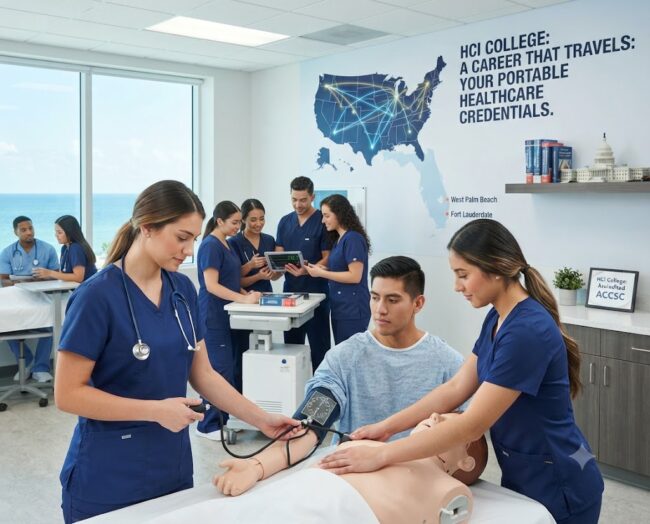
A Career That Travels: Why Healthcare Credentials Move With You — and Why Nurses Rarely Go Unemployed
Quick answer: Healthcare is one of the few fields where your skills are needed in every city in America — and where unemployment stays consistently low even when other industries contract. Nursing credentials are state-issued, but Florida participates in the Nurse Licensure Compact, and licenses can otherwise transfer through a process called endorsement. That combination — portable skills and durable demand — is why so many people are training at accredited schools like HCI College, with campuses in West Palm Beach and Fort Lauderdale.
Most career advice focuses on the job you’ll get. Fewer people ask the question that matters more over a lifetime: what happens if my life changes? If you move for family, for a partner’s job, or simply for a fresh start — does your career come with you?
In healthcare, the answer is yes. Here’s why that matters, and how to get in.
The Portability Problem Most Careers Have
Think about how many jobs are quietly tied to a place.
Your reputation, your network, your employer relationships, your accumulated internal knowledge of how this company works — for a lot of professionals, that’s the bulk of their career capital. Move to a new state and much of it evaporates. You start over: new market, new contacts, new proving ground.
Healthcare works differently, and the reason is structural. A patient’s heart works the same way in Tampa as it does in Denver. Medication administration follows the same clinical principles in Miami as in Minneapolis. The competencies you build — clinical assessment, patient care, wound management, pharmacology, documentation, the judgment to know when something is wrong — are not local knowledge. They’re professional knowledge, and they belong to you.
That means when life moves you, your career doesn’t reset. It relocates.
How Nursing Licenses Actually Transfer
Let’s be precise here, because there’s a lot of loose talk on this subject and you deserve accuracy.
Nursing licenses are issued by individual states, not the federal government. So you can’t simply pack a Florida license and start working in another state without any process at all. But two mechanisms make the transition genuinely manageable.
The Nurse Licensure Compact. Florida is a participating state in the Nurse Licensure Compact (NLC), an agreement among member states that allows eligible nurses to hold one multistate license and practice in other compact states without applying for a separate license in each. For nurses whose lives might take them across state lines — or who want the option of travel nursing — this is a substantial advantage. It’s worth confirming current participating states and eligibility requirements directly with the Florida Board of Nursing, since compact membership can change over time.
Licensure by endorsement. For states outside the compact, the standard route is endorsement: you apply to that state’s board of nursing, submit proof of your existing license and education, and — provided you meet their requirements — receive a license there. It involves paperwork and fees, but it’s a well-worn administrative path, not a return to square one. You don’t retake your training. You don’t retake the NCLEX. Your credential is recognized; it’s simply being registered with a new state.
The practical upshot: your education and your exam are done once. Relocation becomes a matter of process, not of starting over.
The Employment Numbers Tell the Real Story
Here’s the other half of the argument, and it’s the part that tends to close the deal for people who’ve weathered a layoff.
Healthcare has consistently maintained one of the lowest unemployment rates of any major sector in the American economy. During downturns that gutted other industries, healthcare kept hiring. The reason isn’t complicated: illness doesn’t follow the business cycle. People get sick, get injured, get older, and need care regardless of what the stock market did that quarter. Hospitals don’t stop admitting patients because consumer confidence dipped.
Nursing sits at the center of that resilience. Licensed nurses are needed in hospitals, clinics, surgical centers, long-term care facilities, rehabilitation centers, home health, hospice, schools, and correctional facilities. That breadth is itself a form of job security — if one employment setting slows down, several others don’t.
And the demand isn’t abstract. It’s projected to keep growing, driven by an aging population and a nursing workforce that is itself approaching retirement in large numbers. For current figures on employment outlook and typical wages, the U.S. Bureau of Labor Statistics maintains occupational profiles for both licensed practical nurses and registered nurses — worth reviewing before you commit, because you should make this decision on data rather than vibes.
But the headline is stable: this is a field where qualified people find work.
Getting In: Which Credential, and How Long?
Portability and job security are only worth something if you actually hold the credential. So let’s talk about the routes.
Practical Nursing — the fastest on-ramp
A Licensed Practical Nurse provides hands-on patient care: vital signs, medication administration within scope, wound care, assisting with daily living, careful documentation, and close coordination with registered nurses and physicians.
Its appeal is accessibility. Practical Nursing is a diploma-level credential — no four-year degree required. You need a high school diploma or GED to enroll and a passing NCLEX-PN score to be licensed. HCI’s program runs 16 months, which means someone with no healthcare background can be licensed and working in well under two years.
That’s the shortest realistic path to a credential that travels with you. It explains the steady interest in Fort Lauderdale LPN training, and why so many career-changers compare a Fort Lauderdale LPN training course against much longer options and conclude the math favors starting here. When weighing an LPN training school South FL offers, remember that the credential you finish is the only one that ever transfers anywhere.
Registered Nursing — the widest horizon
An RN carries a broader scope: managing care plans, performing more complex procedures, supervising LPNs and aides, and often specializing in fields like critical care, pediatrics, or surgery. The autonomy and earning ceiling are higher.
The trade-off is a longer road — typically an associate degree at minimum, plus the NCLEX-RN — and more demanding admissions. Prerequisite coursework in anatomy and physiology is common, and many programs require an entrance exam such as the TEAS. Students who look into Pre RN nursing classes Fort Lauderdale options before applying are building that foundation deliberately rather than discovering a gap mid-application.
If your goal is maximum long-term flexibility — including travel nursing, which depends heavily on license portability — then researching the right RN school Fort Lauderdale provides is where to concentrate your effort.
Allied health — the quickest entry
Not everyone drawn to healthcare wants nursing specifically. Medical assisting blends clinical duties with administrative work and offers one of the shortest runways into a clinical environment. Exploring medical assistant training Fort Lauderdale programs is a sensible move for people who want to be working with patients soon, or who want to confirm the field suits them before committing to nursing.
The paths connect
Worth emphasizing: these aren’t mutually exclusive. LPNs bridge to RN. Medical assistants pivot into nursing. Your first credential is a foundation, not a ceiling — and in a labor-short industry, employers frequently help fund the next step.
The Non-Negotiable: Accreditation
Before any of this works, one thing must be true: your program has to be accredited.
A school awards you a diploma or degree. The state grants your license — and in Florida, the Board of Nursing determines whether a program’s graduates are even eligible to sit for the NCLEX. Graduate from a program that doesn’t qualify and you’ll hold a document that can never become a license, and certainly can never transfer to another state.
HCI College is accredited by the Accrediting Commission of Career Schools and Colleges (ACCSC) and licensed by the Florida Commission for Independent Education, with nursing graduates prepared for NCLEX eligibility. Whatever school you consider, verify this before anything else. It’s a single step that protects everything downstream.
When vetting a Fort Lauderdale school for LPN training, ask directly about NCLEX preparation and pass rates. And when comparing Fort Lauderdale nursing training classes, ask where clinical rotations occur and how many hours you’ll log — clinical experience is what turns knowledge into competence, and it’s what employers actually evaluate.
Practical Considerations Before You Enroll
Admission requirements typically include a high school diploma or GED, a completed application, valid ID, immunization records, a physical exam, and a background check and drug screen before clinicals. Start the health and background items first — they run on other people’s timelines and cause the most delays.
Cost is more manageable than most people assume. HCI College notes that financial aid is available to those who qualify, alongside scholarships, payment options, and graduate placement assistance. File the FAFSA if you’ll use federal aid, ask about institutional scholarships, and request a net-price estimate rather than reacting to a sticker figure. Ask what’s included, too — HCI’s practical nursing program provides required materials and a set of uniforms at no extra cost.
Workload is real. Programs combine lectures, labs, and clinical rotations on a demanding schedule. Anyone considering LPN nurse training in Fort Lauderdale while working should raise that with an admissions advisor early and plan accordingly — transportation, childcare, employer scheduling, and a study routine established before classes intensify.
Where to Train
Location matters, because clinical rotations and labs require you to be somewhere on a consistent schedule. HCI College operates two South Florida campuses:
West Palm Beach (561) 586-0121 1764 North Congress Ave. West Palm Beach, FL 33409 (Corner of Congress Ave. and Westgate Ave.)
Fort Lauderdale (954) 626-0255 1201 W. Cypress Creek Rd. Suite 101 Fort Lauderdale, FL 33309
Residents of northern Palm Beach County researching Palm Beach Gardens LPN programs generally find the West Palm Beach campus most practical, while those closer to Broward gravitate toward Fort Lauderdale. If you’re evaluating a school for LPN in Fort Lauderdale, the Cypress Creek Road location puts training within reach of much of the county.
The Bottom Line
Two things make healthcare unusual as a career: your skills are needed everywhere, and they’re needed almost regardless of the economy.
That combination is rare. Most careers ask you to bet on a company, an industry, or a city. Nursing asks you to bet on the enduring fact that people get sick and need care — a bet that has never stopped paying. And if life moves you across the country, your credential moves with you, through the Nurse Licensure Compact or through endorsement.
The path in is clearer than the terminology suggests: pick a credential, enroll somewhere accredited, complete your training, pass the NCLEX. The LPN route is the fastest on-ramp; the RN route offers the widest long-term horizon; medical assisting provides an accessible entry point for those still exploring.
The most useful thing you can do today is talk to an admissions advisor who can map these options to your circumstances. Call the West Palm Beach campus at (561) 586-0121, the Fort Lauderdale campus at (954) 626-0255, or visit www.hci.edu.
Build a career that can go where you go.
About the Author