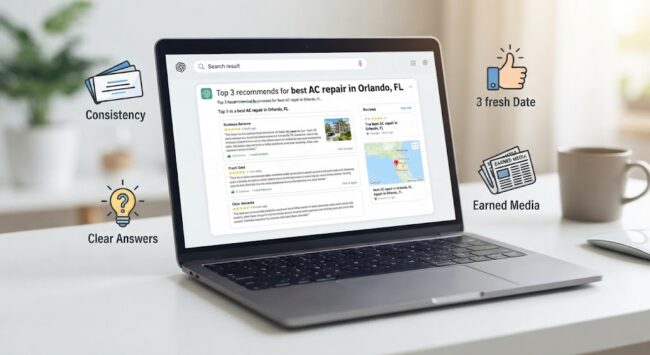
Quick Answer: Yes. ChatGPT, Gemini, and Google’s AI Mode name businesses they can confirm across many independent sources. To beat competitors, a Florida business needs consistent listings everywhere, a steady flow of fresh reviews, coverage in credible third-party publications, and a website that answers customer questions plainly. Most local competitors have not done this yet, so the opening is wide right now.
Can AI Really Recommend a Local Business?
It already does, millions of times a day. When a Tampa homeowner asks ChatGPT for “the best AC repair company near Brandon” or a Miami executive asks Gemini for “a commercial real estate attorney in Brickell,” the assistant does not return ten blue links. It returns a short answer, often naming two or three businesses and explaining why.
That shift happened fast. In BrightLocal’s 2026 Local Consumer Review Survey, 45% of consumers said they had used an AI tool to get a local business recommendation in the past year, up from 6% a year earlier. That puts AI third among sources of local recommendations, behind only Google and Facebook.
The audience behind those tools is enormous. ChatGPT reached 900 million weekly active users in February 2026, more than double the 400 million it had a year before. And the customers using AI to choose businesses are often the ones every Florida company wants most. Yext found that among households earning $150,000 or more, 54.5% now begin a local search with AI rather than Google.
The bottom line: AI recommendation is not a future trend. It is a present-day sales channel, and it rewards the businesses that prepare for it.
Why Most Florida Businesses Are Invisible to AI
Here is the hard part. AI answers are short, so very few businesses make the cut.
SOCi’s 2026 Local Visibility Index reviewed more than 350,000 business locations and found ChatGPT recommends only about 1.2% of them when asked for a local option. Restaurants, one of Florida’s largest small-business categories, fare especially poorly. Local Falcon’s study of 10,000 U.S. restaurants found 74.9% never appear in Google’s AI recommendations, compared with 19.6% that are invisible on Google Maps.
That gap matters. A business can rank well in the traditional map pack and still be absent from the AI answer. The two systems weigh different signals, and most owners are still optimizing only for the old one.
Meanwhile, the old channel is losing value. An Ahrefs study of 300,000 keywords found that when a Google AI Overview appears, the click-through rate for the top-ranking page drops by about 58%. Ranking first on Google no longer guarantees the phone rings. Being named inside the AI answer increasingly does.
How AI Decides Which Business to Recommend
AI assistants are built to avoid embarrassing mistakes. Recommending a business that closed last year, or one with a trail of angry reviews, damages trust in the tool. So the models lean heavily on corroboration: they look for the same facts confirmed by multiple sources they consider reliable.
Four types of evidence carry the most weight.
| What AI Looks For | Where It Finds It | What You Control |
|---|---|---|
| Accurate business facts | Google, Apple Maps, Yelp, Foursquare, Bing | Consistent name, address, phone, category |
| Customer sentiment | Google, Yelp, industry review sites | Volume, freshness, owner responses |
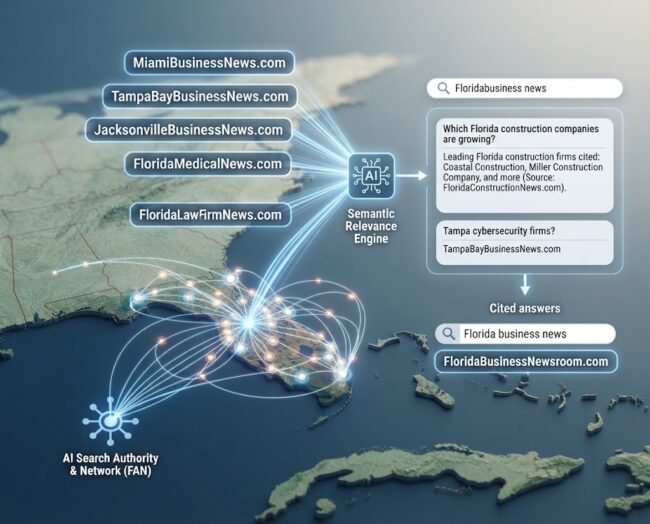
| Third-party credibility | News coverage, “best of” lists, trade press | Earned media and awards |
| Clear answers | Your website, FAQs, service pages | Plain-language, specific content |
1. Third-Party Coverage Outweighs Your Own Website
This is the factor most business owners underestimate. AI engines trust what others say about you far more than what you say about yourself.
Muck Rack’s May 2026 study of more than 25 million links found earned media accounts for 84% of AI citations across ChatGPT, Claude, and Gemini, while paid and advertorial content made up just 0.3%. Journalism alone represented 27% of all cited sources.
Local experts reached the same conclusion from a different angle. In Whitespark’s 2026 Local Search Ranking Factors survey, 47 local search experts ranked appearing on expert-curated “best of” lists as the single most important of 187 factors for AI search visibility.
For a Florida business, that means a feature in a regional business publication, an industry trade outlet, or a credible “top firms in Orlando” roundup can do more for AI visibility than another blog post on your own site.
2. Reviews Still Decide Whether Recommendations Convert
AI did not replace reviews. It made them more important. BrightLocal found that 97% of consumers who use AI for recommendations at least sometimes check the answer against real reviews.
Yext’s research reached the same point and put it bluntly: a brand optimized for AI visibility but not for review quality will generate recommendations that do not convert.
3. Listings Must Match Everywhere
AI tools pull business data from more places than Google. Industry analysts who have studied ChatGPT’s local results report that roughly 60 to 70 percent of the local businesses ChatGPT surfaces first appear to come from Foursquare’s Places API, though OpenAI has not confirmed its data sources. Whatever the exact mix, the practical lesson holds: if your hours, phone number, or category differ between Google, Apple Maps, Yelp, and Foursquare, AI systems have less confidence in you.
4. Your Website Must Answer Questions Directly
When AI does cite a business website, it favors pages that answer a specific question clearly. A service page that says “We install and repair Trane and Carrier systems across Hillsborough and Pasco counties, with same-day emergency service” gives the model something concrete to repeat. A page that says “Your comfort is our passion” gives it nothing.
What It Takes to Beat Your Competition
Because so few businesses have acted, the bar to stand out is lower than it looks. Here is the sequence that produces results, in order of payoff.
Step 1: Audit What AI Says About You Today
Open ChatGPT, Gemini, Perplexity, and Google’s AI Mode. Ask the questions your customers ask: “best [service] in [city],” “who should I hire for [problem] in [county],” and “is [your business name] reputable?” Record who gets named, what reasons are given, and which sources are cited. Your competitors’ citations are a map of where you need to appear.
Step 2: Fix Your Listings in One Weekend
Claim and verify your profiles on Google Business Profile, Apple Business Connect, Bing Places, Yelp, and Foursquare. Make the business name, address, phone, hours, and primary category identical everywhere. Add your service areas by county and city, which matters in a state where customers search by “Palm Beach County” as often as by town name.
Step 3: Build a Review Engine, Not a Review Spike
A burst of 50 reviews in one month followed by silence looks less trustworthy than a steady handful every week. Ask every satisfied customer at the moment of delivery, make it one tap, and respond to every review, positive or negative. Owner responses show AI and consumers alike that a real, attentive business is behind the listing.
Step 4: Earn Coverage in Credible Publications
This is where most competitors stop, and where the biggest gains sit. Practical routes include:
- Regional business news. Expansions, new hires, contracts, community projects, and local economic data are legitimate news in Florida’s regional business press.
- Industry trade publications. Construction, healthcare, marine, real estate, and hospitality each have trade outlets that AI tools cite heavily for category questions.
- “Best of” and awards lists. Apply to credible regional awards and chamber recognitions. Avoid pay-to-play badges that no editor reviewed.
- Expert commentary. Offer journalists your view on hurricane-season preparedness, insurance costs, housing trends, or labor shortages in your field. A quoted expert becomes a named entity AI can find.
The key word is earned. Paid placements barely register in AI citations, so a sponsored listing nobody edited is unlikely to move the needle.
Step 5: Rewrite Your Website for Answers
Turn your most common customer questions into clear page sections with direct answers in the first sentence. Add a frequently asked questions section to every service page. Name the specific cities, counties, certifications, brands, and price ranges you serve. Add structured data (schema markup) for your business type, services, and reviews so machines can read your facts without guessing.
Step 6: Publish Something Only You Can Publish
AI tools must cite the original source of unique information. If you run a Jacksonville roofing company and publish an annual summary of storm-damage claims you handled by neighborhood, or a Sarasota property manager who tracks average rents across your portfolio, you become the source others reference. Original data attracts coverage, and coverage attracts AI citations.
Step 7: Re-Test Every Quarter
AI answers shift as models update and as competitors act. Repeat your audit quarterly, note changes, and track not just whether you appear but whether you are actually recommended or merely mentioned in passing.
How Long Does It Take?
Listing fixes can begin showing up within weeks, because AI tools that search the live web pick up corrected data quickly. Review momentum typically takes two to three months to build. Earned media is the slowest lever but the most durable, since a credible article keeps getting cited long after it runs.
The payoff extends beyond the AI answer itself. Seer Interactive found that brands cited in Google AI Overviews earned 35% higher organic click-through rates and 91% higher ad engagement than brands that were not cited. Being named by AI lifts the rest of your marketing too.
Common Mistakes to Avoid
- Buying fake reviews. The FTC’s rule on fake reviews carries civil penalties, and review platforms routinely purge suspicious clusters.
- Stuffing your site with AI-generated filler. Thin, generic content gives AI nothing worth citing.
- Chasing every new AI tool separately. The same foundation of accurate listings, real reviews, and credible coverage feeds all of them.
- Ignoring the business description. Vague category choices like “consultant” or “services” make it harder for AI to match you to a specific question.
Frequently Asked Questions
Can I pay to be recommended by ChatGPT?
Not in organic answers. There is no way to buy placement in an AI assistant’s recommendation. Visibility comes from the evidence the AI finds across the web.
Do small Florida businesses have a real chance against national chains?
Yes. Local questions favor local evidence. A family-owned Ocala HVAC company with strong reviews and coverage in regional media can outrank a national franchise that has neither in that market.
Is AI optimization different from SEO?
It overlaps but is not the same. Traditional SEO focuses on ranking your own pages. AI visibility depends far more on what independent sources say about you, which is why third-party coverage and reviews carry so much weight.
What is the single most important step?
For most businesses, it is earning credible third-party coverage, because it is the factor competitors are least likely to have and the one AI tools trust most.
Key Takeaways
- Nearly half of U.S. consumers now use AI to find local businesses, up from 6% a year earlier.
- AI recommends only a small fraction of businesses, so early movers gain an outsized advantage.
- Earned media, not owned or paid content, drives the large majority of AI citations.
- Consistent listings and steady, fresh reviews are the baseline requirement.
- Clear, specific website content and original data turn your business into a citable source.
Sources and Further Reading
- BrightLocal, Local Consumer Review Survey 2026, as compiled by Cloutly — 44 AI Search Statistics for 2026
- WiserNotify — ChatGPT Users Statistics 2026
- SEO Worth — Ahrefs: AI Overviews Cut the Top Result’s CTR by 58%
- Seer Interactive — AI Overviews and Click-Through Rate Study
- Muck Rack via GlobeNewswire — Generative Pulse: Earned Media Drives 84% of AI Citations
- Whitespark — 2026 Local Search Ranking Factors
About the Author