For over two decades, the primary playbook for Florida businesses seeking digital growth was simple: rank on the first page of Google. Whether driving personal injury leads in Miami, filling hotel rooms along the Gulf Coast, or attracting home buyers in Orlando, securing high positions on Google Search was the gold standard of digital marketing.
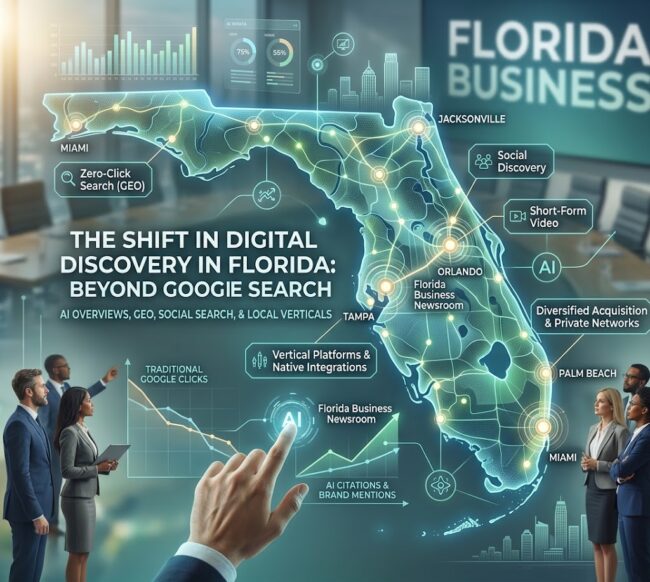
That era is undergoing a structural shift. Over the next three years, traditional Google Search will lose its position as the sole driver of digital acquisition for Florida businesses. A convergence of AI-native answer engines, rising zero-click search behavior, hyper-localized social discovery, and shifts in consumer intent is altering how Floridians find, evaluate, and hire local services.
For corporate executives, local business owners, and marketing leaders across the Sunshine State, adapting to this transition requires understanding why Google’s traditional influence is diluting—and how discovery is being redistributed across new platforms.
The Rise of Zero-Click Search and AI Answer Engines
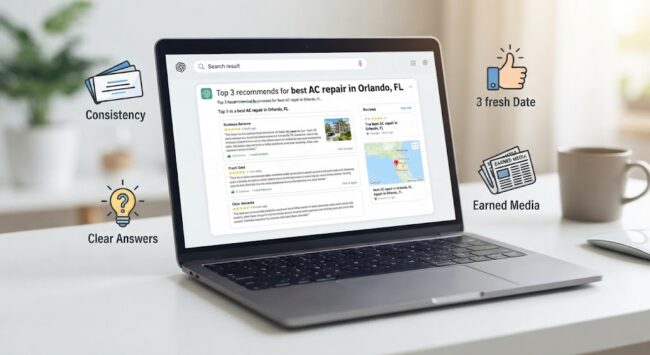
The foundational agreement between businesses and search engines—creating content in exchange for web traffic—is changing. The widespread deployment of Google’s AI Overviews, alongside the rise of standalone conversational platforms like ChatGPT, Perplexity, and Claude, has fundamentally altered query behavior.
- Zero-Click Realities: Industry analyses show that roughly 60% of Google searches now resolve without a user clicking through to an external website. When AI Overviews generate immediate, highly synthesis-driven answers at the top of the Search Engine Results Page (SERP), user demand for organic “blue links” drops sharply.
- Gartner’s Search Volume Forecast: Gartner projected that traditional search engine query volume would fall by 25% as users increasingly rely on generative AI tools to get direct answers rather than browsing multiple website links.
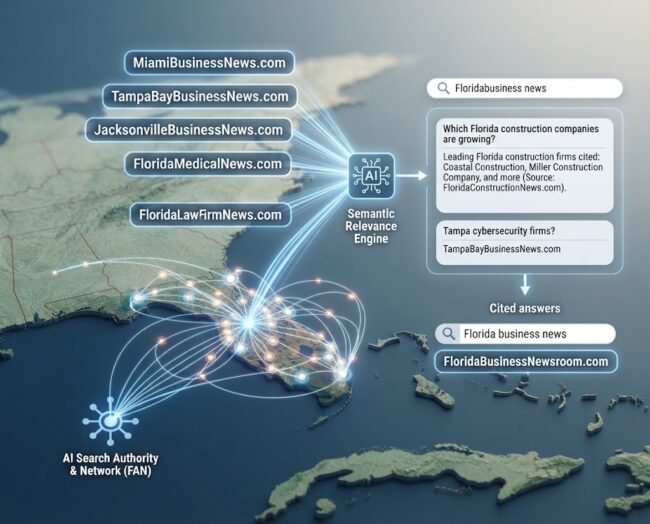
- Shift to Generative Engine Optimization (GEO): Rather than ranking on a search page, the new objective is securing a citation inside generative answers. If a consumer asks an AI assistant for the top-rated estate planning attorney in Tampa or a high-end contractor in Palm Beach, visibility depends on whether the business is synthesized into the AI’s response—not where its website ranks in traditional organic results.
Florida’s Demographics: Social Search and AI Adoption Acceleration
Florida presents a unique demographic landscape that accelerates the decline of traditional search faster than many other regional markets.
- Gen Z and Millennial Social Search: Younger demographics across Florida’s major metropolitan areas increasingly skip Google entirely for discovery. Platforms like TikTok, Instagram, and YouTube have become primary search engines for local dining, home services, lifestyle brands, and travel itineraries. Consumers prefer short-form video proof and authentic local user-generated content over static Google web listings.
- Rapid AI Adoption Among In-Migrants and Retirees: Florida continues to lead the nation in domestic migration, attracting tens of thousands of professionals and retirees annually. Modern newcomers rely on conversational AI assistants to orient themselves in new cities—asking AI agents to compare school districts, medical networks, and neighborhood safety profiles rather than conducting dozens of manual Google searches.
Local Discovery Fragmenting Across Vertical Platforms
Google Local Service Ads (LSAs) and Google Business Profiles once held a near-monopoly on local intent in Florida. Today, local intent is fragmenting across specialized vertical engines and localized social apps.
- Vertical Marketplaces Capturing High-Intent Leads: Consumers looking for home repairs, legal counsel, or specialized medical care are bypassing general search engines in favor of dedicated platforms (such as Angi, Thumbtack, Avvo, Zocdoc, or specialized regional registries) that offer verified reviews, instant scheduling, and direct consumer protections.
- Apple Maps and Native Ecosystem Integration: With Apple expanding native navigation, local business integrations, and conversational Siri capabilities across iOS devices, a growing percentage of local navigational queries occur entirely outside Google’s ecosystem.
The Rising Cost and Declining Efficiency of Google Ads (PPC)
For years, Florida businesses compensated for organic search changes by increasing their Google Pay-Per-Click (PPC) budgets. However, economic pressures and ad fatigue are pushing businesses toward alternative acquisition channels.
- Escalating Cost-Per-Click (CPC): In highly competitive Florida industries—such as legal services, commercial roofing, insurance, and medical aesthetics—Google PPC costs have escalated to unsustainable levels. In major markets like Miami, Fort Lauderdale, and Orlando, competitive keywords can cost dozens or even hundreds of dollars per single click.
- Decreasing Return on Ad Spend (ROAS): As ad placements occupy more vertical space on mobile screens, user ad-blindness has grown. Businesses are discovering that capital yields higher returns when reallocated toward first-party data capture, direct referral networks, video content creation, and targeted social acquisition.
Strategic Shift: How Florida Businesses Must Adapt
As Google’s dominant role in marketing contracts over the next three years, Florida business leaders must reallocate digital strategies to maintain market share:
| Legacy Marketing Focus (Google-Centric) | Future-Proof Strategy (Omnichannel Discovery) |
| Traditional SEO: Keyword stuffing and link building aimed solely at Google algorithms. | AEO & GEO: Structuring modular, authoritative content and JSON-LD schema so AI platforms cite the business. |
| Google Ads Reliance: Heavy spend on high-CPC text ads. | Diversified Acquisition: Directing budget toward video channels, private networks, targeted social, and local sponsorships. |
| Website Clicks: Measuring success by organic traffic and page views. | Brand Mentions & Citations: Measuring direct AI recommendations, phone calls, and direct conversion intent. |
| Generic Written Content: Surface-level blog posts written for search bots. | Proprietary Data & First-Hand Expertise: Original research, video case studies, and local executive thought leadership. |
The decline of Google Search as the central pillar of digital marketing does not mean search intent is disappearing; rather, search is becoming conversational, fragmented, and immediate. Florida enterprises that broaden their presence beyond traditional blue links and position themselves for AI-driven discovery will dominate the state’s digital economy in the years ahead.
Resources and Cited Sources
- Gartner Research:Gartner Predicts Search Engine Volume Will Drop 25% by 2026 Due to AI Chatbots and Virtual Agents.
- Digital Applied / Similarweb Data:AI Search Engine Statistics 2026: Market Share Data & Query Shifts.
- Omnibound AI Industry Report:AI Search Statistics (2025–2026): Data Points on GEO, Zero-Click Trends, and Buyer Behavior.
- Matt Britton / AI Search Trends 2026:Visibility Beats Clicks: Zero-Click Search and Budget Reallocation Strategies for CMOs.
- Precedence Research:AI Search Engine Market Size, Share, and Forecast 2026–2035.
About the Author