By Brian French | April 15, 2026
What artificial intelligence means right now — and in the decade ahead — for every industry, every workforce, and every entrepreneur across the state
This Is Not a Technology Story. It Is a Business Story.
Florida business owners have heard a great deal about artificial intelligence over the past three years. Much of it has been noise — breathless proclamations from tech journalists, vendor marketing dressed up as analysis, and predictions so large they become meaningless. What has been harder to find is a grounded, honest assessment of what AI actually means for the specific industries, economic conditions, and workforce realities that define doing business in this state.
That is what this guide sets out to provide.
Florida is not Silicon Valley. Its economy is not built on software companies and venture capital. It is built on tourism, hospitality, healthcare, real estate, construction, agriculture, logistics, financial services, and the small and mid-sized businesses that serve the 23 million people who live here and the 150 million visitors who pass through every year. AI will change all of those industries — some dramatically, some gradually, and some in ways that are more opportunity than threat. The business owners who understand that distinction clearly will make better decisions than those who either dismiss the technology or surrender to the hype.
Here is what you need to know.
The Baseline: Where AI Adoption Actually Stands Right Now
What the Data Shows About Business Adoption in 2026
Before assessing what AI will do to Florida businesses, it helps to understand where adoption genuinely stands — not in tech press releases, but in hard survey data.
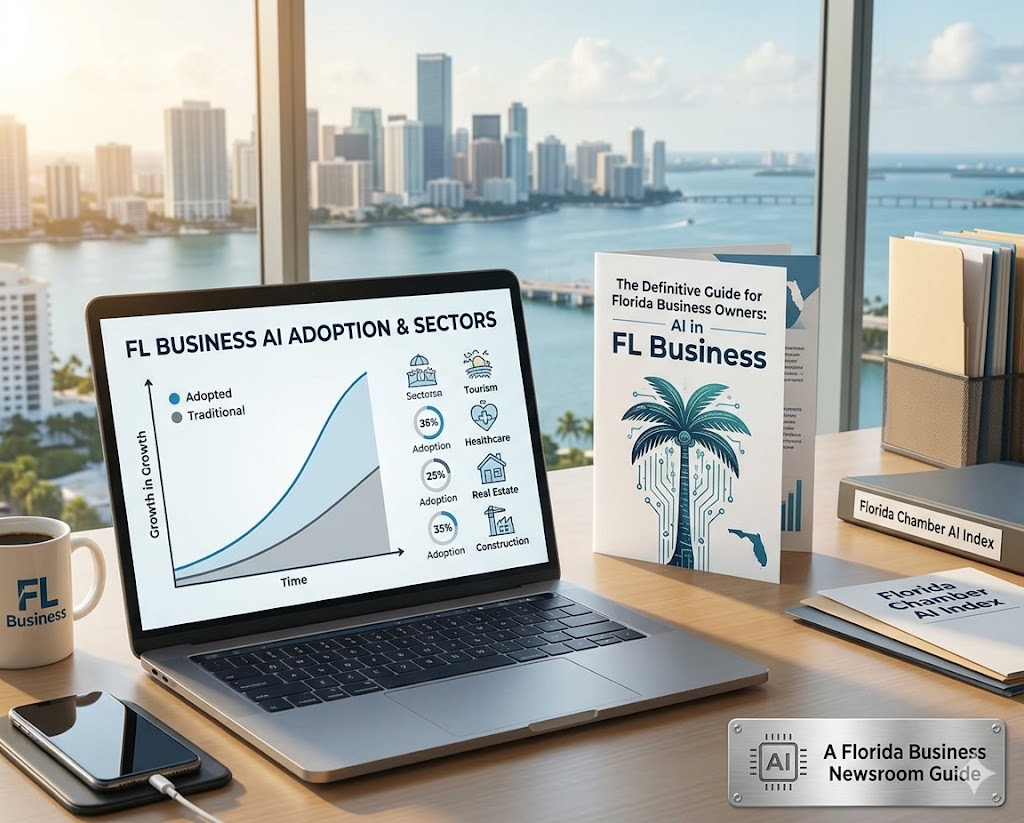
According to the Federal Reserve’s Business Trends and Outlook Survey, AI adoption by U.S. businesses stood at approximately 18 percent of firms at the end of 2025. Prior to a revision in survey methodology, the adoption rate had grown by 68 percent — roughly 3.9 percentage points — over the prior year.
That means roughly four out of five American businesses have not yet integrated AI into their core operations. This is not a story of a technology already saturating the market. It is a story of early momentum with the majority of the adoption curve still ahead.
Deloitte’s 2026 State of AI in the Enterprise report found that worker access to AI rose by 50 percent in 2025, and that the number of companies with 40 percent or more of their AI projects in active production is expected to double within six months. Twice as many senior leaders as the year prior reported transformative business impact from AI investments.
The acceleration is real. But Deloitte also found that only 34 percent of companies are truly reimagining how their business works around AI — the rest are layering AI tools onto existing processes rather than rethinking the processes themselves. That distinction matters enormously for Florida business owners. The organizations capturing the most value from AI are not simply automating what they already do. They are rebuilding workflows from scratch around what AI makes possible.
PwC’s 2026 AI predictions note that AI agents are now capable of handling roughly half of the tasks that people currently perform, but realizing that potential requires fundamentally new governance and workflow design — not just technology deployment. PwC found that 80 percent of an AI initiative’s value comes from redesigning how work is done, with technology delivering only the remaining 20 percent.
For Florida business owners, this is the most important takeaway from the global data: buying AI tools is not the same as gaining competitive advantage. The companies winning are the ones redesigning operations around what AI enables.
Florida’s Specific Vulnerabilities — and Its Specific Strengths
The Honest Risk Assessment for Florida’s Economy
Florida’s economy has structural characteristics that make it simultaneously more exposed to certain AI disruptions and better positioned than most states to absorb and capitalize on the technology’s benefits.
A workforce analysis using MIT and Oak Ridge National Laboratory research identified a structural risk specific to Florida’s economic composition: too many workers are employed in roles that depend on planning, organizing, documenting, summarizing, and processing information — precisely the skill categories that AI systems are most capable of automating today. Florida’s service-centered economy relies heavily on these jobs, which makes the state especially vulnerable to certain forms of automation.
The categories most at risk in Florida’s workforce include administrative support roles, clerical and data entry positions, financial processing functions, and coordination-intensive jobs in real estate transactions, insurance claims processing, and corporate back-office operations. These are not fringe roles — they represent hundreds of thousands of jobs across the state, concentrated particularly in South Florida’s financial services corridor, Central Florida’s corporate support functions, and the administrative infrastructure surrounding the state’s massive healthcare system.
The roles that remain resilient across all of Florida’s major industries are those requiring direct human presence, physical dexterity, emotional intelligence, or complex situational judgment — direct patient care, construction trades, hands-on hospitality service, mechanical maintenance, and supervisory functions that require managing both people and ambiguous situations simultaneously.
Florida’s Competitive Advantages in the AI Era
Against those vulnerabilities stand genuine structural advantages that position Florida unusually well as AI transforms the national business landscape.
Florida’s business-friendly regulatory environment and the absence of state income tax mean that the economic costs of AI adoption are structurally lower for Florida businesses than for competitors in high-tax, high-regulation states. One analysis from the James Madison Institute found that overly restrictive AI regulation could cost Florida’s economy as much as $38 billion in lost productivity — a finding that underscores how much the state’s light-touch regulatory posture contributes to its competitive position in the AI economy.
Florida’s AI sector benefits from 40 to 60 percent lower operational costs compared to California or New York, a favorable business climate, access to international talent through Miami’s global connections, and growing venture capital activity. Miami has attracted significant attention as what the industry calls “Silicon Beach,” drawing AI startups and established technology firms with its bilingual workforce and proximity to Latin American markets.
Florida’s massive tourism and hospitality ecosystem — which generates hundreds of billions in annual economic activity — also provides a uniquely data-rich laboratory for applied AI development. Every hotel reservation system, every theme park capacity model, every cruise line pricing algorithm, and every restaurant customer management platform generates the kind of real-world operational data that makes AI systems smarter. Florida businesses that invest in capturing and leveraging that data will develop AI capabilities that are inherently harder for competitors based elsewhere to replicate.
Industry by Industry: What Changes, What Stays the Same, and What You Should Do About It
Tourism and Hospitality: The Industry With the Most to Gain — and the Most to Lose
Tourism is the backbone of Florida’s economy, and it is being transformed by AI from two directions simultaneously — customer-facing innovation and back-office optimization.
On the customer side, hotels and resorts across Florida are increasingly adopting AI-powered chatbots and recommendation engines to tailor guest experiences. The more sophisticated applications go well beyond chatbots. Dynamic pricing systems now adjust room rates in real time based on dozens of variables simultaneously — weather forecasts, competing inventory, event calendars, booking velocity, and even social media sentiment about the destination. Revenue management that previously required a dedicated analyst team is now largely automated, allowing smaller independent hotels and vacation rental operators to compete on pricing sophistication with the major chains.
Visit Florida CEO Brian Griffin described AI’s impact on tourism marketing as transformational: the organization’s ability to harvest data online will fundamentally change how marketing dollars are deployed to attract visitors. Griffin sees AI serving an accountability function — helping publicly funded tourism organizations demonstrate precise, measurable returns on marketing investments in ways that were simply impossible before.
The threat dimension in hospitality is real and requires honest acknowledgment. Front desk check-in kiosks, AI-powered phone systems that handle reservations and guest inquiries, and automated housekeeping scheduling systems are reducing the labor intensity of hotel operations at the entry level. These are the first jobs Florida’s hospitality workforce typically accesses — and their reduction requires a proactive response from workforce development programs and individual workers who want to remain competitive in the industry.
What hospitality businesses should do now:
- Implement AI-powered revenue management and dynamic pricing if not already in use — the ROI is among the fastest of any AI application in any industry
- Invest in training current staff to work alongside AI tools rather than assuming they will be replaced by them
- Capture and structure your customer data now — businesses with richer operational data will have better AI outcomes than those trying to implement AI on thin records
Healthcare: The Most Consequential AI Transformation in Florida
Florida has the oldest median population of any major U.S. state, the second-largest medical device manufacturing sector in the country, more than 2,900 life science companies employing over 186,000 professionals, and the second-largest medical district in the United States in Miami. No industry in Florida has more at stake in the AI transition than healthcare — and no industry has more legitimate reasons for both optimism and caution.
Lindsay Shaw, associate administrator at Mayo Clinic Jacksonville, described AI as transitioning in 2026 from an experimental endeavor to something “more defaulted and embedded” in everyday clinical operations. She has already seen AI applied in ways that minimize administrative burdens for staff, freeing them to focus on clinical workflows and patient care rather than documentation and coordination tasks.
The specific applications gaining traction in Florida’s healthcare system include AI-assisted diagnostic imaging that flags potential anomalies for physician review, predictive models that identify high-risk patients before they require emergency intervention, ambient documentation systems that transcribe patient encounters in real time and populate electronic health records automatically, and scheduling optimization tools that reduce appointment no-shows and match patient needs to appropriate care levels.
Shaw also offered the clearest statement of what responsible AI adoption in healthcare actually looks like: “We really need to think through innovations, whether that’s AI or not, that demonstrate measurable and real value for our patients — not just a technological promise.” This standard — measurable, real patient value, not technological novelty — should guide every healthcare AI investment in Florida.
What healthcare businesses should do now:
- Prioritize AI applications that reduce administrative load on clinical staff — documentation, scheduling, and prior authorization are the highest-ROI starting points
- Require vendors to demonstrate outcomes data from comparable Florida healthcare environments before committing to any AI system
- Engage legal counsel with healthcare technology expertise on data privacy and liability implications before deployment — the regulatory environment is evolving rapidly
Real Estate: AI Reshapes Every Stage of the Transaction
Florida’s real estate market — ranked second in the nation for commercial real estate investment as of 2025, with a residential market transitioning from explosive growth to more measured appreciation — is encountering AI across every phase of the transaction process.
On the investment and development side, AI modeling tools are enabling more precise underwriting of assets, better prediction of neighborhood trajectory, and more sophisticated analysis of supply/demand dynamics across the state’s fragmented regional markets. A developer evaluating an opportunity in a rapidly growing master-planned community in St. Johns County and another in a dense urban infill project on Brickell Avenue need fundamentally different market intelligence — and AI systems that synthesize zoning data, permit activity, population flow data, and comparable transaction history are making that intelligence accessible to mid-sized developers who previously lacked the resources for custom research.
For real estate agents, AI is reshaping client acquisition, property matching, and document management simultaneously. Natural language AI tools can draft listing descriptions, analyze comparable sales, and respond to routine buyer and seller inquiries around the clock. Contract review AI can flag non-standard terms and missing provisions in seconds rather than hours. Virtual staging tools eliminate the need for physical staging on vacant properties. The transaction volume that a single experienced agent can manage without additional staff is expanding materially as AI absorbs routine cognitive work.
What real estate businesses should do now:
- Adopt AI-powered CRM and lead nurturing tools — the cost of client acquisition decreases measurably when AI handles initial qualification and follow-up
- Invest in AI contract review tools — the risk reduction on missed provisions justifies the cost for any active transaction practice
- For developers and investors: treat AI market analysis as infrastructure, not a luxury — the competitive advantage of acting on better-informed site selection and underwriting decisions compounds over time
Construction and Trades: The Industry That AI Cannot Automate — But Can Dramatically Improve
Construction is among the industries most resistant to AI displacement, for a simple physical reason: the work requires skilled human hands operating in variable, unstructured physical environments that robots and software cannot reliably navigate. A plumber diagnosing a problem inside an existing wall, a roofer adapting to an irregular structure, a concrete finisher reading the state of a pour and responding in real time — these are tasks that remain fundamentally human.
But the back-end of construction is a different story entirely. Project scheduling, materials procurement, subcontractor coordination, bid preparation, and compliance documentation are all information-intensive processes that AI can streamline dramatically. Estimation software powered by AI can analyze project plans and generate material and labor estimates in a fraction of the time previously required. Project management platforms with AI integration can predict schedule risks, flag permitting bottlenecks, and model the cost impact of scope changes before they are approved.
For Florida’s construction industry specifically — serving one of the most active building markets in the country, with massive demand from population growth, infrastructure investment, and resort and commercial development — AI-assisted project management is not a future possibility. It is a present competitive differentiator.
What construction businesses should do now:
- Implement AI-powered estimation and takeoff tools — the time savings on bid preparation alone pay for most platforms within the first year
- Explore AI-assisted safety monitoring on job sites — computer vision systems that identify OSHA compliance issues in real time are reducing workers’ compensation claims for early adopters
- Use AI for documentation and change order management — the paper trail discipline AI enforces protects you in disputes and on bonding applications
Small Business: The Democratization Opportunity
This is the story that gets the least attention in AI coverage focused on enterprise technology, and it may be the most significant story for Florida’s economy. AI is democratizing capabilities that previously required enterprise-scale resources.
A solo marketing consultant in Tampa can now produce copy, analyze campaign performance, generate visual assets, and manage client communications with an AI toolkit that costs less per month than a single overtime hour. A five-person law firm in Orlando can use AI-powered contract review and legal research tools that approach the output quality of associates at major firms. A 15-person accounting practice in Jacksonville can deploy AI bookkeeping and anomaly detection that previously required a dedicated internal audit function.
For Florida small businesses in 2026, the practical AI roadmap involves three concurrent activities: using AI features built into tools they already pay for, adding focused AI services to automate repetitive work, and connecting systems so that data flows smoothly between applications. The businesses that approach AI this way — as operational infrastructure rather than experimental novelty — are seeing measurable cost reductions within six to twelve months of implementation.
The starting points with the fastest returns for Florida small businesses include:
Customer communication: AI-drafted email sequences, follow-up systems, and inquiry responses reduce the time cost of client communication by 60 to 80 percent for businesses that implement them consistently.
Administrative paperwork: Invoice processing, expense categorization, appointment scheduling, and report generation are tasks where AI delivers immediate, measurable time savings in every industry.
Marketing content: Local businesses that previously could not afford professional copywriting can now produce high-quality content for websites, social media, and email marketing using AI writing tools — closing a competitive gap that used to favor larger, better-resourced competitors.
Financial analysis and forecasting: AI-powered bookkeeping platforms detect anomalies, categorize transactions, and generate cash flow projections that help small business owners make faster, better-informed decisions.
Florida’s AI Talent Infrastructure: The Institutions Building Tomorrow’s Workforce
USF’s Bellini College: The Most Important Higher Education Development in Florida’s Business History
In Fall 2025, the University of South Florida opened what stands as a landmark in Florida’s transformation into a technology-forward economy. The Bellini College of Artificial Intelligence, Cybersecurity and Computing — made possible by a $40 million gift from Tampa entrepreneur Arnie Bellini and his wife Lauren, the largest donation in USF’s history — became the first college in Florida named for artificial intelligence and one of a small number in the entire country dedicated to the convergence of AI and cybersecurity as a unified discipline.
“We are at a pivotal moment in history where AI and cybersecurity must evolve together,” said USF President Rhea Law. “This college will produce the talent and innovation needed to meet the escalating challenges of the digital era.”
The college is designed to serve 3,000 to 5,000 students with real-world industry placements in Tampa Bay’s technology ecosystem. It offers undergraduate and graduate degree programs that pair AI capabilities with cybersecurity applications, recognizing that in the business environment of the 2020s, AI is simultaneously the most powerful tool available to organizations and the most dangerous attack surface they face.
ReliaQuest CEO Brian Murphy, whose Tampa-based cybersecurity firm has hired hundreds of USF graduates through a boot camp program that has trained more than 445 students, described the talent challenge plainly: “While we often hear about the shortage of trained and skilled cybersecurity professionals, there is no shortage of people who would like to join the cybersecurity industry if given the chance. Connecting the immense amount of talent with opportunities to build their knowledge and skills is the real issue.”
The Bellini College directly addresses that connection failure — not just by producing graduates, but by offering free public microcourses in AI skills accessible to any Florida professional regardless of prior technical background. USF’s free AI Whisperer microcourse in generative AI prompt engineering is exactly the kind of accessible, practical skills development that Florida’s existing business workforce needs to participate in the AI economy rather than be displaced by it.
Florida Chamber’s Three-Pillar AI Strategy
Beyond the university system, the Florida Chamber of Commerce is pursuing a structured response to AI’s economic impact through three coordinated initiatives:
The Florida Chamber Foundation is developing an AI Readiness Index — a first-of-its-kind benchmarking tool to assess Florida’s AI workforce readiness, infrastructure capabilities, and industry-specific opportunities. The Florida AI Institute is being designed as a collaborative hub connecting business leaders, educators, and policymakers to drive AI adoption through research, partnerships, and pilot programs. And an AI Academy is being developed to help business community members better understand the evolving technology and its practical potential.
These three pillars — measurement, research infrastructure, and practical business education — represent the scaffolding that Florida’s private sector needs to move from individual AI experiments to coordinated economic strategy. For Florida business owners, engagement with the Florida Chamber’s AI initiatives is one of the highest-value professional development investments currently available in the state.
The Workforce Reality: What AI Means for the People Florida Businesses Employ
The Jobs That Change and the Jobs That Don’t
The most politically charged and emotionally loaded question in any discussion of AI is the jobs question. It deserves a clear-eyed answer rather than reassurance or alarm.
Goldman Sachs economist Joseph Briggs projects that as many as 7 percent of U.S. workers could be displaced by AI over the next decade, and that 25 percent of U.S. jobs have significant exposure to automation. These are material numbers. For a state with Florida’s employment base, 7 percent displacement represents hundreds of thousands of workers whose current roles will be fundamentally altered or eliminated.
But displacement is not the same as unemployment. The historical pattern of technological transformation — from agricultural mechanization to factory automation to the digital revolution — is not one of permanent mass unemployment. It is one of role transformation, where the content of work changes more rapidly than the number of working people.
What changes for Florida workers is which skills are economically valuable. Administrative tasks, data entry, document processing, standard customer service interactions, and routine analysis are all moving toward automation. What remains uniquely valuable is everything that requires genuine human judgment applied to ambiguous situations: the nurse who reads patient distress that does not appear in the vital signs, the contractor who recognizes a structural problem that no blueprint anticipated, the hotel manager who de-escalates a complex guest dispute, the financial advisor who helps a client navigate a difficult life transition.
The opportunity for Florida specifically is to pivot its workforce development strategy toward trades, patient-care careers, and supervisory and integrator positions — roles that require judgment, supervision, ethical reasoning, and coordination across complex systems, which AI cannot replicate.
What Florida Business Owners Must Do for Their Teams
The business owners who will navigate this transition successfully are the ones who treat AI workforce transition as a leadership responsibility rather than a passive market outcome.
Practically, this means:
Audit your roles for AI exposure before displacement happens. Identify which functions in your organization have the highest AI automation risk and develop transition paths for the people in those roles — upskilling, role evolution, or redeployment to positions where human judgment is genuinely irreplaceable.
Invest in AI literacy across your entire organization. The productivity gap between workers who are competent AI users and those who are not will widen every year. Training your team to work effectively with AI tools is a direct investment in your business’s competitiveness.
Reframe the conversation with your employees. The narrative most damaging to organizational culture is the one where AI is arriving to replace people and nobody is talking about it. The narrative that builds loyalty and performance is the one where AI is a tool your organization is learning to use together, and where the people who learn it fastest gain new capabilities and career development rather than pink slips.
The Regulatory Environment: Why Florida’s Approach Matters
Florida has approached AI regulation through a deliberately light framework — focusing on regulating the harms associated with AI use, such as discrimination and deceptive practices, without imposing comprehensive restrictions on AI development or deployment. This approach stands in contrast to California, Colorado, and European regulatory frameworks that have imposed broader constraints.
Analysis from the James Madison Institute estimated that overly restrictive AI regulation could reduce Florida’s economic output by as much as $38 billion, reduce jobs, and lower wages for workers across the state — findings that informed the state’s continued preference for targeted rather than comprehensive AI oversight.
For Florida businesses, this regulatory posture is a strategic asset. It means that AI tools available in the market can generally be deployed without navigating state-level approval frameworks. It means that the operational efficiency gains from AI adoption translate into competitive advantage rather than compliance costs. And it means that Florida remains attractive to AI companies and AI-deploying enterprises evaluating where to locate operations.
The caveat is that federal regulation and litigation risk remain real. Employers using AI tools for hiring, promotion, and compensation decisions face exposure under existing anti-discrimination law regardless of state regulatory posture. AI-generated content carries copyright and liability risks that require legal counsel regardless of which state you operate in. And the healthcare and financial services industries carry federal regulatory obligations that govern AI deployment independent of Florida’s state framework.
The Florida AI Business Playbook: What to Do Right Now
The gap between businesses that are capturing real value from AI and those that are not is not primarily a gap in access to technology. It is a gap in organizational clarity about what problems they are actually trying to solve.
Step one: Define the problem before choosing the tool. The Florida businesses getting the best AI returns have started not with “What AI should we use?” but with “What is the most expensive, time-consuming, or error-prone process in our operation?” That problem-first discipline consistently produces better results than technology-first adoption.
Step two: Start where the data already exists. AI tools improve with data, and most Florida businesses have rich untapped data in their CRM systems, their accounting platforms, their customer service histories, and their operational records. Beginning AI adoption in areas where your existing data is cleanest produces faster, more reliable results than starting in areas that require new data collection.
Step three: Measure before and after — rigorously. The Deloitte finding that only 34 percent of companies are achieving transformative AI impact reflects, in part, an adoption pattern that lacks rigorous measurement. Florida business owners who establish clear baseline metrics before implementing any AI tool and track outcomes with the same discipline they apply to financial reporting will be able to identify what works, scale it, and cut what doesn’t.
Step four: Engage with Florida’s AI education ecosystem. USF’s free microcourses, the Florida Chamber’s AI Academy, and the growing network of AI-focused professional development programs across the state are accessible now. The business owners whose teams are most AI-capable in five years are the ones investing in that capability development today, not waiting until the urgency is undeniable.
Step five: Think about talent, not just technology. The businesses that will lead Florida’s AI economy are the ones that attract and retain people who can do what AI cannot — exercise nuanced judgment, build genuine relationships, navigate complex situations with empathy and creativity, and take responsibility for outcomes in ways that software never will. AI amplifies human capability. It does not replace the humans worth amplifying.
The Bottom Line for Florida Business Owners
Artificial intelligence is not arriving in Florida’s economy as a future event. It is already present, already restructuring workflows, already influencing which businesses grow and which fall behind. The question for every Florida business owner is not whether to engage with it but how — with what level of intentionality, preparation, and strategic clarity.
Florida’s specific combination of industries, workforce composition, regulatory environment, academic infrastructure, and economic diversity creates a genuinely distinctive AI opportunity. The tourism economy provides data-rich laboratories for applied AI development. The healthcare system creates massive demand for AI solutions that improve care while reducing administrative burden. The construction and trades workforce provides a durable employment base that AI will augment rather than replace. The state’s tax and regulatory environment makes the economics of AI adoption more favorable than in most competitor states. And institutions like the Bellini College are building the talent pipeline that will sustain Florida’s technology leadership into the 2030s.
The businesses that will define Florida’s economy in ten years are the ones making thoughtful, problem-focused, measurement-driven AI investments today. Not chasing every new capability. Not ignoring the technology out of skepticism. But building — deliberately and practically — toward an operation that is more capable, more efficient, and better positioned to serve Florida’s growing population than it was before the technology arrived.
That has always been what successful Florida business looks like. AI changes the tools. It does not change the fundamental obligation to build something worth building and serve people worth serving.
This guide was researched and written using publicly verified sources including the Federal Reserve’s Business Trends and Outlook Survey, Deloitte’s State of AI in the Enterprise 2026 report, PwC’s 2026 AI Business Predictions, Stanford HAI’s AI Index 2025, the James Madison Institute, the Florida Chamber of Commerce, the University of South Florida, MIT and Oak Ridge National Laboratory workforce research, the Florida Chamber Foundation Economic Outlook Summit 2026, Business Observer, and current Florida regional business coverage. Information is current as of April 15, 2026. This is an informational guide and does not constitute technology, legal, or investment advice.
As search engines evolve, Florida entrepreneurs must look beyond traditional SEO to maintain their digital presence. Discover how Answer Engine Optimization is redefining the future of marketing for businesses across Florida.
Beyond theoretical potential, the practical implementation of AI models can solve real-world operational challenges for local companies. Learn actionable strategies for applying Large Language Models to drive efficiency in your Florida-based operations.
Choosing the right infrastructure is a critical decision for any Florida firm looking to scale its AI capabilities safely and effectively. Explore the key differences between cloud and local AI computing to determine which transformation path suits your business needs.
While innovating with technology, Florida business owners must also remain vigilant about core regulatory and economic responsibilities. Ensure your business stays compliant by reviewing our comprehensive guide on Florida Sales Tax Audits and what they mean for your bottom line.
About the Author