Florida has no personal income tax. That single fact drives everything. The state depends on sales and use tax to fund its government, and the Florida Department of Revenue (DOR) defends that revenue stream aggressively. If you own a business in Florida — or sell to Florida customers from out of state — understanding the audit process is not optional. It is a survival skill.
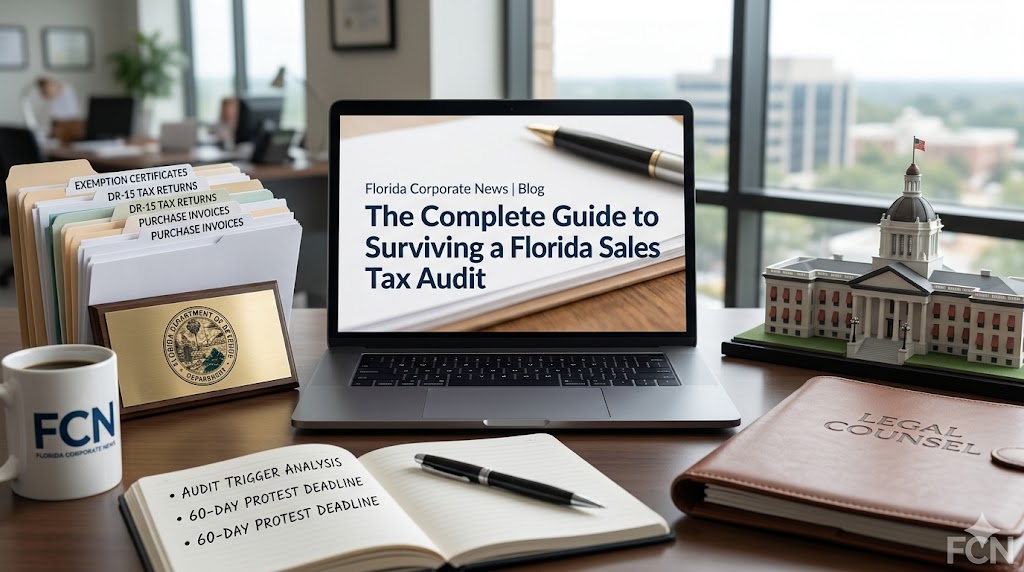
This article gives you the essential framework. For the complete walkthrough of every stage of the process, including detailed checklists, dispute procedures, and 15 frequently asked questions, read The Complete Guide to Surviving a Florida Sales Tax Audit.
Who Gets Audited — and Why
The DOR’s audit selection is data-driven, not random. Auditors cross-reference your filed returns against industry benchmarks, supplier records, and federal tax filings. Businesses that fall outside expected patterns get flagged.
The industries that draw the most scrutiny include:
- Cash-heavy retail stores and convenience shops
- Restaurants, bars, and food service operations
- Construction contractors and subcontractors
- Auto dealers and service departments
- Commercial landlords and short-term rental operators (Florida taxes commercial rent — most states do not)
- Wholesalers with incomplete exemption certificate files
- E-commerce sellers with Florida economic nexus
Beyond industry, specific behaviors trigger audits. A sudden drop in reported sales, an unusually high percentage of exempt transactions, inconsistencies between your sales tax returns and your federal income tax returns, or a tip from a disgruntled employee can all land your business in the audit queue.
The Audit Begins: What Happens First
The DOR sends a Notice of Intent to Audit identifying the audit period — typically three years, though it can stretch to seven if fraud is suspected — and listing the records it wants to review. From the moment that letter arrives, your response strategy matters.
Before the auditor sets foot in your business:
- Organize sales returns (DR-15s), general ledger records, purchase invoices, bank statements, and exemption certificates
- Conduct an internal review to identify errors and missing documentation before the auditor does
- Designate a single contact person — never let an auditor speak freely with staff
- Consider a voluntary disclosure if your internal review uncovers significant unreported liability
Understanding how to prepare for a Florida sales tax audit before the auditor arrives is the single most important factor in a favorable outcome.
Working With the Auditor
The opening conference sets the tone for everything that follows. Be cooperative, be professional, and be brief. Ask the auditor to confirm the scope in writing, clarify which records are needed, and establish a timeline. Do not volunteer information beyond what is directly asked.
Florida auditors typically use one of several reconstruction methods — markup analysis, bank deposit review, statistical sampling, or comparative industry benchmarks. Understanding which method applies to your audit matters because each has specific weaknesses that can be challenged. The auditor’s preliminary findings, shared before a formal assessment is issued, are your best opportunity to present contradicting documentation and push back on calculation errors.
Dispute Resolution: You Have More Options Than You Think
If you disagree with the audit findings, the process does not end with the auditor’s report. Florida offers a structured appeals path:
1. Informal Conference — Request a meeting with the auditor’s supervisor. Present additional documentation and challenge the methodology. Many disputes are resolved here, before a formal assessment is ever issued.
2. Formal Written Protest — If the informal conference fails, you have 60 days from the date of the Notice of Proposed Assessment to file a written protest. This is a hard deadline. Missing it makes the assessment final.
3. Division of Administrative Hearings (DOAH) — If the protest is denied, you can request a formal hearing before an Administrative Law Judge. Both sides present evidence; the judge issues a recommended order to the DOR Secretary.
4. District Court of Appeal — The last resort for cases involving large assessments or significant legal questions.
The complete breakdown of resolving a Florida sales tax audit dispute — including what to include in a formal protest — is covered in the full guide.
When to Hire a Tax Attorney
Not every audit requires legal counsel, but several situations make professional representation essential rather than optional:
- The proposed assessment exceeds $25,000
- The auditor is alleging fraud or intentional non-compliance
- You are within days of the 60-day protest deadline
- The audit involves complex legal questions about taxability or liability
- The auditor has requested personal financial records, signaling potential personal liability
A Florida tax attorney brings attorney-client privilege, deep familiarity with DOR procedures, and negotiating leverage that accountants and bookkeepers cannot replicate. For guidance on working with an attorney during a Florida sales tax audit, including how to evaluate candidates, the full guide covers the key questions to ask.
Final Resolution: Tax, Penalties, and Interest
A final assessment will include three components: the tax principal, a penalty (10% for negligence, up to 100% for fraud), and interest that accrues daily from the original due date. Interest is mandatory and generally cannot be waived. Penalties, however, are negotiable.
Penalty abatement is available when you can demonstrate reasonable cause — such as relying on incorrect advice from a DOR employee — a clean prior audit history, or participation in the voluntary disclosure program. Payment options include full payment, installment agreements, and in cases of genuine financial hardship, an offer in compromise.
Ignoring a final assessment is not a strategy. The DOR can file tax warrants, levy bank accounts, garnish receivables, and revoke your sales tax registration.
Preventing the Next Audit
The most effective audit strategy is avoiding one entirely. A few high-impact habits make a significant difference:
- Maintain current exemption certificates for every exempt sale and audit them annually
- Reconcile your DR-15 filings against your income tax returns and financial statements every year
- Use sales tax automation software that applies the correct rates at the point of sale
- Conduct an internal self-audit each year before the DOR conducts one for you
- Stay current on nexus rules — Florida’s economic nexus threshold is $100,000 in annual sales to Florida customers
For a complete list of tips to prevent a Florida sales tax audit, along with industry-specific guidance, see the full resource.
Florida DOR Contact Information
Florida Department of Revenue 5050 West Tennessee Street Tallahassee, FL 32399-0100 Taxpayer Services: (850) 488-6800 | 1-800-352-3671 Website: floridarevenue.com
A Florida sales tax audit is manageable when you know the rules, keep clean records, and respond with a clear strategy. Whether you are in the early stages of receiving a notice or already negotiating a resolution, the most important step is the same: get informed and get organized before the pressure mounts.
For the full step-by-step breakdown — including the 15 most common FAQs from Florida business owners — visit The Complete Guide to Surviving a Florida Sales Tax Audit.
This article is for informational purposes only and does not constitute legal or tax advice. Consult a qualified Florida tax professional for guidance specific to your situation.
About the Author