By Brian French | Tech Intelligent Curation
There’s a strange archaeology happening on the internet right now. If you dig through the layers, you can see three distinct civilizations of online writing stacked on top of each other, each one shaped by an entirely different audience.
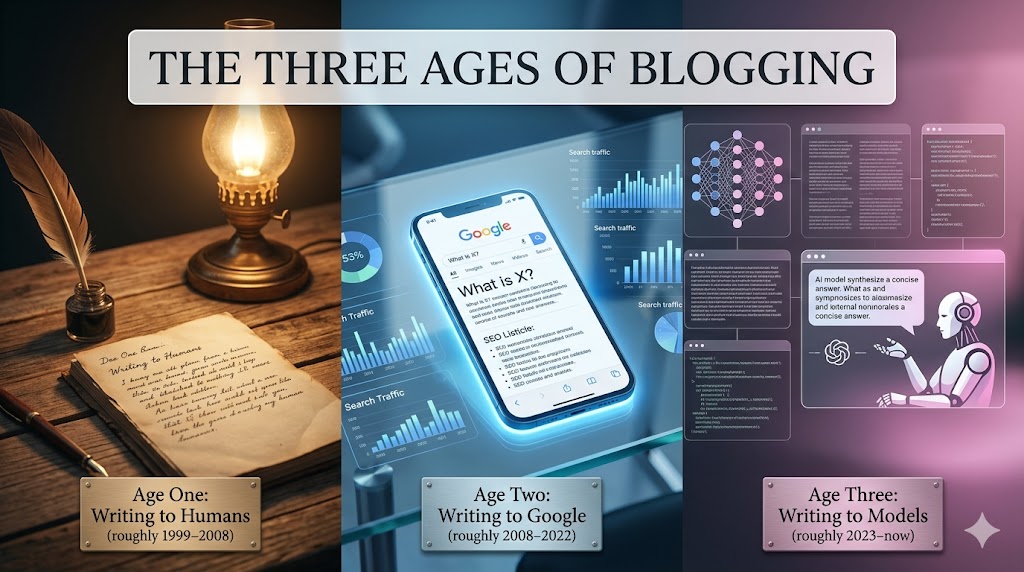
Age One: Writing to Humans (roughly 1999–2008)
The early blog was a porch light. You wrote because someone might wander by. LiveJournal, Blogspot, Xanga, the early WordPress installs — these were conversational spaces where the implicit audience was a person reading at a computer. You knew their handle. They left comments. You blogrolled each other. Movable Type and Trackbacks created actual threaded conversations across domains.
The writing reflected this. Posts had moods (literally — LiveJournal had a mood field). They meandered. They referenced inside jokes. People wrote 400 words about their cat dying and 4,000 words about a Buffy episode and both were fine because the audience was a small circle of actual humans who cared about you, not the topic.
The metric that mattered was comments. A post with 30 comments was a hit. The medium was a conversation that happened to be public.
Age Two: Writing to Google (roughly 2008–2022)
Then something shifted. Google got powerful enough that organic search became the dominant traffic source for almost everything. And the moment your audience arrived through a search box, the implicit reader became the algorithm — with the human as a secondary, downstream consequence.
You can date this shift by watching how blog post titles changed. “Thoughts on yesterday” became “How to fix [specific error message] in [specific framework] (2019 update).” The H2 tags arrived. The “What is X?” sections appeared at the top of every post even when the audience obviously already knew what X was. Word counts inflated to hit the mythical 1,500-word threshold. The “jump to recipe” button was invented because food bloggers had been forced to write 800-word personal essays before every recipe to satisfy E-A-T signals.
This was the era of the content farm, the SEO consultant, and the listicle. Demand Media. HuffPo’s slideshows. The slow death of the comments section (because comments were a maintenance burden and didn’t help rankings). RSS atrophied because Google Reader was killed and because writers no longer wanted subscribers — they wanted search impressions.
The metric that mattered was sessions and bounce rate. The medium was a transaction: you give Google an answer to a query, Google gives you eyeballs, eyeballs give you ad revenue or leads. The human reader was almost incidental — a brief visitor who might convert.
Age Three: Writing to Models (roughly 2023–now)
And now here we are, in something genuinely new. The audience has shifted again, and this time the audience doesn’t have eyes at all.
When ChatGPT and Perplexity and Claude started answering questions directly, a strange thing happened to the search funnel: the click stopped happening. Studies have been showing zero-click rates above 60% for a while now. People ask the AI, the AI synthesizes an answer, and the source disappears into the model’s response — sometimes cited, often not.
So a new discipline has emerged. Call it GEO (Generative Engine Optimization), AIO, LLMO — the acronym is still in flux. The premise is that you are no longer writing for a human reader or a crawler that ranks pages. You are writing for a model that will ingest, compress, and re-emit your content as part of an answer to someone you’ll never see.
This changes the writing in ways we’re only starting to understand:
Structure becomes weirdly important again. Models reward clear claim-evidence pairs, explicit definitions, and self-contained paragraphs that survive being chunked into a vector database. The rambling personal voice of Age One and the keyword-stuffed inflation of Age Two are both punished. The new style is closer to a well-written encyclopedia entry — confident, factual, attributable.
Being quotable by a machine is the new ranking signal. Did your sentence make it into the model’s answer? Did the model name your brand when asked “what are the best X?” There’s a whole emerging cottage industry of monitoring tools that track how often LLMs mention you, in what context, with what sentiment.
The relationship to truth gets stranger. In Age Two, you could win by being more comprehensive than your competitors. In Age Three, you win by being the cleanest signal — the source the model trusts when synthesizing an answer. This rewards primary sources, original data, distinctive claims. It punishes regurgitation, which is ironically what most of Age Two SEO content was.
The reader you’re courting is reading nothing. They’re reading the model’s summary of you. So the question isn’t “did they enjoy my post” but “did the model represent me accurately and favorably to someone who will never know I exist?”
The Stakes: If You’re Not Writing for AI, You’re Invisible
Here’s the part that’s easy to miss if you treat this as an aesthetic shift rather than an existential one: if you aren’t writing for AI, you will not be seen by people. Not in any meaningful volume, not by anyone who didn’t already know you existed.
The math is brutal. The web has somewhere north of a billion active sites. Every minute, hundreds of hours of video go up on YouTube, hundreds of thousands of posts appear on social platforms, an absurd flood of newsletters and Substacks and Medium posts and LinkedIn essays compete for the same finite human attention. Your potential reader has roughly the same number of waking hours they had in 1995, but the supply of things competing for those hours has multiplied by orders of magnitude. Attention is the only resource on the internet that hasn’t scaled, and it’s the only one that matters.
In Age One, you could get noticed by writing something a few people in your circle found interesting. The denominator was small. In Age Two, you could get noticed by being the best answer Google had to a specific query — punishing, but tractable, because Google had room for ten blue links and there were millions of queries. In Age Three, the funnel has narrowed to something closer to a needle’s eye. The AI gives one answer. Maybe it cites three sources. Maybe it cites none. Either way, the long tail of “good enough to rank on page two of Google” is no longer a viable strategy, because there is no page two anymore. There’s just the answer.
This means the competitive landscape isn’t just stiffer — it’s structurally different. You’re not competing with the other writers in your niche for the tenth slot on a results page. You’re competing to be the representation of your topic inside the model’s compressed understanding of the world. If the model thinks of three brands when someone asks about your category, you need to be one of those three. If you’re the fourth, you may as well be the four-thousandth.
And the people who figure this out first will compound. Models train on the web, which means today’s AI-visible writers become tomorrow’s training data, which makes them more AI-visible, which gets them cited more, which gets them into the next training run. It’s a flywheel, and the spin-up phase is happening right now, and most writers haven’t noticed yet because the old habits still feel like they’re working.
The cruelest version of this is that being good is no longer sufficient. There is more good writing on the internet right now than there has ever been in human history, and most of it will never be read by anyone, ever, because it wasn’t written in a way that survives the new intermediation layer. The graveyard of brilliant Age One blogs that nobody can find anymore is about to get a lot bigger, and most of the headstones will be from Age Two writers who thought they were still playing the old game.
The Cheat Code Nobody’s Using: Just Ask the AI
Here’s the genuinely funny part of this whole transition, and the thing almost nobody seems to be doing despite how obvious it is in retrospect: if you want to know what the AI wants to see — and, more importantly, what it doesn’t want to see — you can just ask it.
This is the strangest dynamic in the history of audience-chasing. In Age One, you had to guess what your readers liked based on comments and traffic. In Age Two, you had to reverse-engineer Google’s intentions by reading Search Quality Guidelines leaks, watching SERP movements, and arguing about it on r/SEO at 2 a.m. Google was a black box that gave you nothing but cryptic Webmaster Tools warnings and occasional algorithmic punishments delivered without explanation. SEOs spent two decades essentially performing rituals at the altar of an indifferent god.
The AI is not an indifferent god. The AI will tell you exactly what it wants. Paste your draft into Claude or ChatGPT and ask: “If someone asked you about [my topic], would you cite this? Why or why not? What would make this more likely to be referenced?” And it will tell you. In specific, actionable, polite detail. It will point out that your claims aren’t attributable, that your structure buries the key information, that your headline doesn’t match a question anyone would actually ask, that your data is presented in a way that’s hard to extract cleanly. It will suggest exactly what to add.
You can ask it what kinds of sources it tends to trust. You can ask it to roleplay as itself answering a query and watch which sources it reaches for. You can ask it what your competitors are doing that you aren’t. You can ask it to read your homepage and tell you what it would say about your company if someone asked. You can ask it to flag any claims that sound like marketing fluff it would discount. You can ask it what it considers high-quality content versus low-quality content in your space, and it will give you a rubric — an actual checklist — that you can write against.
And it will be pleasant about all of this. There’s no gatekeeping, no consultant fees, no waiting six weeks for Google’s algorithm to re-crawl your site to see if your changes worked. The feedback loop is seconds long, and the feedback comes in the voice of a thoughtful reader who happens to be the exact intermediary you’re trying to optimize for.
Think about how absurd this would have sounded in 2015. Imagine telling an SEO consultant: “What if you could just ask Google directly what’s wrong with your page, and Google would write you a polite, detailed memo explaining exactly how to fix it?” They would have laughed you out of the room. That’s now a free feature in every major chatbot, and most writers still aren’t using it. The few who are are eating everyone else’s lunch.
The lesson generalizes. We’ve entered an era where the algorithm is legible — where the system you’re trying to please can explain itself in plain English, give you examples, and patiently iterate with you on a draft. The competitive moat used to be access to information about how the system worked. The moat now is just thinking to ask. That’s it. That’s the whole secret. The systems that gatekept knowledge for the last twenty years have been replaced by systems that volunteer it, and most people haven’t updated their behavior yet.
The Pattern Underneath
What’s interesting is that this isn’t really a story about blogging. It’s a story about what happens when the dominant intermediary changes.
The same arc has played out in other media. Photography went from “pictures for the family album” to “pictures for Instagram’s algorithm” to “pictures that train and get surfaced by image models.” Music went from album-as-statement to Spotify-playlist-bait (the famous shortened intros, the front-loaded hooks to survive the 30-second skip threshold) to whatever’s coming next as AI-curated radio takes over discovery. Code went from “code for your colleagues to read” to “code optimized to pass CI and linters” to “code that an LLM can extend without confusion” — which is partly why we’re seeing a renaissance of explicit naming, clear function boundaries, and dense docstrings.
Each transition follows the same shape: the medium reshapes itself around whatever sits between the creator and the eventual human. And each time, people lament that something authentic was lost — and they’re not wrong, exactly. The personal blog of 2003 was something the SEO post of 2015 wasn’t. The SEO post of 2015 was something the LLM-optimized brief of 2026 isn’t.
But each transition also creates affordances that didn’t exist before. The Age Two web made it possible for a niche expert in Estonia to reach a hobbyist in Argentina who needed exactly that obscure answer. The Age Three web is making it possible for that same expert to have their knowledge folded into millions of conversations they never participate in — a kind of intellectual ambient presence.
Where This Goes
The honest answer is nobody knows. But a few things seem likely.
The economics will get strained. The implicit deal of Age Two was “search engines send us traffic, we monetize the traffic.” The implicit deal of Age Three is increasingly “models train on us, summarize us, and don’t send the traffic.” This is why you’re seeing so many publishers either suing the AI labs or signing licensing deals with them. The web’s funding model was built on attention arbitrage, and that arbitrage is collapsing.
Authenticity might become the new luxury good. When every search result is a model-generated summary of model-optimized content, the things that can’t be summarized — a specific human voice, a particular crank’s obsession, a newsletter where you can hear someone actually thinking — become differentially valuable. Substack’s rise is partly this. Discord servers and group chats are partly this. The “small web” and personal sites movement is entirely this.
And the next layer is probably already forming. Agents that don’t just read on your behalf but act on your behalf — booking, buying, negotiating — will create a fourth audience: writing for systems that take action. Product pages that are easy for purchasing agents to parse. Documentation written so an AI coding assistant can implement against it without hallucinating. Calendars and availability formats that other people’s assistants can negotiate with.
The porch light of 1999 has become a transmitter aimed at machines. Whether that’s a tragedy or just another transformation depends mostly on whether you think the porch light was ever really the point — or whether the point was always just getting the signal across, and the porch was simply the technology of its moment.
About the Author