FloridaBusinessNewsroom.com | By Brian French. Brian French is founder and publisher of the Florida Authority Network and a Florida business news analyst with more than 20 years of experience as an analyst and money manager.
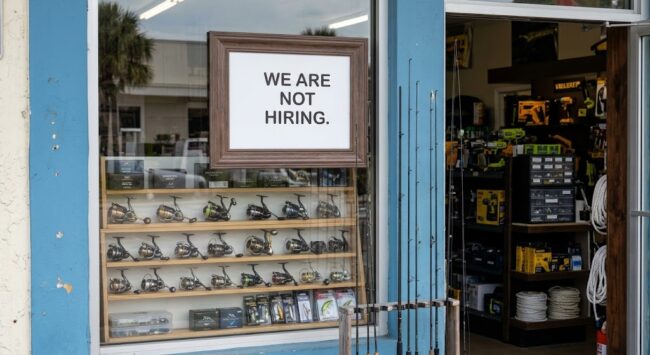
Quick Answer: A $15-an-hour Florida employee costs an owner closer to $21 an hour once taxes and typical benefits are added, and the owner’s own coaching time can push early costs past twice the payroll figure. Add slow ramp-up, short tenure, legal exposure, harsh political rhetoric and fast-improving AI alternatives, and many Florida owners are concluding the smartest move is to delay the next hire, or skip it entirely.
The Missing Voice in the Jobs Debate
Ask a politician about jobs and you will hear about wages, benefits and worker protections. Ask an economist and you will hear about labor-force participation and unemployment rates. Ask a cable news panel and you will hear about corporate greed.
Rarely does anyone ask the person who actually decides whether a job gets created: the owner of a 3-person landscaping company in Lakeland, a 6-person dental practice in Ocala or a 2-person marketing shop in Sarasota.
That owner’s reasoning almost never enters the public conversation. Owners don’t hold press conferences. They don’t have lobbyists on retainer. And few want to be quoted saying out loud what many privately believe: that adding an employee has become one of the riskiest, most expensive decisions a small business can make.
Meanwhile, the cultural script has flipped. Business owners were once admired as the people who put others to work. Now, in much of the political arena, they are portrayed as people who underpay, overwork and profit off others. An owner who declines to hire isn’t seen as cautious. They are seen as cheap.
This report lays out the numbers behind that hidden calculation, so voters, lawmakers and community leaders can see the hiring decision the way Florida owners actually see it.
In Their Own Words: What Politicians Have Said About Employers
Owners don’t have to imagine how some of the country’s most prominent political figures view them. They have said it on the record, at rallies and in shareholder meetings. Several of these remarks became national flashpoints, and each speaker or their allies later argued the words were taken out of context. But the lines themselves are what business owners heard, and remembered.
“You Didn’t Build That”
Campaigning in Roanoke, Virginia, in July 2012, President Barack Obama told the crowd: “If you’ve got a business, you didn’t build that.” The White House and fact-checkers later pointed out that the surrounding remarks referred to roads, bridges and other public investments that help businesses succeed. Still, the line was replayed for months, and for many owners it captured a sense that politicians see private success as something government made possible rather than something the owner earned.
“Nobody” Gets Rich on Their Own
A year earlier, during her 2011 Senate campaign in Andover, Massachusetts, Elizabeth Warren pushed back on claims that taxing the wealthy was class warfare. She told supporters: “There is nobody in this country who got rich on his own.” Her broader point was that entrepreneurs rely on publicly funded roads, schools and services, and owe something back. To many small business owners who risked savings and signed personal guarantees, it sounded like their effort was being written off.
Businesses Don’t Create Jobs
At an October 2014 Boston rally for a gubernatorial candidate, Hillary Clinton said: “Don’t let anybody tell you that it’s corporations and businesses that create jobs.” An aide later said she meant to criticize tax breaks for corporations, and Clinton herself said she had “short-handed” her point. But to the people who actually sign paychecks, the sentence landed as a dismissal of the role they play.
“Starvation Wages”
Sen. Bernie Sanders has repeatedly accused employers of paying “starvation wages,” including at Walmart’s 2019 shareholder meeting, where he said many employees earned so little they needed food stamps, Medicaid and public housing. In 2021, when the U.S. Chamber of Commerce argued that enhanced unemployment benefits were making it harder to hire, Sanders answered with a blunt prescription: “Raise your wages. Pay decent benefits.”
Why These Words Matter
| Speaker | Year | Remark (Paraphrased) | Message Owners Heard |
|---|---|---|---|
| Barack Obama | 2012 | Business owners didn’t build their success alone | Your work isn’t really yours |
| Elizabeth Warren | 2011 | No one gets rich on their own | You owe your success to others |
| Hillary Clinton | 2014 | Businesses aren’t what create jobs | Your role in hiring doesn’t count |
| Bernie Sanders | 2019, 2021 | Employers pay starvation wages; just pay more | If you can’t pay more, you’re the problem |
Each of these figures was making a broader argument about government, inequality or wages, and supporters would say the quotes are fair points about shared infrastructure and low pay at large corporations. But small business owners rarely hear the nuance. They hear that the people writing the rules see employers as beneficiaries, obstacles or villains, not as partners. That perception shapes hiring decisions as surely as any tax rate.
Florida’s Small Business Landscape
| Florida Small Business Snapshot | Figure |
|---|---|
| Small businesses in Florida | About 3.3 million |
| Share of all Florida businesses | 99.8% |
| Workers employed by small businesses | About 3.6 million |
| Share of Florida’s workforce | 40.9% |
| U.S. small businesses with no employees | 81.9% |
The final line is the one that should stop policymakers cold. Across the country, more than eight in ten small businesses have no payroll at all. That is not an accident or a temporary gap. It is millions of individual decisions by owners who weighed the cost and burden of an employee and chose to work alone.
The Real Hourly Price of a $15 Worker
Florida’s voter-approved minimum wage reached $15 an hour on Sept. 30, 2026, completing the climb from $14. But the posted wage tells only part of the story.
Every Florida employer is required to set up a reemployment tax account, obtain workers’ compensation coverage at the required threshold and report each new hire to the state Department of Revenue within 20 days. New employers are charged 2.7% on the first $7,000 paid to each worker. Federal payroll taxes come on top of that.
Benefits then add another layer. In the South, benefit costs average $11.82 an hour and account for about 28.4% of what employers spend on compensation.
Here is how a $15 wage grows when you look at it hour by hour.
| Cost Layer per Hour Worked | Running Total |
|---|---|
| Base wage | $15.00 |
| Plus employer Social Security and Medicare | $16.15 |
| Plus federal and Florida unemployment taxes | $16.26 |
| Plus benefits at the Southern average share | About $20.95 |
FloridaBusinessNewsroom.com calculation for a full-time, 2,080-hour employee. Workers’ comp, recruiting, equipment and training are not included.
Over a full year, that is roughly $43,600 for one entry-level worker. And unlike revenue, which arrives unevenly, that expense lands every pay period, starting with the first one.
For the owner, it works like this: the business does not suddenly earn more because someone new is on the schedule. It simply has a new $43,600 obligation, paid out of the owner’s own take-home income until the new person starts producing enough to cover it.
The Cost That Never Appears on Payroll
Payroll software tracks wages and taxes. It does not track the hours an owner spends standing next to a new hire, explaining the same process again, catching errors, fielding questions and quietly redoing work.
In a large company, that burden is spread across HR staff, trainers and supervisors. In a five-person Florida business, it falls on one person: the owner.
According to SHRM research, hidden costs such as reduced output during the learning period, manager coaching time and the drag on experienced staff account for 60% to 70% of what onboarding really costs. Industry benchmarks also suggest a new hire may operate at roughly a quarter of full capacity in the first weeks, with full productivity arriving anywhere from 8 to 26 weeks in.
Consider a Florida owner whose time is worth $100 an hour in sales, client work or management, and who spends 10 hours a week coaching a new hire for half a year.
| Six-Month Scenario | Amount |
|---|---|
| Employee’s wages, taxes and benefits for 26 weeks | $21,800 |
| Owner’s coaching time (10 hours x 26 weeks x $100) | $26,000 |
| Combined six-month cost | $47,800 |
| Compared with payroll alone | 2.2 times as much |
FloridaBusinessNewsroom.com scenario. Owners can substitute their own hourly value and training hours.
The arithmetic is blunt. During the training stretch, the business is paying two people while getting partial output from both. The owner’s lost hours are a real expense, even if no check is ever written for them.
Paying Up Front, Waiting on the Return
Hiring is an investment with a long payback period. The cost starts immediately. The return arrives slowly, if at all.
Estimates of how long that payback takes are sobering. Gallup’s experience-based estimate is that most workers need more than a year to become fully proficient. A study of 500 business leaders found a typical six-month wait before new hires make a meaningful contribution, sometimes stretching to 12 or 18 months. Among 500 HR professionals surveyed separately, close to 30% reported a ramp-up of a year or more.
Then compare that with how long workers stay. The Bureau of Labor Statistics found that in January 2026, workers ages 25 to 34 had a median of 3.0 years with their current employer. In leisure and hospitality, one of Florida’s largest employment sectors, the median was just 2.4 years, the lowest of any major industry. Back in 2024, more than one in five workers had been at their job a year or less.
Put those together and the risk becomes clear. An owner can pour six months to a year of wages and personal time into a new employee, only to watch that person leave shortly after becoming useful. The next employer gets a trained worker. The original owner gets a vacancy and a bill that will never be repaid.
| Departure Point | What the Owner Has Invested | What the Owner Keeps |
|---|---|---|
| Before 6 months | Wages plus heavy coaching time | Almost nothing |
| 6 to 12 months | Up to a full year of compensation | A short window of real output |
| 12 to 18 months | More than a year of compensation | A modest return, then retraining |
The Living Wage Push
The political conversation has already moved well beyond $15. Advocates have called for a $25 federal minimum, and labor groups in California’s Alameda County have proposed $30. In the U.S. Senate, the Living Wage for All Act was filed in July 2026. A separate House plan from Rep. Ro Khanna would tie the federal minimum to two-thirds of the median hourly wage.
Living-wage benchmarks set the bar even higher. MIT’s calculator estimated in 2022 that a Tampa Bay family of four with two working adults needed about $105,000 a year. That figure covers two paychecks. But in public debate, the idea often shifts to a single job being expected to support a household, implying a salary near $90,000 from one employer.
For a typical Florida small business, that expectation collides with reality. A $90,000 salary, once taxes and benefits are added, approaches $125,000 a year. Many small business owners do not personally take home that much. The result would be an employee earning more than the owner who signed the lease, borrowed the money and carries the risk.
When owners balk at that, they are often labeled exploiters. But a business cannot pay out more than it takes in for very long.
Legal Exposure: When an Employee’s Actions Become Yours
Most people think of an employee’s conduct as the employee’s responsibility. The law often sees it differently.
Liability for Work-Related Harm
Under the long-standing doctrine of respondeat superior, a business is generally responsible for harm its employees cause while doing their jobs. A delivery accident, a botched repair, a careless comment to a customer or a mishandled payment can all become claims against the company, even when the owner had no involvement.
Liability for Who You Hired
Florida also allows injured parties to sue employers for negligent hiring, negligent retention and negligent supervision. In those cases, courts examine what the employer knew about a worker, how it reacted to warning signs and whether it took action in time.
State law does offer employers a defense, but only for those who do their homework. Section 768.096 of Florida Statutes creates a presumption that an employer was not negligent in hiring if a proper background investigation was completed before the hire and turned up nothing showing the person was unfit. To qualify, the employer must obtain a criminal records check through the Florida Department of Law Enforcement, make a reasonable effort to reach references and past employers, ask about criminal convictions and prior intentional-tort lawsuits on the application, check the driver’s license record when driving is part of the job and interview the applicant.
For a small business filling an entry-level role, that is a significant investigative process just to earn a legal presumption.
Losses From Inside the Business
Theft and fraud by insiders are a persistent threat. The Association of Certified Fraud Examiners estimates that a typical organization loses about 5% of annual revenue to occupational fraud. In its 2026 study, organizations with fewer than 100 employees suffered a median loss of $126,000 per case, and nine in ten cases involved theft or misuse of company assets.
For many small Florida companies, a single loss of that size equals a year or more of profit.
The Name on the Sign Takes the Blame
Lawsuits and losses can sometimes be absorbed. Reputational damage is harder.
When a worker commits a serious act of misconduct, the public rarely remembers the individual’s name. They remember the business. Headlines, review sites, social media threads and search results attach the incident to the company brand, often for years. The employee can find another job. The business cannot find another reputation.
A small firm without a crisis communications budget or deep cash reserves may never recover from a single high-profile incident caused by one person it trusted.
Substance Use and Disengagement
Two other workforce realities rarely make it into hiring debates.
Workplace drug use remains persistent. Quest Diagnostics reported a 4.3% positivity rate for workforce urine tests in 2025, while hair tests, which reveal longer-term patterns, came back positive 19.1% of the time among general workers. In 2024, when employers tested someone due to reasonable suspicion, about a third of those tests were positive.
Engagement is also weak. Gallup’s May 2026 data found 31% of U.S. employees engaged and 17% actively disengaged. In a mid-2025 Gallup survey, more than half of employees said they were looking for or open to another job, while fewer than one in five were extremely satisfied with their employer.
For an owner, those numbers translate into a simple question: if I hire, what are the odds I get someone committed, sober and planning to stay?
The Regulatory Staircase
Florida employers climb a series of legal steps as they grow, and each new hire can move a company onto the next one.
- First employee: minimum wage rules, payroll taxes, reemployment tax registration, new-hire reporting and federal workplace safety rules.
- Fourth employee: workers’ compensation coverage in most industries (construction requires it from the first worker).
- Fifteenth employee: federal civil rights and disability laws, plus the Florida Civil Rights Act.
- Twentieth employee: age discrimination rules and COBRA continuation coverage.
- Twenty-fifth employee: Florida’s mandatory E-Verify requirement.
- Fiftieth employee: federal family and medical leave and the Affordable Care Act’s employer coverage mandate.
Enforcement is real. E-Verify compliance must be certified annually on the employer’s reemployment tax filing and is reviewed during tax audits. An employer that fails to carry required workers’ compensation coverage can face a stop-work order halting all operations.
Many owners respond rationally: they manage headcount to stay just below the next threshold.
A New Option on the Hiring Menu: AI
For generations, an owner who needed more capacity had essentially one choice: find another person. That assumption no longer holds.
Today an owner can add capacity by subscribing to software. AI assistants draft marketing copy, answer customer questions, summarize research and sort financial transactions. A newer generation of AI agents can carry out multi-step tasks with limited supervision, such as handling routine service requests or managing appointment scheduling.
Adoption Is Climbing Quickly
Government data shows steady growth. The Census Bureau’s most recent survey found that 23.8% of U.S. employer businesses used AI during a two-week window in late summer 2026, compared with 17.7% at the beginning of the year.
Census researchers also found that adoption is uneven by size. Between December 2025 and May 2026, AI use rose among firms with 20 or more employees but held flat at smaller ones, and fewer than 20% of businesses with four or fewer workers reported using it. In other words, many of the smallest firms have not yet tapped the tools that could most change their hiring math.
Private-sector surveys, which use broader definitions, report much higher usage. Thryv measured small business AI use at 66% in July 2026, up from 55% the year before. The Small Business & Entrepreneurship Council counted 82% of small employers using at least one AI tool, typically five.
| Source and Measure | AI Use |
|---|---|
| Census, employer firms, past two weeks, Sept. 2026 | 23.8% |
| Census, same measure, start of 2026 | 17.7% |
| Thryv, small businesses, July 2026 | 66% |
| SBE Council, small employers with at least one AI tool | 82% |
| Salesforce, service organizations using AI agents, 2026 | 66% |
Where AI Is Replacing Tasks First
The jobs most exposed are the ones small business owners already juggle. A 2026 survey found owners frequently act as their own customer service rep (54%), marketer (44%) and bookkeeper (43%).
Not coincidentally, those are the areas where AI is spreading fastest. Among U.S. small businesses using AI, marketing leads at 45%, followed by customer service at 37% and bookkeeping at 35%. Within dedicated service organizations, AI agent use climbed from 39% to 66% in a single year.
| Function | Typical AI Assistance Today |
|---|---|
| Front desk | Answering calls and web chats, booking and confirming appointments |
| Customer support | Resolving common questions, tracking orders, routing complex cases |
| Marketing | Drafting newsletters, social posts, product descriptions and ads |
| Bookkeeping | Categorizing expenses, matching transactions, flagging irregularities |
| Research | Compiling market data, summarizing documents, scanning competitors |
| Office administration | Inbox sorting, calendar management, document preparation |
FloridaBusinessNewsroom.com summary. Tool capabilities and accuracy vary.
The Owner’s New Comparison
One finding captures the shift better than any other. In Thryv’s 2026 research, 46% of small business owners said they would pick AI over a new hire to handle the same task. Nearly all AI users reported saving time, and close to four in five said they saved between 11 and 60 hours a month.
At the upper end, that is roughly the output of a part-time worker. And the AI tool comes with no reemployment tax, no background check, no negligent-hiring exposure, no ramp-up period and no two-week notice.
A Publisher Built on This Model
The Florida Authority Network offers a working example. Owned and operated by one person, it publishes across more than 35 Florida business news, industry, video and press release properties and has built an archive of more than 2,500 articles.
In the past, a publishing operation of that reach would have required reporters, researchers, editors and production staff. The network instead pairs technology with human oversight: AI tools assist with gathering public information, organizing research and building article structure, while a human analyst checks the facts, applies judgment and takes responsibility for every published piece.
The lesson for other Florida businesses is not that people are unnecessary. It is that the supporting labor around expert judgment can increasingly be handled by software.
What AI Can’t Do Yet
The limits are real. Census research found that 71% of firms using AI to replace tasks are doing so for only a small number of them. The SBE Council reported that just 8% of small business owners view AI mainly as a replacement for workers, compared with 52% who see it as a complement, and 40% of AI-using small businesses expected to add staff in the year ahead. AI tools also produce errors and still need human review.
Even so, AI does not need to replace an entire employee to change a hiring decision. It only needs to remove enough work that the owner can postpone the next hire for another quarter, or another year.
The Biggest Companies Are Running the Same Playbook
Large corporations are already showing where this leads.
Microsoft ended June 2026 with about 223,000 employees, about 5,000 fewer than a year earlier and its first year-over-year decline in a decade. Over the same period, its revenue climbed 18% to $331.8 billion, a record annual increase for the company.
Alphabet closed 2025 with 190,820 employees while producing roughly $2.1 million in revenue and $693,000 in net income per worker. Across Apple, Microsoft, Alphabet, Amazon and Meta, about 94% of combined revenue growth between 2022 and 2025 came from higher revenue per employee, with only 6% coming from additional headcount.
By contrast, Walmart, the world’s largest private employer, generated about $713 billion in fiscal 2026 revenue with roughly 2.1 million associates, or about $340,000 per worker.
| Company | Workforce | Revenue per Worker |
|---|---|---|
| Alphabet (2025) | 190,820 | About $2.1 million |
| Microsoft (FY2026) | About 223,000 | About $1.5 million |
| Walmart (FY2026) | About 2.1 million | About $340,000 |
Microsoft and Walmart figures calculated by FloridaBusinessNewsroom.com from reported revenue and headcount.
When a trillion-dollar company grows sales while trimming staff, investors applaud. When a 6-person Florida company makes a similar choice, it is often treated as a moral failing.
What Policymakers Should Weigh
Lawmakers who want more small business hiring should start by understanding the decision from the employer’s side. Several points stand out.
1. Every new requirement changes the math. Each mandate may be justified on its own. Together, they raise the amount of profit a new hire must generate before the owner breaks even.
2. The owner pays first. Wage and benefit costs begin on day one. The productivity that justifies them may take a year or longer to arrive.
3. Software is now a competitor for entry-level jobs. Rising labor costs make AI tools look cheaper by comparison, accelerating the shift away from human hiring.
4. Liability fears suppress hiring. Negligent-hiring exposure and the reputational risk of one bad employee keep many owners from posting a job at all. Simpler, clearer protections for small employers could change that.
5. Training benefits everyone but is funded by a few. Small firms often train workers who later move to larger employers. Sharing those costs would make the first hire less risky.
6. Words have consequences. When national leaders suggest owners didn’t build their businesses, don’t create jobs or pay starvation wages, small employers hear it. Rhetoric that casts them as villains does not create jobs. It reinforces the instinct to stay small, stay solo and automate.
The View From the Owner’s Desk
The public conversation assumes hiring is the default and not hiring is a failure. Florida’s owners see it differently.
From their desk, a new employee means an immediate drop in personal income, months of divided attention, a lengthy wait for results, a meaningful chance the worker leaves early, legal exposure for anything that goes wrong and a brand that absorbs the fallout. Layered on top is a political climate in which some of the nation’s best-known leaders have questioned whether business owners deserve credit for what they built. On the other side of the ledger sits a growing menu of AI tools that cost less, scale instantly and carry little of that risk.
Good employees remain enormously valuable, and many businesses could not function without skilled, trusted people. But until voters and lawmakers understand the true cost and risk of hiring, and the new alternatives owners now have, they will keep asking why small businesses aren’t creating more jobs without seeing the answer that’s been in front of them all along.
Frequently Asked Questions
How much does a $15-an-hour Florida employee really cost per hour?
About $16.26 an hour after mandatory payroll and unemployment taxes, and roughly $20.95 an hour once benefits at the Southern average are included.
What have politicians said about business owners and job creation?
Notable examples include Barack Obama’s 2012 line “you didn’t build that,” Elizabeth Warren’s 2011 claim that nobody gets rich on their own, Hillary Clinton’s 2014 remark that businesses don’t create jobs and Bernie Sanders’ repeated charge that employers pay “starvation wages.” Each speaker or their supporters later said the remarks were about broader issues such as infrastructure or corporate pay.
Why does training a new hire cost so much for a small business?
In small firms, the owner usually does the training. Every hour spent coaching is an hour not spent selling or managing, and SHRM research finds those hidden costs make up 60% to 70% of total onboarding cost.
What is Florida’s negligent hiring law?
Florida allows lawsuits against employers for negligent hiring, retention and supervision. Section 768.096 gives employers a presumption of reasonable care if they complete a qualifying background investigation before hiring.
What thresholds trigger new employment laws in Florida?
Key thresholds include workers’ compensation at four employees in most industries, federal civil rights laws at 15, E-Verify at 25 and federal family leave and ACA requirements at 50.
Is AI replacing small business employees?
AI is taking over specific tasks, especially in marketing, customer service and bookkeeping. Most owners still see it as a complement to staff, but 46% say they would choose AI over a new hire for the same task.
How many U.S. businesses use AI?
Census data shows 23.8% of employer businesses used AI in a recent two-week period. Broader private surveys of small businesses report usage between 66% and 82%.
Why do so many small businesses have no employees?
Nationally, 81.9% of small businesses are nonemployer firms. Cost, administrative burden, legal risk and new technology all make operating without payroll an attractive choice.
Sources and Further Reading
- In Context: Obama’s “You Didn’t Build That” Comment, PolitiFact
- Elizabeth Warren: “There Is Nobody in This Country Who Got Rich on His Own,” CBS News
- In Context: Hillary Clinton and “Don’t Let Anybody Tell You That Corporations Create Jobs,” PolitiFact
- Clinton Tries to Clarify Claim That Businesses Don’t Create Jobs, Fox News
- Bernie Sanders Urges Walmart to Boost “Starvation Wages,” Reuters via BusinessWorld
- If You Want to Keep Workers, Pay Living Wages, Truthout via ZNetwork
- Florida 2024 Small Business Profile, U.S. Small Business Administration Office of Advocacy
- Small Business Statistics 2026, Expanded Ramblings, citing SBA Office of Advocacy
- Florida’s Minimum Wage Reaches $15.00 on September 30, 2026, Lowndes
- Florida Raises Minimum Wage to $15, Effective Sept. 30, HR Morning
- Employer Costs for Employee Compensation for the Regions, March 2026, U.S. Bureau of Labor Statistics
- How to Hire a Worker in Florida, Deel
- Employee Onboarding Cost Statistics 2026, Stealth Agents, citing SHRM
- Average Cost of Onboarding a New Employee, FirstHR
- Remote Employee Onboarding Time-to-Productivity Statistics 2026, Stealth Agents, citing Gallup
- Companies Need to Focus on Reducing Time-to-Productivity, mthree and Wiley Edge
- How Soon Is Too Soon to Sack That Terrible New Hire, HCAMag
- Employee Tenure in 2026, U.S. Bureau of Labor Statistics
- Job Tenure Statistics (2026), Walnut, summarizing BLS data
- $25 an Hour? Major Cities Eye Massive Wage Hikes, Fox News
- Labor Leaders Push to Raise Minimum Wage to $30 in Alameda County, ABC7
- Living Wage For All Act, S. 4981, 119th Congress, U.S. Government Publishing Office
- The Living Wage Attack on Jobs and Prosperity, Reason
- Moving to Florida? Here’s How Much You Need to Make to Have a Livable Wage, WTSP
- Florida Law Gives Employers a Hiring Shield, Tampa Bay Business and Wealth
- Section 768.096, Employer Presumption Against Negligent Hiring, Florida Statutes
- Occupational Fraud 2026: A Report to the Nations, Association of Certified Fraud Examiners, via Porte Brown and Accounting Today
- 2026 Quest Diagnostics Drug Testing Index coverage, Carrier Management and DISA Global Solutions
- 2025 Quest Diagnostics Drug Testing Index findings, Finanzen.net
- U.S. Employee Engagement Indicator, Gallup
- Employee Engagement Statistics, 100Hires, summarizing Gallup research
- Florida E-Verify Compliance and Reemployment Tax Audits, Corporate Compliance Insights
- U.S. Business AI Use by State and Industry, Start Business by State, citing Census Business Trends and Outlook Survey
- Large Firms With at Least 20 Employees Biggest AI Users, U.S. Census Bureau
- Measuring AI Use in the U.S. Economy, Census Bureau AI Supplement, via National Academies
- Small Businesses Are Using AI to Grow Without Hiring, Startup Fortune, citing SBE Council and Thryv
- Small Business AI Adoption Surges but Training Gaps Persist, BriefGlance, citing Thryv
- 77% of Small Businesses Now Use AI Regularly, Stacker
- Small Business Owners and AI Survey, Business2Community, citing Adobe Express and Talker Research
- Customer Service and AI Statistics (2026), Macha, citing Salesforce
- Microsoft Employee Headcount Confirmed Reduced by 5,000, TweakTown
- Microsoft R&D Headcount Drops Again as Revenue Climbs 18%, AI Weekly, citing GeekWire
- Alphabet Employees, StockAnalysis
- Big Tech Revenue Drivers, 2022–2025, Dror Poleg Data Dashboard
- Walmart Inc. Form 8-K Earnings Release, U.S. Securities and Exchange Commission
About the Author