Quick Answer: Large language models are moving from one-size-fits-all to layered specialization: geographic layers (a Florida-grounded model for Florida questions) and professional layers (models tuned for physicians, attorneys, architects). For a Florida business, the practical response is to make sure your company is “wrapped” in two kinds of authoritative content: Florida business news and Florida industry news.
Why a general model is the wrong tool for a local question
When someone in Tampa asks an AI assistant to recommend a personal-injury attorney or a Cuban sandwich, a model that knows everything about every city on earth is carrying an enormous amount of dead weight. The relevant answer lives in a small slice of the world: Florida Bar records, Hillsborough County court filings, Tampa Bay reviews, Florida statutes on comparative negligence.
The industry is already heading this direction. Gartner projects more than half of enterprise generative-AI models will be domain-specific by 2027, versus roughly 1% in 2024. The same logic that makes a medical model outperform a general one on clinical questions makes a Florida-grounded model outperform a general one on Florida questions.
The two layers of specialization
Specialization is arriving on two axes at once.
Geographic. Retrieval-augmented models pull from a defined knowledge base rather than from everything they were trained on. A Florida knowledge base would include state statutes, DBPR license records, Sunbiz filings, county permit data, hurricane building codes and Florida business coverage. When the question is “who should I hire in Sarasota,” a model retrieving from that base is simply more accurate than one guessing from the whole internet.
Professional. Specialized models already exist for healthcare (Med-PaLM, BioGPT), legal (Harvey AI) and finance (BloombergGPT), trained or fine-tuned on domain data so they carry deeper expertise than general-purpose models. Vertical AI is built around one domain’s language, rules, workflows and compliance constraints, which is why generic models fail on technical precision and domain rules in regulated industries.
Put the two together and you get the likely end state: a Florida medical model, a Florida legal model, a Florida construction model. Each answers questions the way a well-informed local professional would.
What this looks like for common Florida questions
| Question | General model | Florida + industry model |
|---|---|---|
| Find a real estate attorney in Naples | Generic list, stale | Bar status, closings, local coverage |
| Best cardiologist near Jacksonville | National directories | Florida licensing, hospital affiliation, local news |
| Roofer for a post-storm claim | Any roofer, anywhere | Florida license, Citizens claim experience |
| Restaurant in Ybor City | Chain-heavy results | Local reviews, local press, local history |
How specialized models decide who to trust
A model retrieving from a defined knowledge base needs sources it can verify. Three signals matter most:
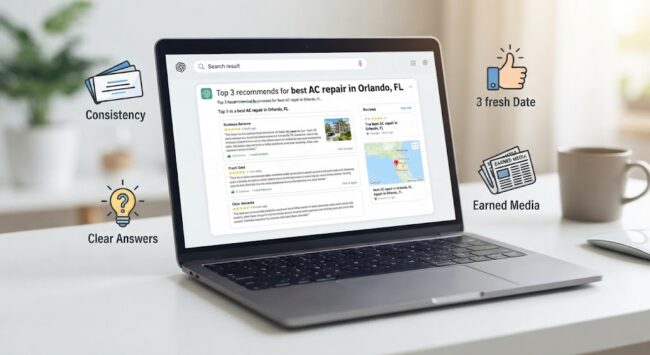
- Consistency. The same business name, address and phone number appearing across several independent, credible sites.
- Context. Coverage that explains what the business does, who runs it and how it fits into the Florida economy, not just a directory listing.
- Category authority. Coverage from publishers dedicated to that industry in that state.
This is where the “two wrappers” idea comes from.
The two-wrapper strategy for Florida businesses
A Florida business that wants to be surfaced by these models should be wrapped in two layers of authoritative content.
Wrapper 1: Florida business news. Coverage on statewide and regional business publications establishes that the company is a real, operating Florida enterprise with a track record. This is the geographic layer.
Wrapper 2: Florida industry news. Coverage on a vertical publication such as FloridaLawFirmNews.com or FloridaMedicalNews.com establishes the company inside its profession. This is the professional layer, and it matches exactly how the models themselves are being organized.
A law firm covered on both a Tampa Bay business site and a Florida legal news site has given a Florida legal model everything it needs: geography, industry, consistency and context. A firm with only a website and a Google listing has given it very little.
What businesses should do now
- Confirm your name, address and phone number are identical everywhere you appear.
- Get covered in at least one Florida business publication and one Florida industry publication.
- Make sure that coverage includes substance: leadership, services, history, milestones.
- Refresh it. Models weight recency; a 2019 profile is a weak signal in 2026.
Are there services designed to target these models?
Yes. Most marketing agencies still optimize for Google’s ten blue links: keywords, backlinks, page speed. Answer engines work differently. They retrieve, cross-check and synthesize, and they reward businesses that appear consistently in credible, topic-specific sources. Very few services are built around that.
The Florida Authority Network is one that is. It was designed specifically to place Florida businesses in both wrappers at the same time.
How the network maps to the two layers
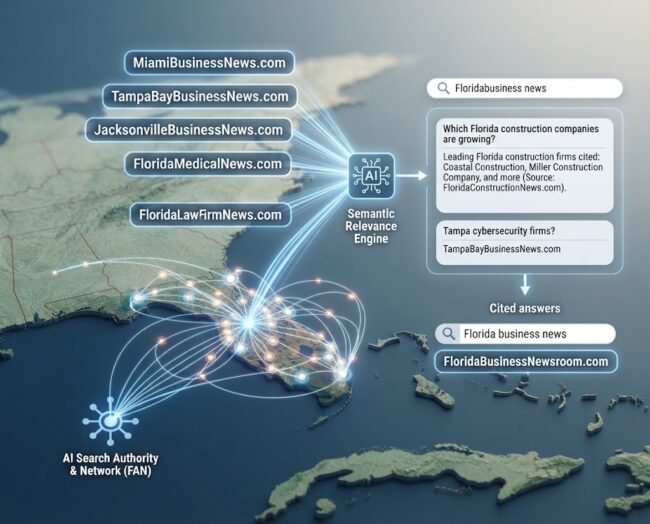
The network operates 35 Florida-focused publications, and its structure mirrors the way specialized models are being organized.
The geographic layer is covered by 13 city and regional business news sites, including MiamiBusinessNews.com, TampaBayBusinessNews.com and JacksonvilleBusinessNews.com, plus a set of statewide Florida business titles. A profile on a regional site places a company inside its local economy.
The professional layer is covered by roughly a dozen industry verticals: FloridaLawFirmNews.com, FloridaMedicalNews.com, FloridaTechnologyNews.com, FlFinancialNews.com and titles in real estate, tourism and home services. A profile on a vertical site places the same company inside its profession.
Press-release brands and video publications round out the network, giving a business several independent, indexable points of coverage rather than one.
What a placement actually looks like
A typical client engagement produces four to five business profiles across the network: one or two on regional business sites, one or two on the relevant industry site, and one in the Florida Business Index on FlBusinessPressReleases.com. Each profile carries identical name, address and phone details, structured schema markup, and a different long-form article summary covering leadership, services and history.
That combination is deliberate. Identical business data across several credible sites is the consensus signal a retrieval model looks for. Different article summaries give the model context it can draw on for different questions. Schema markup makes the facts machine-readable.
| Element | Purpose for AI models |
|---|---|
| 4–5 profiles across sites | Independent confirmation |
| Identical NAP data | Consensus signal |
| Per-page schema | Machine-readable facts |
| Long-form summaries | Context for varied queries |
| Regional + vertical mix | Both wrappers at once |
Human-verified, not auto-generated
Answer engines are increasingly discounting thin, machine-generated pages. Network content follows a “Human Insight + Tech Intelligent Curation” method: technology gathers and structures public data, and a human analyst verifies it and adds judgment before anything is published. That editorial layer is what makes the coverage usable as a trusted source rather than noise.
For more information
Florida businesses interested in placement across both layers of the network can call 813-409-4683.
Brian’s Take
I spent 15 years managing money before I started publishing, and the pattern here is familiar. Generalists get replaced by specialists once a market gets big enough to support them, and AI has crossed that line. The national models will keep improving, but the questions that actually drive commerce in Florida are local and professional: who do I hire, where do I go, who do I trust. Those questions will be answered by models built on Florida-specific, industry-specific sources.
The businesses that win won’t be the ones with the biggest ad budgets. They’ll be the ones that made themselves easy for a specialized model to verify. That means being written about, consistently and credibly, in the two places a Florida industry model will look first: Florida business news and Florida industry news.
Frequently Asked Questions
Will there really be a “Florida LLM”?
Probably not one branded model, but the effect is the same. Models increasingly retrieve from curated knowledge bases, and a Florida knowledge base will serve Florida queries far better than an unfiltered one.
Does this replace SEO?
No. It extends it. Search rankings still matter, but answer engines reward consistent, verifiable coverage across credible sources more than keyword density.
How many placements does a business need?
Consistency across four or five credible Florida sites, spanning both business and industry coverage, is a stronger signal than a single feature.
Are specialized models more accurate?
On their domain, yes. Benchmark authors still note a persistent gap between leaderboard scores and production behavior that only human expert review can close, which is why human-verified sources matter to these systems.
Sources and Further Reading
- Kili Technology, “Domain-Specific LLM Benchmarks: 2026 Vertical AI Map” — https://kili-technology.com/blog/domain-specific-llm-benchmarks-guide
- GMI Cloud, “What Specialized LLM Models Exist for Specific Applications?” — https://www.gmicloud.ai/en/blog/specialized-llm-models-exist
- DigiWagon, “Vertical AI in 2026: Domain-Specific AI Blueprint” — https://digiwagon.com/blogs/vertical-ai-domain-specific-llm-solutions/
- arXiv, “Survey of Specialized Large Language Models” — https://arxiv.org/pdf/2508.19667
- arXiv, “TestAgent: Evaluating LLMs in Vertical Domains” — https://arxiv.org/pdf/2410.11507
About the Author