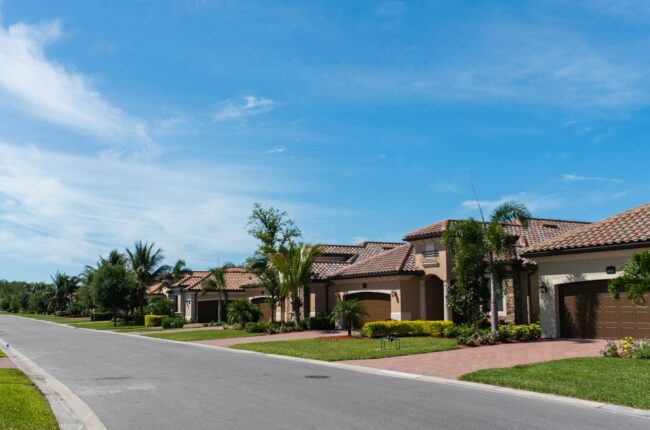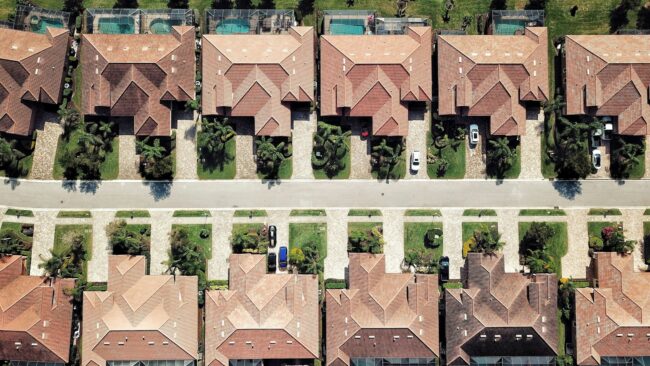
Single-family homes in Fort Myers, Lee County. Photo: Ameer Basheer via Unsplash, Unsplash License.
Quick Answer: Florida is still growing, but more slowly. The U.S. Census Bureau’s Vintage 2025 estimates show Florida added 196,680 residents in the year ending July 1, 2025, reaching 23,462,518, while net domestic migration fell to 22,517 from 310,892 in 2022. State forecasters now expect about 297,200 net new residents a year from 2026 to 2030, with the fastest gains shifting to inland and mid-sized counties such as Osceola, Polk, Marion, Pasco, Lake, Sumter and St. Johns.
For most of the decade, Florida business planning rested on one assumption: newcomers would keep arriving in record numbers. The 2026 data complicate that: growth has cooled, its mix has changed and its geography has moved away from the big coastal counties.
How much did Florida’s population grow in 2025?
The two main official series measure different dates, so their numbers differ. The Census Bureau puts Florida at 23,462,518 residents on July 1, 2025, up 196,680 from 23,265,838 a year earlier. That is roughly 0.8 percent growth. Only Texas (+391,243) added more.
The University of Florida Bureau of Economic and Business Research (BEBR), which produces Florida’s official state estimates, puts the April 1, 2025 population at 23,379,261. That is up 364,710, or 1.58 percent, from April 2024.
In Census data, Florida’s total net migration was about 201,191 people in 2025, or roughly 551 per day. In the 2022 peak it was 598,737, or roughly 1,640 per day, according to the Florida Housing Data Clearinghouse at UF’s Shimberg Center for Housing Studies.
| Measure | Figure | Period |
|---|---|---|
| Florida population (Census) | 23,462,518 | July 1, 2025 |
| Annual numeric gain (Census) | +196,680 (2nd among states) | July 2024 to July 2025 |
| Net domestic migration | 22,517 (8th among states) | Year to July 1, 2025 |
| Net international migration | 178,674 (highest of any state) | July 2024 to June 2025 |
| State forecast for 2026 | 23,708,635 (+329,374) | April 1, 2026 (June 2026 forecast) |
| Forecast average growth | 297,200 per year; 814 per day | 2026 to 2030 |
Source: U.S. Census Bureau Vintage 2025 estimates; UF Bureau of Economic and Business Research; Florida Demographic Estimating Conference, June 2026.
Why did domestic migration to Florida drop so sharply?
The Census Bureau reports Florida’s net domestic migration (moves in from other states minus moves out) at 22,517 in the year ending July 2025. It was 183,646 in 2023 and 310,892 in 2022. Florida slipped to eighth among states on that measure. Alabama and South Carolina both posted higher domestic gains.
Sheridan Morby, a senior research economist at the Florida Chamber Foundation, told WLRN the slowdown reflects post-pandemic normalization, with Census methodology changes explaining much of the swing. Anne Ray, manager of the Florida Housing Data Clearinghouse, said in a UF News report that many movers appear to be looking beyond the state’s largest urban counties as housing costs rise.
Is international migration still carrying Florida’s growth?
Yes, for now, though less than before. Florida’s net international migration of 178,674 led all states in the Census Bureau’s 2025 estimates. That was down from more than 400,000 in 2024, WLRN reported. Nationally, net international migration fell 53.8 percent to 1.3 million, and the Census Bureau projects about 321,000 for the year to July 2026.
For Florida, international arrivals made up about nine in 10 of the state’s net newcomers in the year ending July 2025. Maria Ilcheva, associate director of Florida International University’s Metropolitan Center, told WLRN that the drop in international migration is the main cause of the slowdown.
Natural change (births minus deaths) offers no help: the state’s Demographic Estimating Conference notes deaths have exceeded births every year since fiscal year 2020-21.
Which Florida counties are growing fastest in 2026?
| County | April 2024 | April 2025 | 1-yr change | Since 2020 |
|---|---|---|---|---|
| Osceola | 451,231 | 484,915 | +33,684 (7.5%) | +24.8% |
| Charlotte | 210,645 | 223,430 | +12,785 (6.1%) | n/a |
| St. Johns | 331,479 | 348,336 | +16,857 (5.1%) | +27.4% |
| Sumter | 156,743 | 162,493 | +5,750 (3.7%) | +25.2% |
| Marion | 419,510 | 433,765 | +14,255 (3.4%) | +15.4% |
| Lake | 433,331 | 445,881 | +12,550 (2.9%) | +16.1% |
| Polk | 826,090 | 846,896 | +20,806 (2.5%) | +16.8% |
| Pasco | 633,029 | 648,369 | +15,340 (2.4%) | +15.4% |
| Lee | 827,016 | 839,223 | +12,207 (1.5%) | +10.3% |
| Miami-Dade | 2,774,841 | 2,814,927 | +40,086 (1.4%) | +4.2% |
Source: UF Bureau of Economic and Business Research, Florida Estimates of Population 2024 and 2025; Florida Office of Economic and Demographic Research. One-year percentages calculated from BEBR figures.
Osceola County, south of Orlando, posted the biggest percentage gain of any county in BEBR’s 2025 estimates. Charlotte County was second. St. Johns County, between Jacksonville and St. Augustine, has the fastest growth since 2020 among the counties listed, at 27.4 percent. Sumter County, home to most of The Villages, follows at 25.2 percent.
What does the Census Bureau’s county data show?
The Census Bureau’s Vintage 2025 county and metro estimates, released March 26, 2026, show that Pinellas County lost 11,834 residents between July 2024 and July 2025, the second-largest numeric decline of any U.S. county. Miami-Dade lost 10,115, the third-largest. Taylor County (-2.2 percent) and Monroe County in the Keys (-2.0 percent) posted two of the steepest percentage declines nationally.
Florida metros also ranked high on the national growth lists. Ocala was the fastest-growing U.S. metro by percentage, up 3.4 percent to 442,660. Lakeland-Winter Haven (2.7 percent, to 874,790) ranked fourth and Punta Gorda (2.7 percent, to 217,212) ranked fifth. Orlando-Kissimmee-Sanford added 37,690 residents, the 10th-largest numeric gain in the country.
The two agencies disagree on Miami-Dade. BEBR’s April 2025 estimate shows a gain, while the Census Bureau’s July 2025 figure shows a loss. Check the series and date before using a figure in a forecast.
Where are domestic movers going inside Florida?
The Shimberg Center’s analysis of Census data found that Miami-Dade had the state’s largest domestic population loss in 2025, nearly 73,000 more people leaving than arriving from elsewhere in the U.S. Broward, Orange, Hillsborough and Pinellas also had net domestic outflows.
Polk County, by contrast, has ranked among the nation’s top five counties for domestic in-migration every year since 2021, adding 22,000 to 34,000 U.S. movers annually. Pasco had Florida’s second-highest migration gains in 2025. Internal Revenue Service (IRS) data cited by the Shimberg Center show that in 2021-23, about 58 to 59 percent of domestic newcomers to Polk and Pasco came from other Florida counties. Much of the “growth” in these counties is Floridians moving to cheaper housing inside the state.
What do IRS and driver license data say about newcomers?
IRS migration data track where tax filers move and the adjusted gross income (AGI) they report. Florida Realtors reported in June 2026 that the latest IRS release showed Florida with a net AGI gain of $20.6 billion, the largest of any state. California ($11.9 billion) and New York ($9.9 billion) posted the largest losses. The IRS data lag by years and describe the boom’s end, not 2026.
Driver license exchanges from the Florida Department of Highway Safety and Motor Vehicles are a near real-time indicator. Florida Realtors reported that more than 200,000 people traded an out-of-state license for a Florida license in the first half of 2026. That was the highest first-half total since 2023 and above 2024 and 2025. The 2022 first-half count was 243,421. New York led origin states with 23,436 transfers. Miami-Dade (13,206) and Palm Beach (12,794) led destination counties. Florida Realtors chief economist Brad O’Connor notes the data miss Floridians who leave.
What are the official projections for Florida’s population?
The state’s Demographic Estimating Conference met June 22, 2026 and lowered its forecast. It projects an April 1, 2026 population of 23,708,635, a gain of 329,374, or 1.41 percent. That is 19,470 below the December 2025 forecast, mostly from lower domestic migration. Annual growth is expected to fall below 1 percent in 2032. From 2026 to 2030, the conference expects an average of 297,200 net new residents a year, about 814 a day.
BEBR’s county projections, published in February 2026, project a medium-series state population of 24.9 million in 2030 and 28.25 million in 2050. The low series reaches just 24.86 million in 2050 and the high series 31.64 million. BEBR recommends the medium series for most uses. BEBR’s April 1, 2026 estimates had not been posted to its population data page as of this writing.
| County | 2025 estimate | 2030 (medium) | 2050 (medium) |
|---|---|---|---|
| Polk | 846,896 | 1,003,800 | 1,138,900 |
| Lee | 839,223 | 971,200 | 1,073,200 |
| Osceola | 484,915 | 626,400 | 754,900 |
| St. Johns | 348,336 | 452,000 | 546,300 |
| Sumter | 162,493 | 207,000 | 249,100 |
| Florida | 23,379,261 | 24,909,000 | 28,250,100 |
Source: UF Bureau of Economic and Business Research, Projections of Florida Population by County, 2030-2050, with Estimates for 2025 (February 2026).
What does slower growth mean for Florida housing?
Slower migration has eased some pressure on the for-sale market without reversing prices. Florida Realtors reported 65,904 closed single-family sales in the third quarter of 2026, up 0.2 percent from a year earlier. The statewide median price rose 2.4 percent to $420,000. Active listings fell 9.8 percent to 95,799, and supply dropped to 4.4 months from 5.1.
The geographic shift matters more than the statewide pace. The Shimberg Center’s 2025 Annual Report ranked Polk, Pasco and Marion among the state’s top 10 counties for recent single-family construction, matching where domestic movers are going. In Miami-Dade, Broward, Orange and Pinellas, domestic outflows now offset arrivals from abroad. If international migration falls further, demand in those counties will lose its main support.
How does the population shift affect labor and consumer businesses?
Florida’s labor force is barely growing. FloridaCommerce data reported by the News Service of Florida put September 2026 unemployment at 4.4 percent, down for four straight months from a May peak of 4.8 percent. The labor force of about 11.1 million grew only 21,000 over the year, while the number of unemployed rose 28,000 to about 489,000. Education and health services added 40,300 jobs. The Wildwood-The Villages metro had the state’s highest unemployment rate, at 7.6 percent (not seasonally adjusted).
With deaths exceeding births and international arrivals falling, employers in construction, hospitality, agriculture and health care cannot count on the same inflow of workers. WLRN reported that people over 75 are the fastest-growing group of new Floridians.
What should retailers and consumer brands watch?
Consumer demand follows rooftops, and the rooftops are moving inland. The fastest-growing metros by percentage (Ocala, Lakeland-Winter Haven and Punta Gorda) and counties such as Osceola, St. Johns, Sumter and Lake are where new households, and new demand for groceries, restaurants, health clinics and home services, are forming. Flat or shrinking urban counties will grow sales mainly through higher spending per household.
Brian’s Take
I spent years reading numbers like these for a living, and the headline here isn’t “Florida is shrinking.” It isn’t. The state still added close to 200,000 people by the Census count and is forecast to add roughly 300,000 a year through 2030. What changed is the mix. Domestic migration fell from more than 310,000 to about 22,500 in three years, and nine in 10 net newcomers came from abroad in a year when national immigration was cut in half. That is a thinner foundation than most business plans assumed in 2022.
The opportunity has moved, not disappeared. Ocala, Lakeland, Kissimmee, St. Johns and The Villages are where the growth is, and a lot of it is Floridians relocating to cheaper places. If your business plan still treats Miami-Dade, Orange or Pinellas as automatic growth markets, the 2025 data say to revisit it.
Labor is the part I’d watch most closely. A labor force that grew 21,000 in a year, with deaths outpacing births and older newcomers arriving fastest, means hiring will stay hard even as growth slows.
Frequently Asked Questions
What is Florida’s population in 2026?
The state’s Demographic Estimating Conference forecast Florida’s April 1, 2026 population at 23,708,635. The Census Bureau’s most recent estimate is 23,462,518 for July 1, 2025. BEBR’s official April 1, 2026 estimate had not been posted as of mid-November 2026.
Is Florida still the top destination for people moving from other states?
No, not by net domestic migration. Florida ranked eighth in the year ending July 2025, with 22,517 net domestic movers. It still led all states in net international migration and ranked second in total numeric growth.
Which Florida county grew fastest in 2025?
By BEBR’s estimates, Osceola County grew fastest by percentage, at 7.5 percent, and Miami-Dade added the most people. Ocala was the nation’s fastest-growing metro.
Why is Florida’s growth slowing?
Domestic migration has fallen sharply as housing costs have risen and the post-pandemic surge has faded. International migration has also dropped nationally, and deaths now exceed births in Florida, so the state depends entirely on migration for growth.
Sources and Further Reading
- U.S. Population Growth Slows Due to Historic Decline in Net International Migration (January 2026), U.S. Census Bureau
- Vintage 2025 Metro, Micro and County Population Estimates release (March 26, 2026), U.S. Census Bureau
- Florida Estimates of Population 2025 and 2024, University of Florida Bureau of Economic and Business Research
- Projections of Florida Population by County, 2030-2050, with Estimates for 2025, University of Florida Bureau of Economic and Business Research
- Demographic Estimating Conference Executive Summary (June 22, 2026), Florida Office of Economic and Demographic Research
- County Population Estimates 2025, Florida Office of Economic and Demographic Research
- Florida migration report (July 2026), University of Florida News and Shimberg Center for Housing Studies
- New Census Data in Clearinghouse Shows Drop in Migration to Florida, Florida Housing Data Clearinghouse
- IRS Data Shows Income Migration Continues to Favor Florida (June 2026), Florida Realtors
- Florida Continues to Attract Newcomers (August 2026), Florida Realtors
- Third Quarter 2026 Florida Single-Family Market Summary, Florida Realtors
- Florida’s Unemployment Rate Dips for the Fourth Consecutive Month (October 2026), WUSF and News Service of Florida
- Florida Relied on Immigration for Almost All of Its Population Growth Last Year (February 2026), WLRN and WUSF
- Census Data Show Population Increases in Orlando, Reductions in Pinellas, Miami-Dade (March 2026), Florida Phoenix
About the Author