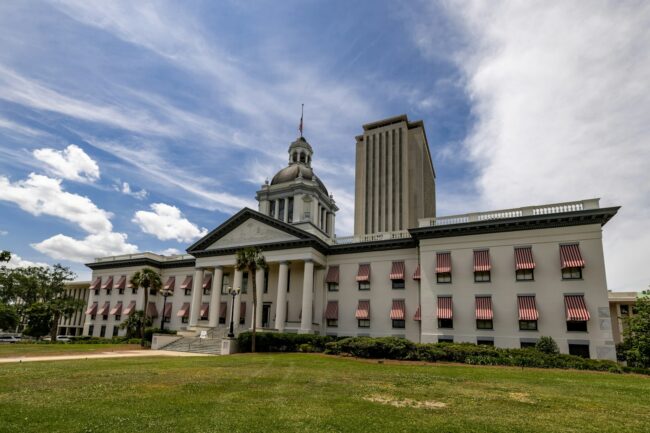
The Old Florida Capitol with the New Capitol in the background, Tallahassee. Photo: Civil10, via Wikimedia Commons. CC0 1.0 public domain dedication.
Quick Answer: Florida’s 2026 Long-Range Financial Outlook, adopted September 11, 2026, projects a General Revenue surplus of $7.1 billion in fiscal 2027-28 and $3.4 billion in 2028-29, then a deficit of just over $1.0 billion in 2029-30. General Revenue is forecast to grow less than 1% in 2026-27, from $51.9 billion to $52.3 billion.
Every September, Florida’s Legislative Budget Commission adopts a Long-Range Financial Outlook that projects whether the state’s main operating account, General Revenue, can cover expected spending over the next three years. The 2026 edition, built on the August 14, 2026 General Revenue Estimating Conference, shows a state with large reserves today, slowing revenue growth and a narrowing cushion by the end of the decade.
For Florida businesses, the outlook matters because General Revenue funds much of the state’s spending on education, Medicaid, infrastructure-related programs and public safety, and because the state’s tax policy choices, from corporate income tax to sales tax holidays, are made within these limits. This report summarizes the official numbers from the Office of Economic and Demographic Research (EDR) and the Legislature’s outlook document.
What does Florida’s 2026 Long-Range Financial Outlook project?
The outlook covers fiscal years 2027-28 through 2029-30. It starts with the revenue estimate, adds the unused balance carried forward from the prior year, sets aside a minimum reserve, then subtracts the recurring base budget and projected spending “drivers,” before adjusting for tax changes, trust fund transfers and revenue adjustments that assume recent legislative patterns continue.
| General Revenue ($ millions) | FY 2027-28 | FY 2028-29 | FY 2029-30 |
|---|---|---|---|
| Revenues available | 53,455 | 54,782 | 56,011 |
| Unused reserve from prior year | 10,890 | 9,220 | 5,497 |
| Minimum reserve | (2,085) | (2,137) | (2,184) |
| Recurring base budget | (49,105) | (51,275) | (53,208) |
| Previously authorized appropriations | (342) | (344) | (345) |
| Critical Needs drivers | (1,906) | (2,728) | (2,271) |
| Other High Priority Needs drivers | (3,333) | (3,304) | (3,254) |
| Ending balance after expenditures | 7,575 | 4,215 | 246 |
| Tax and fee changes | (673) | (1,150) | (1,628) |
| Trust fund transfers and redirects | 233 | 295 | 358 |
| Revenue adjustments | (440) | (855) | (1,270) |
| Projected surplus / (deficit) | 7,135 | 3,360 | (1,025) |
Source: 2026 State of Florida Long-Range Financial Outlook, as adopted by the Legislative Budget Commission, September 11, 2026.
How does this compare with last year’s outlook?
The 2026 outlook is considerably better than the 2025 version for the overlapping years. The 2025 outlook projected a $1.5 billion deficit for fiscal 2027-28; the new outlook projects a $7.1 billion surplus for the same year. For 2028-29, the 2025 outlook projected a $6.6 billion deficit; the new one projects a $3.4 billion surplus. The third year, 2029-30, shows a deficit of just over $1.0 billion.
Two forces explain most of the improvement: a larger starting balance carried forward from strong collections, and a smaller set of projected spending drivers. Total drivers over three years come to $16.8 billion, which the outlook says is 17.4% lower than the $20.3 billion in the prior year’s outlook.
What assumptions sit behind the numbers?
The outlook keeps a minimum reserve of 3.9% of the revenue estimate each year. It does not account for any new or expanded programs. Its “tax and fee changes” and “revenue adjustments” lines assume that lawmakers will continue cutting taxes and making revenue-related changes at roughly the scale of recent sessions, which is why those lines grow larger each year, reaching a combined $2.9 billion reduction in 2029-30.
How much General Revenue will Florida collect?
EDR’s August 14, 2026 financial outlook statement shows General Revenue of $51.857 billion for fiscal 2025-26 and a forecast of $52.340 billion for 2026-27, a gain of about 0.9%. Growth then picks up to roughly 2% to 2.7% a year through 2031-32.
| Fiscal year | General Revenue ($ millions) | Growth |
|---|---|---|
| 2025-26 (revenues) | 51,857.1 | — |
| 2026-27 (estimate) | 52,339.9 | +0.9% |
| 2027-28 | 53,289.6 | +1.8% |
| 2028-29 | 54,616.8 | +2.5% |
| 2029-30 | 55,846.1 | +2.3% |
| 2030-31 | 57,315.3 | +2.6% |
| 2031-32 | 58,849.4 | +2.7% |
Source: EDR General Revenue Financial Outlook Statement, August 14, 2026. Growth rates calculated from reported totals.
The same statement shows fiscal 2025-26 ending with a General Revenue balance of $13.33 billion after effective appropriations of $54.05 billion. For 2026-27, effective appropriations of $54.92 billion exceed estimated revenue, and the unallocated balance is projected at $11.05 billion at year-end. In other words, the state is currently spending more than it collects in a year and drawing on its accumulated balance to do so.
Which taxes are running above or below forecast?
Fiscal 2025-26 General Revenue collections came in $869.6 million, or 1.7%, above the January 2026 estimate. In August, the estimating conference raised its forecast by $475.1 million for 2026-27 and $508.0 million for 2027-28, a two-year increase of $983.1 million, less than 1%.
| Revenue source | Change to forecast, FY 2026-27 | Change to forecast, FY 2027-28 |
|---|---|---|
| Corporate income tax | +$527.2M | +$439.0M |
| Sales tax | +$183.5M | +$93.8M |
| Insurance premium tax | -$594.9M over the two years combined | |
| Total General Revenue | +$475.1M | +$508.0M |
Source: 2026 Long-Range Financial Outlook, summary of the August 2026 General Revenue Estimating Conference.
Corporate income tax produced the largest upward revision, $966.2 million over two years. Sales tax ended fiscal 2025-26 virtually on estimate, helped by a strong July. Sales tax, documentary stamp tax and earnings on investments each gained more than $230 million over the two years.
The only material reduction came from the insurance premium tax, down $594.9 million over two years, reflecting slowing growth in calendar 2025 premiums, especially for homeowners and auto coverage. That is a business signal in its own right: after years of rapid rate increases, Florida’s property and auto insurance premium growth is cooling.
What spending is driving the outlook?
The outlook identifies 15 Critical Needs drivers and 28 Other High Priority Needs drivers. Critical Needs total $6.9 billion over three years, or 41.1% of all drivers; Other High Priority Needs total $9.9 billion. Just over half, 50.6%, of the three-year need is recurring, and the outlook puts the cumulative cost over three years at almost $23.1 billion.
| Selected drivers ($ millions) | FY 2027-28 | FY 2028-29 | FY 2029-30 |
|---|---|---|---|
| State employee benefits (driver 15) | 947.5 | 1,142.8 | 1,321.0 |
| Medicaid (driver 6) | 1,210.0 | 789.3 | 438.0 |
| Transfer to Emergency Preparedness and Response Fund (driver 13) | 533.3 | 533.3 | 533.3 |
| All drivers combined | 5,239.0 | 6,031.4 | 5,525.1 |
Source: 2026 Long-Range Financial Outlook.
By policy area, the largest three-year totals are Administered Funds and Statewide Issues at $6.50 billion, Human Services at $4.69 billion, Natural Resources at $2.70 billion and Higher Education at $1.91 billion. PreK-12 Education shows a net reduction of $764.2 million in General Revenue need over the period.
Why is the state employee health plan a pressure point?
The State Group Health Insurance program, a $4.9 billion program with more than 390,000 members, is one of the outlook’s fastest-growing costs. Expenses are growing about 8.5% a year. Without changes, the trust fund’s projected ending cash goes negative: a shortfall of $62.2 million in 2026-27, $1.016 billion in 2027-28, $1.392 billion in 2028-29 and $1.795 billion in 2029-30. The outlook notes prior premium increases of 10% in fiscal 2024-25 and 9% in 2025-26, $1.4 billion in nonrecurring General Revenue transfers over five years, and that a formulary management bill, HB 5015, was vetoed.
For employers, the state’s experience mirrors what many private companies report: health benefit costs rising well faster than revenue.
How was the 2027-28 starting balance calculated?
The outlook begins with the $11.05 billion General Revenue balance projected at the end of fiscal 2026-27 and adjusts it for $151.2 million in additional costs already identified for the current year. Those include $74.9 million for Medicaid, $62.2 million for state employee health insurance, $12.3 million for Kidcare and $1.8 million for veterans programs. The result is the $10.89 billion “unused reserve” that carries into 2027-28 in the summary table.
The outlook also counts trust fund money available as nonrecurring resources in 2027-28, including $318.9 million from the Educational Enhancement Trust Fund and $434.0 million from the State School Trust Fund, which receives unclaimed property. Abandoned property deposits into that fund are projected at $413.9 million in 2026-27 and $602.1 million in 2027-28.
How large are Florida’s reserves?
According to EDR’s August statement, the Budget Stabilization Fund, the state’s constitutional rainy-day fund, held $4.870 billion in cash, including a $429.6 million General Revenue transfer in fiscal 2025-26 and $1.056 billion in Lawton Chiles Endowment transfers from 2021-22 through 2025-26. The statement says required transfers for 2026-27 through 2030-31 will not be needed.
The statement also describes HJR 5019, a proposed constitutional amendment that would raise the Budget Stabilization Fund cap from 10% to 25% of net General Revenue collections, with an annual transfer of $750 million or the amount needed to reach the cap. It required approval by 60% of voters and, if adopted, would take effect January 12, 2027.
What other obligations affect the balance?
- Debt reduction: HB 5017 (Chapter 2025-207) set a $250 million recurring transfer for debt reduction beginning in fiscal 2025-26.
- Reinsurance: HB 5013 reduced cumulative transfers for the Reinsurance Assistance Program from $2 billion to $900 million; $818.9 million had been transferred, with an $86.1 million contingency reserve.
- Emergency fund: A $240 million transfer to the Emergency Preparedness and Response Fund, approved September 11, 2026, would reduce the starting balance for 2027-28 from $10.89 billion to $10.65 billion.
- Deepwater Horizon: The state receives $26.7 million a year in settlement payments, $2.0 billion in total from 2016-17 through 2032-33.
What do other state revenue sources show?
The outlook also tracks revenue that flows to education trust funds rather than General Revenue. Lottery sales were $9.713 billion in fiscal 2025-26, $98.4 million, or 1.0%, below estimate; transfers to the Educational Enhancement Trust Fund are projected at $2.25 billion in 2026-27, rising to $2.36 billion by 2029-30. Slot machine tax collections were $247.9 million, slightly below estimate, after a rate cut from 35% to 34%.
On property values, the 2026 preliminary school taxable value roll was $3.966 trillion. The outlook projects $4.144 trillion for 2027, a downward revision of $45.3 billion, or 1.08%, from the prior forecast, followed by annual growth of 5.3% to 6.3% through 2030. One mill of school property tax is worth about $3.98 billion in 2027.
| FY 2025-26 General Revenue | $51.86 billion ($869.6M above January estimate) |
| FY 2026-27 General Revenue forecast | $52.34 billion |
| Projected 2027-28 surplus | $7.1 billion |
| Projected 2029-30 result | Deficit of just over $1.0 billion |
| Budget Stabilization Fund cash | $4.87 billion (August 2026 statement) |
| Minimum reserve policy | 3.9% of revenue estimate |
| 2027 school taxable value forecast | $4.144 trillion |
Key facts compiled from EDR and the 2026 Long-Range Financial Outlook.
What does the outlook mean for Florida businesses?
Tax relief has room, but the room is shrinking. The surplus in the first two years gives lawmakers flexibility for tax changes in the 2027 session. But the outlook already assumes tax cuts continue at recent scale, and even with that assumption, the third year turns negative. Larger permanent cuts would push the deficit earlier.
Corporate income tax is outperforming. The $966.2 million two-year upward revision to corporate income tax shows corporate tax receipts running well ahead of earlier expectations, which also makes the tax a likely subject of policy debate.
Insurance markets are cooling. The downward revision to insurance premium tax collections reflects slower premium growth in homeowners and auto lines, an early signal of stabilization in a cost that has weighed on Florida employers and households.
Property tax bases keep growing, but more slowly than forecast. The 1.08% downward revision to 2027 school taxable value shows property value growth slowing in the near term, even as values are still projected to rise.
Frequently Asked Questions
Does Florida have a budget surplus?
The 2026 Long-Range Financial Outlook projects General Revenue surpluses of $7.1 billion in fiscal 2027-28 and $3.4 billion in 2028-29, followed by a deficit of just over $1.0 billion in 2029-30.
How much General Revenue does Florida expect in 2026-27?
EDR’s August 2026 forecast puts 2026-27 General Revenue at $52.34 billion, up about 0.9% from $51.86 billion in 2025-26.
Which Florida taxes are beating forecasts?
Corporate income tax had the largest upward revision, $966.2 million over two years. Sales tax, documentary stamp tax and investment earnings also rose. Insurance premium tax was revised down by $594.9 million.
How much is in Florida’s rainy-day fund?
EDR’s August 2026 statement shows the Budget Stabilization Fund with $4.87 billion in cash.
When was the 2026 Long-Range Financial Outlook adopted?
The Legislative Budget Commission adopted the outlook on September 11, 2026. It covers fiscal years 2027-28 through 2029-30.
Sources and Further Reading
- 2026 State of Florida Long-Range Financial Outlook, Fall 2026 Report (Florida Legislature, Legislative Budget Commission)
- General Revenue Financial Outlook Statement, August 14, 2026 (Florida Office of Economic and Demographic Research)
- The Old Florida Capitol, Tallahassee, photograph (Wikimedia Commons)
About the Author