By Brian B. French
The promise of autonomous vehicles has always rested on a compelling premise: computers don’t get drunk, distracted, or drowsy. They don’t road rage, text while driving, or fall asleep at the wheel. In theory, self-driving cars should easily surpass human drivers in safety. Yet despite this logical advantage, autonomous vehicles face a paradox that threatens their commercial viability: they must be not just better than human drivers, but dramatically, almost impossibly better.
The reason isn’t technical—it’s legal.
The Asymmetry of Accountability
When a human driver causes an accident, our legal system has spent more than a century developing efficient mechanisms to handle the aftermath. Insurance companies assess fault, pay out claims within established parameters, and move on. Even in cases of gross negligence, the financial liability is bounded by the assets of an individual driver and their insurance policy limits. The system, for all its flaws, functions smoothly because it’s designed around the assumption of human fallibility.
But when an autonomous vehicle causes an accident, everything changes. Suddenly, the defendant isn’t an individual with limited means—it’s a corporation worth billions, armed with technology it has publicly proclaimed as revolutionary and safer than human judgment. The legal landscape shifts from routine insurance claims to high-stakes litigation, with plaintiff attorneys seeing not just compensation for victims, but an opportunity to hold deep-pocketed tech companies accountable for their bold promises.
This creates a profound asymmetry. A human driver who kills someone in a tragic accident might face a wrongful death suit capped by policy limits and personal assets—often resulting in settlements in the hundreds of thousands or low millions of dollars. A self-driving car that kills someone in the same circumstances exposes its manufacturer to potentially tens or hundreds of millions in damages, punitive awards, and the reputational destruction that comes from headlines screaming that their “revolutionary technology” failed catastrophically.
The Unknowable Standard
What makes this challenge particularly acute is that we don’t yet know where the legal bar will ultimately be set. Our roads present thousands of low-probability, high-complexity scenarios every year—scenarios that haven’t yet been tested in court with autonomous vehicles as defendants.
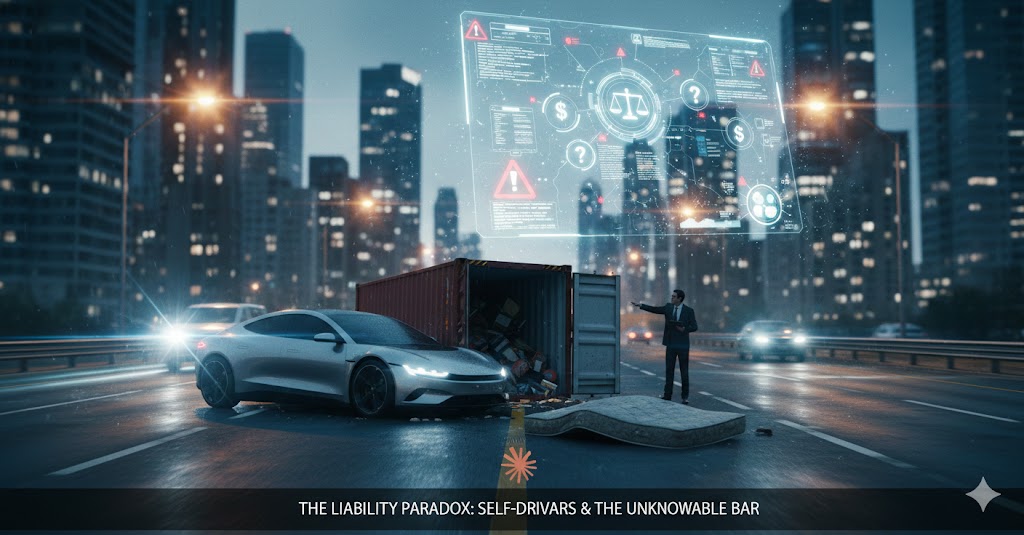
Consider a few examples: A mattress flies off a pickup truck on the highway, giving an autonomous vehicle milliseconds to react. Does the car swerve into another lane, potentially causing a multi-car pileup? Does it brake hard, risking a rear-end collision? Does it maintain course and collide with the mattress, possibly injuring passengers? When a human driver makes a split-second decision in such circumstances, we generally accept their judgment as reasonable unless it was grossly negligent. But when a computer algorithm makes the same choice, every line of code becomes evidence, every programming decision becomes scrutinized, and the company’s entire development process becomes subject to discovery.
Or consider weather conditions that create blinding glare or whiteout conditions. Human drivers slow down, pull over, or proceed cautiously based on instinct and experience. If they misjudge and cause an accident, it’s typically handled as an unfortunate consequence of difficult conditions. But if an autonomous vehicle’s sensors fail to properly detect a hazard in similar conditions, the manufacturer faces questions about whether the technology was truly ready for deployment, whether testing was adequate, and whether the marketing claims about safety were fraudulent.
Animal strikes present another murky area. A deer jumps into the road—does the autonomous system swerve and risk hitting a cyclist, or maintain course and strike the animal, potentially killing passengers when it crashes through the windshield? Whatever choice the algorithm makes will be dissected in court, with expert witnesses debating whether alternative programming could have prevented the tragedy.
Death by a Thousand Edge Cases
The fundamental challenge is that road travel involves an almost infinite variety of edge cases. Most trips are routine, but every year produces thousands of bizarre, unpredictable situations. Until autonomous vehicles encounter these scenarios in the real world and the resulting litigation works its way through the courts, manufacturers cannot know what standard they’ll be held to.
Will judges and juries accept that autonomous vehicles, like human drivers, must make imperfect decisions in impossible situations? Or will they hold manufacturers to a standard of near-perfection, reasoning that if the technology wasn’t ready to handle rare-but-foreseeable scenarios, it shouldn’t have been deployed at all?
The answer will likely vary by jurisdiction, judge, and the specific facts of each case. This uncertainty means that every serious accident involving an autonomous vehicle becomes a multi-million-dollar gamble for manufacturers, even when their technology performed better than a human likely would have in the same circumstances.
The Commercial Viability Question
This brings us to the core issue: we don’t yet know how safe autonomous vehicles must be to survive commercially in our legal environment. If they need to be merely better than the average human driver—who causes an accident roughly once every 300,000 miles—that may be achievable. But if litigation losses and reputational damage require them to be ten times safer, or a hundred times safer, the path to profitability becomes much longer and more uncertain.
Early autonomous vehicle companies may face years or decades of massive litigation expenses as courts establish precedents. Even if they eventually prevail in most cases, the cost of defending against aggressive plaintiff attorneys, the occasional massive jury verdict, and the drumbeat of negative publicity may prove economically unsustainable. Insurance companies pricing coverage for autonomous vehicle manufacturers face similar uncertainty, potentially charging premiums so high they undermine the business model.
The Efficiency of Familiarity
Perhaps the most frustrating aspect of this paradox is that our legal system’s efficiency in handling human error isn’t necessarily because we’ve concluded that human drivers are acceptable—it’s because we’re accustomed to them. We’ve built an entire infrastructure of insurance, litigation, and regulation around human imperfection. We accept roughly 40,000 traffic deaths per year in the United States because we’ve always accepted roughly that many deaths. It’s normalized, priced in, and handled through established channels.
Autonomous vehicles, by contrast, represent the unfamiliar. Even if they prove safer than humans in aggregate, every failure will be scrutinized as a potential systemic flaw. Every death will prompt questions about whether the technology should have been deployed at all. And critically, every accident presents an opportunity for litigation that can pierce the corporate veil and reach the vast assets of technology companies in a way that litigation against individual drivers simply cannot.
The Path Forward
Until our legal system develops a mature body of case law around autonomous vehicle liability—a process that will take decades and countless court battles—manufacturers operate in a fog of uncertainty. They must not only build technology that’s genuinely safer than human drivers, but technology that’s safe enough to survive the financial and reputational consequences of inevitable failures, as scrutinized by juries, judges, and media who hold them to an evolving and unknown standard.
This is the true barrier to commercial viability: not the technology itself, but the asymmetry between how our society treats human error versus corporate failure. Until autonomous vehicles have weathered the storm of litigation and emerged with a clear understanding of their legal obligations and exposure, the companies developing them are making what amounts to a trillion-dollar bet on how forgiving our legal system will ultimately prove to be.
The irony is bitter. The technology that could save tens of thousands of lives per year may be held back not because it isn’t safe enough, but because it isn’t safe enough to overcome a legal and cultural double standard that we’ve never required of human drivers. We’ve designed a system that efficiently manages human imperfection while making corporate imperfection prohibitively expensive—and in doing so, we may be ensuring that the perfect remains the enemy of the good for generations to come.
About the Author