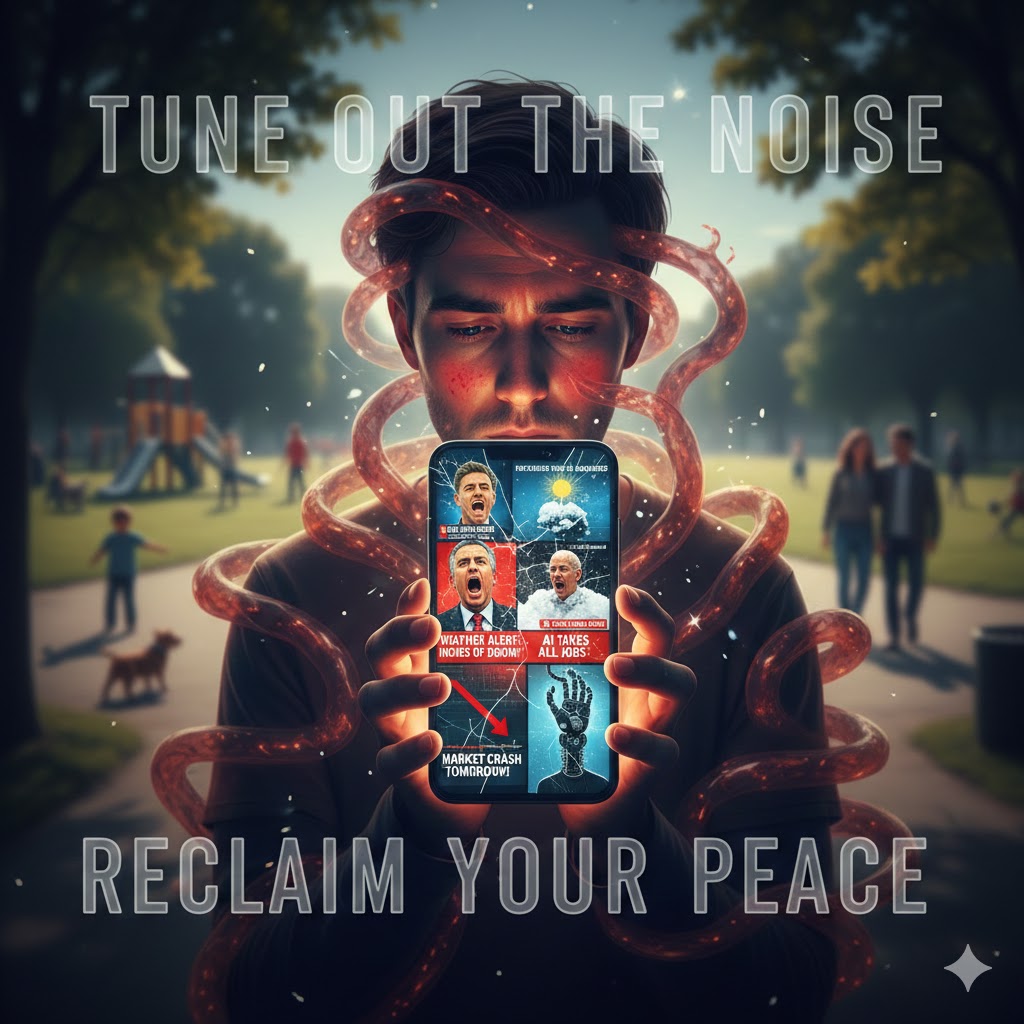
The Outrage Industry: How We’re Being Sold Toxicity
The Business Model of Manufactured Crisis
We live in an age of manufactured crisis. Every day brings a new emergency, a fresh catastrophe, an unprecedented disaster demanding our immediate attention. The truth is far more mundane: most people navigate ordinary days—work, family, bills, the unremarkable challenges of being human. But there’s no money in ordinary, no clicks in calm, no ratings in reasonable. So we’ve built an entire industry around convincing us that the sky is perpetually falling.
The outrage industry operates on a simple principle: your attention is valuable, and fear is the most efficient way to capture it. Whether it’s news networks, social media platforms, political organizations, or financial commentators, the business model is identical—keep you watching, scrolling, donating, and sharing by convincing you that this moment, right now, is uniquely terrible.
Political Theater: When Every Election Becomes Armageddon
Politics has perfected this art form. Every election cycle becomes an apocalyptic struggle between good and evil, with one side cast as saviors and the other as existential threats. Nuance is discarded for hyperbole. Compromise becomes betrayal. The opposition isn’t just wrong—they’re monsters, fascists, communists, or whatever historical villain seems most inflammatory. The exaggerations know no bounds because measured disagreement doesn’t drive fundraising emails or viral tweets.
News networks don’t simply report on opposing viewpoints—they feature them for hours, carefully selecting the most extreme representatives to parade before their audience. The goal isn’t understanding; it’s provocation. Viewers are meant to feel angry, threatened, superior, vindicated. Each segment is engineered to elevate blood pressure and reinforce tribal loyalties. The network becomes a funhouse mirror, distorting reality to keep you angry enough to keep watching.
Weather Apocalypse: How Snow Became a National Emergency
Even the weather has been weaponized for drama. A winter storm that previous generations handled with snow shovels and common sense now triggers wall-to-wall “weather alert” coverage, complete with reporters standing in blizzards to demonstrate that yes, snow is indeed falling. Ten inches of snow in the Northeast—a region that has experienced winter since the glaciers receded—becomes grounds for interviews with FEMA officials and breathless speculation about supply chain disruptions. The Weather Channel brands and names winter storms like blockbuster movies, complete with promotional graphics and ominous music.
Economic Doomsday: The Crash That’s Always Coming Tomorrow
Economics journalism follows the same playbook. The market crash is always imminent. The recession is always just around the corner. AI will eliminate everyone’s job in three years. Crypto will either make everyone rich or destroy the financial system—possibly both simultaneously. These aren’t sober assessments of risk; they’re attention-getting headlines designed to make you click, watch, and worry. The constant drumbeat of imminent catastrophe serves the outrage merchants, not the truth.
The Health Cost of Constant Crisis
Living in constant outrage, fear, or heightened alertness has real physiological consequences. Your body responds to perceived threats by releasing cortisol and adrenaline, hormones designed for short-term survival. But when the threats never stop coming, your body remains in chronic stress. Prolonged cortisol elevation is linked to weakened immune function, increased inflammation, cardiovascular problems, anxiety, depression, and cognitive impairment. We’re literally making ourselves sick by consuming a steady diet of outrage.
The cruel irony? The entities profiting from your fear and anger don’t actually care about your wellbeing. They have quarterly earnings to consider, engagement metrics to optimize, and donation goals to meet. Your emotional state is simply a means to their end.
Welcome to the Tune-Out Society: A Better Way Forward
So what’s the alternative? Welcome to the tune-out society—not a retreat from reality, but recognition of the difference between what matters and what’s manufactured. This doesn’t mean ignorance or apathy. It means becoming a discerning consumer of information and a better steward of your own attention and emotional energy.
When you encounter news that makes you intensely angry or afraid, pause and ask: who benefits from this emotional response? Is this information genuinely useful, or designed primarily to provoke? Does this actually affect my life in a concrete way? Is the framing reasonable, or designed to eliminate nuance in favor of drama?
Practical Steps to Reclaim Your Peace
Diversify your information sources—not just politically, but by medium and pace. Read long-form journalism that has room for complexity. Seek sources that explain without sensationalizing. Follow people who think carefully rather than react quickly. Set boundaries on your news consumption. You don’t need to know about every crisis in real time.
Understand that you’re allowed to care about some things and not others. You’re allowed to acknowledge complexity instead of picking a team. You’re allowed to say “I don’t know enough about this” or “this doesn’t affect my life in any meaningful way.” These aren’t failures of citizenship; they’re acts of self-preservation.
Rediscovering Reality: Life Beyond the Outrage Machine
Cultivate direct experience. Spend time with people who disagree with you politically and discover they’re not demons. Engage with your actual community rather than online arguments about national issues you can’t influence. Pay attention to what’s happening in your own life, neighborhood, and city. You’ll often find that reality is more complicated, more interesting, and less apocalyptic than the outrage merchants would have you believe.
Life for most people, most of the time, is not dramatic. It’s ordinary, complicated, sometimes difficult, occasionally wonderful, and generally manageable. The outrage industry wants you to forget this, because calm, grounded people who trust their own experience don’t make good customers.
The Liberation of Letting Go
Here’s what happens when you step away from the outrage machine: you start to notice things. The sky looks bluer. Conversations become more genuine. Problems feel more solvable. You realize that your neighbor who votes differently isn’t your enemy—they’re just someone trying to figure out life like you are. You can be informed without being consumed, engaged without being enraged, aware without being anxious.
The world has real problems that deserve serious attention, but you can’t address them effectively when you’re exhausted, anxious, and emotionally manipulated. Real change comes from people who have the clarity to think clearly, the energy to act purposefully, and the emotional bandwidth to work with others—even those they disagree with.
The Power You Didn’t Know You Had
You have the power to ignore the algorithm. You have the power to refuse the bait. You have the power to say “this doesn’t deserve my energy” and mean it. You have the power to invest your attention in things that actually matter—your family, your community, your craft, your growth. You have the power to be happy in a world that’s trying very hard to convince you that happiness is irresponsible.
When enough people opt out of the outrage cycle, something remarkable happens. The business model starts to fail. The merchants of fear lose their audience. And in that space, something healthier can grow. Media that informs rather than inflames. Politics that solve rather than divide. Communities that connect rather than fragment.
Your Life, Reclaimed
You don’t need anyone’s approval to prioritize your mental health over someone else’s profit margins. You can start today by simply deciding that your peace of mind is worth more than their engagement metrics.
Turn it off. Log off. Tune out—but tune into something better. Tune into the laughter of your kids, conversation with your partner, the satisfaction of work well done, the pleasure of a good book, the connection with actual humans in actual spaces. Tune into sunsets and inside jokes and meals shared with friends and the quiet pride of keeping your commitments.
The outrage industry will survive without you, but that’s not your problem. Your question is simpler: can you thrive without it? Can you build a life based on what’s real rather than what’s manufactured? Can you find meaning in the ordinary rather than constantly chasing the dramatic?
The answer is yes. Thousands of people are already doing it. They’re informed but not obsessed. They care but don’t catastrophize. They engage but don’t exhaust themselves. They’ve discovered that life is actually pretty good when you’re not constantly being told it’s terrible.
This is your invitation to join them. To reclaim your attention, your emotional energy, and your right to live without constant artificial drama. To discover that you can be a good citizen, a caring person, and an informed individual without sacrificing your sanity to the outrage machine.
The sky isn’t falling. It never was. And once you stop staring at screens telling you otherwise, you might just look up and see how beautiful it actually is.
About the Author