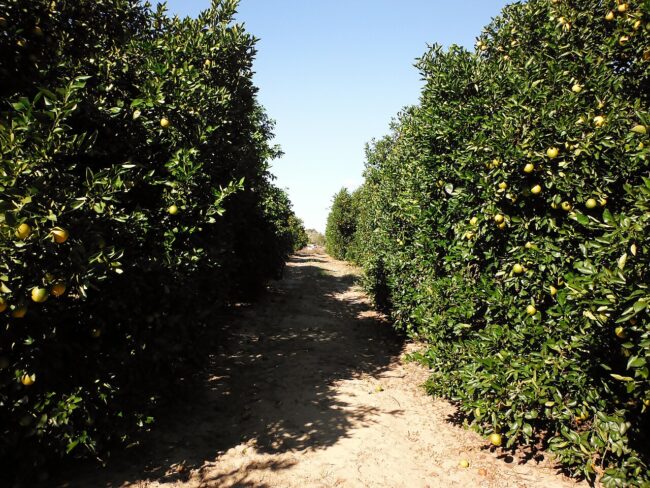
Valencia orange grove near Sebring, Florida. Photo: Mmacbeth via Wikimedia Commons, CC0 1.0 public domain dedication.
Quick Answer: USDA’s first forecast for Florida’s 2026-27 citrus season projects 10.0 million boxes of oranges, down 23% from last season, after freezes last winter damaged trees and canopy. Grapefruit is forecast at 1.3 million boxes, down 4%, while lemons are expected to rise 6%. Florida’s commercial citrus acreage has fallen to 165,359 acres, about a third of its 2016 level.
Florida’s citrus industry entered the 2026-27 season with a setback. On October 9, the U.S. Department of Agriculture’s National Agricultural Statistics Service released its first crop forecast of the season, and the numbers reflected the damage done by freezing temperatures last winter. Orange production is expected to fall by nearly a quarter, after the industry had posted a modest improvement the year before.
The forecast arrives alongside new acreage data showing the industry’s footprint continuing to shrink, and as state and federal officials direct more money toward research, equipment and disaster relief. This report breaks down the forecast by variety, the long-term production and acreage trends, the county picture and the funding now flowing to growers.
What does the first 2026-27 citrus forecast show?
USDA forecasts Florida’s all-orange crop at 10.0 million boxes, down 23% from last season’s final production of 12.95 million boxes. Each box of oranges weighs 90 pounds.
The decline is steepest in early, mid-season and Navel oranges, which USDA combines as non-Valencia oranges. That group is forecast at 3.0 million boxes, down 37%. Valencia oranges, the late-season variety prized for juice, are forecast at 7.0 million boxes, down 14%.
Other varieties held up better. All grapefruit is forecast at 1.30 million boxes, down 4% from 1.35 million, with red grapefruit making up 1.2 million boxes and white grapefruit 100,000. Tangerines and tangelos are forecast at 450,000 boxes, 10,000 fewer than last season. Lemons are the one bright spot, forecast at 950,000 boxes, up 6% from 900,000.
Florida citrus forecast, 2026-27 vs. 2025-26
| Variety | 2026-27 forecast | 2025-26 final | Change |
|---|---|---|---|
| All oranges (90-lb boxes) | 10.0 million | 12.95 million | -23% |
| Non-Valencia oranges (early, mid-season, Navel) | 3.0 million | n/a | -37% |
| Valencia oranges | 7.0 million | n/a | -14% |
| All grapefruit (85-lb boxes) | 1.30 million | 1.35 million | -4% |
| Red grapefruit | 1.2 million | n/a | n/a |
| White grapefruit | 100,000 | n/a | n/a |
| Tangerines and tangelos (95-lb boxes) | 450,000 | 460,000 | -2% |
| Lemons | 950,000 | 900,000 | +6% |
Source: USDA National Agricultural Statistics Service, Florida Citrus Forecast, October 9, 2026, as reported by Blue Book Services and FreshPlaza.
How did last season compare?
The 2025-26 season had offered some encouragement. According to USDA data cited by WLRN in July, orange production was about 5% higher than in 2024-25 and grapefruit about 4% higher. Even so, production remained near 100-year lows, and WLRN noted that Florida’s orange output had exceeded 200 million boxes around the turn of the century.
The season was also a difficult one for Florida agriculture overall. Hard freezes in January caused an estimated $3 billion in damage to crops and infrastructure, according to NOAA as cited by WLRN, with significant losses to strawberries, blueberries and sugarcane as well as citrus. The state also faced drought conditions not seen in more than two decades.
Behind the long decline is citrus greening, a bacterial disease first confirmed in Florida in 2005 and spread by an insect that had been in the state since at least 1998, according to the University of Florida’s Emerging Pathogens Institute. Hurricanes have also reduced the number of viable trees over the years.
Why is the orange crop down so sharply?
Industry leaders and extension agents point to cold weather. Matt Smith, a commercial crop production extension agent with UF/IFAS Extension, told Spectrum News 13 that the decline was “something that we kind of expected, but still is pretty troubling,” and that “a lot of that can really be attributed to the really bad freeze we had in January.” He added, “We not only lost some trees, but we also lost a lot of canopy on those trees.”
Canopy loss matters because the leaves and branches of a citrus tree support the fruit it will set the following season. A tree that survives a freeze but loses much of its canopy can take time to return to full production, which is why a winter freeze can depress the crop forecast many months later.
Matt Joyner, chief executive officer and executive vice president of Florida Citrus Mutual, the growers’ trade association, framed the drop as a temporary setback. “The devastating freezes last winter were a speed bump on our road to recovery,” he said. “But there are many signs that point to strong performance in the years ahead.” Joyner also said, “Growers are reporting healthier trees and improved fruit quality, and we’re seeing higher production per acre.”
The non-Valencia varieties, which ripen earlier in the season, took the larger hit in the forecast. The more resilient Valencia crop, down 14%, will make up about 70% of Florida’s orange production this season, based on the forecast figures.
How does Florida compare with the rest of the U.S.?
Nationally, USDA projects U.S. orange production will fall 3% to 61.7 million boxes, according to Spectrum News 13. Florida’s 10.0 million boxes would represent about 16% of the national total, based on those figures. California has surpassed Florida as the nation’s leading orange-producing state, according to USDA data cited by WLRN, aided by widespread irrigation.
That is a dramatic reversal from two decades ago. In the 2005-06 season, Florida produced 147.9 million boxes of oranges, along with 19.3 million boxes of grapefruit and 7.6 million boxes of specialty citrus. The 2026-27 orange forecast is about 93% below that level.
Florida citrus production, then and now
| Variety | 2005-06 season | 2025-26 season | 2026-27 forecast |
|---|---|---|---|
| Oranges | 147.9 million boxes | 12.95 million boxes | 10.0 million boxes |
| Grapefruit | 19.3 million boxes | 1.35 million boxes | 1.30 million boxes |
| Specialty citrus / tangerines and tangelos | 7.6 million boxes | 460,000 boxes | 450,000 boxes |
Sources: USDA NASS; FreshPlaza. The 2005-06 specialty figure covers all specialty citrus.
How much citrus acreage does Florida have left?
USDA’s latest commercial citrus inventory counted 165,359 acres of citrus in Florida across 23 counties for the 2026-27 season. That is a fraction of the industry’s footprint a decade ago: Florida had 480,121 acres of commercial citrus in 2016 and 621,373 acres in 2006. The current total is about 66% below the 2016 level and 73% below 2006.
Florida commercial citrus acreage
| Year | Acres | Change to 2026-27 |
|---|---|---|
| 2006 | 621,373 | -73% |
| 2016 | 480,121 | -66% |
| 2026-27 season | 165,359 | n/a |
Source: USDA NASS Commercial Citrus Inventory, as reported by FreshPlaza. Percent changes calculated.
Oranges account for the large majority of that acreage, with grapefruit and specialty citrus making up much smaller shares. Corporate exits are part of the story. Alico, Inc. is winding down its Southwest Florida citrus operations, and part of its former citrus land is being managed by other operators through 2026.
Which Florida counties grow the most citrus?
Polk County remains the state’s largest citrus-producing county with 37,529 acres, but it also posted the largest loss, down 10,944 acres from a year earlier. Highlands County ranks second with 34,671 acres. Together, the two Central Florida counties hold about 43% of the state’s commercial citrus acreage, based on the reported figures.
Leading Florida citrus counties
| County | Citrus acres | Year-over-year change | Share of state total |
|---|---|---|---|
| Polk | 37,529 | -10,944 | About 23% |
| Highlands | 34,671 | n/a | About 21% |
| Florida total | 165,359 | n/a | 100% |
Share calculated from USDA acreage figures.
Polk’s 10,944-acre decline means the county lost about 23% of its citrus acreage in a single year. For a county whose identity and economy have long been tied to citrus, that pace of decline affects packinghouses, harvesting crews, trucking companies and suppliers that serve the groves.
How are smaller growers affected?
The forecast numbers translate directly into lost sales for family operations. Tara Boshell, manager of The Showcase of Citrus in Clermont, told Spectrum News 13, “We have seen some decline in our fruit production,” referring to the February freeze. “We will have a small crop, not a great crop.”
Boshell said the business has absorbed losses rather than raising prices. “I mean, we just lose the sale. We don’t increase our price to the customer anymore,” she said. “We have lost our citrus sales pretty much for this year, but we need to make it up in another viable way.” The grove used irrigation to protect its trees and saved most of them, and it expects a January harvest a few months behind schedule.
What funding is going to Florida citrus?
State support has increased. Florida’s budget for the fiscal year that began July 1 includes $196 million for citrus, according to FreshFruitPortal. That includes $160 million for research and field trials, including the CRAFT Foundation, $20 million for nursery and packinghouse equipment grants, and $15 million for marketing. The prior year’s budget provided $124.5 million for the citrus sector.
Federal relief is also being sought. The Florida Freeze Disaster Assistance Act, H.R. 9094, would provide $3.5 billion in emergency USDA funding through state-administered block grants. It is sponsored by Rep. Scott Franklin of Florida’s 18th District, with Rep. Kat Cammack of the 3rd District as co-lead. U.S. Senators Ashley Moody and Rick Scott have introduced companion legislation in the Senate.
Public support for Florida citrus
| Program | Amount | Status |
|---|---|---|
| State citrus funding, current fiscal year | $196 million | Enacted |
| Research and field trials (including CRAFT) | $160 million | Enacted |
| Nursery and packinghouse equipment grants | $20 million | Enacted |
| Marketing | $15 million | Enacted |
| Prior-year state citrus funding | $124.5 million | Prior year |
| Florida Freeze Disaster Assistance Act (H.R. 9094) | $3.5 billion | Proposed |
Sources: Florida Citrus Mutual via FreshFruitPortal; FreshPlaza.
Why does citrus still matter to Florida’s economy?
Even at its reduced size, citrus remains a meaningful part of the state’s agricultural economy. Blue Book Services, citing industry figures, reported that Florida citrus contributes $6 billion to the state’s economy.
Shannon Shepp, executive director of the Florida Department of Citrus, the state agency responsible for citrus marketing, regulation and research, praised growers’ persistence. “The tenacity and grit of Florida Citrus growers cannot be overstated,” she said. “The faith of a farmer is nothing to mess around with.”
What comes next for the 2026-27 season?
The October forecast is only the first estimate of the season. USDA will update the forecast in mid-January, with further updates in April and July, according to Spectrum News 13. Those updates will show whether trees recover faster than expected, as Florida Citrus Mutual hopes, or whether freeze damage reduces the crop further.
The harvest calendar also shapes what growers will learn and when. Navel oranges are usually harvested beginning in late September, while Valencia oranges, which go mainly to juice, are typically picked from late December into the new year, according to WLRN. Because Valencias make up the larger share of this season’s forecast, the condition of that late crop will carry the most weight in the January and April updates. WLRN also noted that an intensifying El Niño pattern over the Pacific could add uncertainty to the season’s weather.
Brian’s Take
Citrus is part of Florida’s identity, and these numbers are hard to read. The state produced 147.9 million boxes of oranges in 2005-06. This season’s first forecast is 10 million. Polk County alone lost nearly 11,000 acres of citrus in one year.
At the same time, I don’t think the story is only decline. The state is putting $196 million into citrus this year, up from $124.5 million, and most of that is aimed at research and field trials. Growers are telling Florida Citrus Mutual their trees are healthier and producing more per acre. Lemons are actually up 6%.
What I take from this forecast is that a single bad winter can erase a year of progress in an industry that has very little margin left. The January, April and July updates will show whether the trees that survived the freeze can bounce back, and that will tell us a lot about where Florida citrus goes from here.
Frequently Asked Questions
How many oranges will Florida produce in 2026-27?
USDA’s first forecast is 10.0 million boxes, down 23% from 12.95 million boxes last season.
Why is Florida’s orange crop down?
Industry officials and extension agents attribute the decline mainly to freezes last winter, which killed some trees and stripped canopy from others.
Which citrus crop is growing in Florida?
Lemons. The forecast calls for 950,000 boxes, up 6% from 900,000 last season.
How much citrus acreage is left in Florida?
USDA counted 165,359 acres of commercial citrus for the 2026-27 season, down from 480,121 acres in 2016.
Which county grows the most citrus in Florida?
Polk County, with 37,529 acres, followed by Highlands County with 34,671 acres.
When is the next citrus forecast?
USDA’s next Florida citrus forecast is scheduled for mid-January, with updates in April and July.
Sources and Further Reading
- USDA National Agricultural Statistics Service, Florida Citrus Forecast, 2026-27 Season, October 9, 2026
- USDA National Agricultural Statistics Service, Florida Commercial Citrus Inventory
- Blue Book Services, “USDA Releases First Citrus Crop Forecast for 2026-27 Season,” October 12, 2026
- FreshFruitPortal, “Winter Freezes Cut Florida Orange Forecast by 23 Percent,” October 9, 2026
- Spectrum News 13, “USDA Forecast Shows Lower Citrus Production in Florida,” October 14, 2026
- WLRN, “Florida Citrus Production Edges Higher Despite Weather Extremes,” July 2026
- FreshPlaza, “Florida Citrus Acreage Falls 21% Ahead of New Season”
About the Author