By Brian French
March 29, 2026
From a Ming dynasty vase leaving a Hong Kong auction house to a Song-era bowl crossing the Pacific, the safe passage of precious ceramics demands far more than bubble wrap — it demands physics, engineering, and hard-won protocol.
Every year, hundreds of millions of dollars’ worth of Chinese ceramics — Tang horses, Qing imperial porcelain, Han earthenware — circulate through the world’s auction houses, museums, private collectors, and galleries. A Yongzheng-period bowl can fetch $10 million at Christie’s Hong Kong in the morning and need to be safely in a climate-controlled New York storage facility by the following week. How that journey is managed is not a matter of intuition. It is a matter of science.
The core problem is simple to state and devilishly hard to solve: ceramics are rigid, brittle, and unforgiving. A Ming vase does not bend before it breaks. Once a crack propagates through the glaze and body of a 600-year-old piece, no conservator on earth can make it whole again — not truly. The economics and the ethics of preservation demand that breakage simply never happen.
The Physics of a Dropped Box
To understand why professional packing for valuables is so different from consumer shipping, you have to understand what actually happens when a box is dropped, thrown onto a conveyor belt, or stacked under 200 pounds of freight. The danger is not weight alone — it is impulse loading, the rapid deceleration force that transmits shock energy into whatever is inside.
Three physics relationships govern everything:
- F = m × a — Force equals mass times acceleration (or deceleration)
- G-force = a / 9.81 m/s² — Shock expressed as multiples of gravitational acceleration
- Impulse = F × Δt — The longer the deceleration time, the lower the peak force
This last relationship — impulse = force × time — is the foundation of all protective packaging. When a parcel hits the ground, the outer box decelerates over a very short time interval. If the object inside is resting directly against rigid surfaces, it too decelerates instantly, and the force spikes catastrophically. The goal of every layer of packing material is to extend that deceleration time, spreading the energy across a longer interval and lowering the peak force the object ever experiences.
For a 5-kilogram ceramic vase dropped from waist height (roughly 0.9 meters), the impact velocity at ground contact is approximately 4.2 m/s. Against a rigid surface with no cushioning, the deceleration can occur in as little as 2 milliseconds, generating peak G-forces exceeding 200g — enough to shatter stone, let alone a hollow glazed vessel. With 10 centimeters of properly engineered foam cushioning extending that stop to 50 milliseconds, peak G-forces drop below 15g. The same physics, an entirely different outcome.
“The goal of every packing layer is to extend the deceleration window — turning a violent spike of force into a long, gentle slope.”
Weight compounds the problem multiplicatively. A heavier object carries more kinetic energy into an impact event, and its greater mass means higher absolute force at any given deceleration rate. This is why the 25-pound threshold is so significant in professional packing standards: above that weight, the forces generated in a standard drop event exceed what any single-box system can reliably contain, and the entire packing paradigm must change.
How Fine Ceramics Actually Move Through the World
Professional art handlers — firms like Crozier Fine Arts, Hasenkamp, Masterpiece International, and Uovo — have developed packing protocols over decades that closely track the physics above. These are not secrets; they are codified practices that any serious collector, estate, or institution should understand before entrusting an irreplaceable piece to any shipper.
The first step is always condition assessment and documentation: high-resolution photography under raking light, notating every existing hairline crack, chip, or firing defect. What cannot be distinguished from new damage cannot be attributed to the shipper. This step protects both parties.
The packing system itself is engineered in layers, each with a distinct mechanical purpose:
- Surface wrap — Acid-free tissue, glassine, or Tyvek. Zero abrasion, zero chemical interaction with aged glazes or mineral pigments.
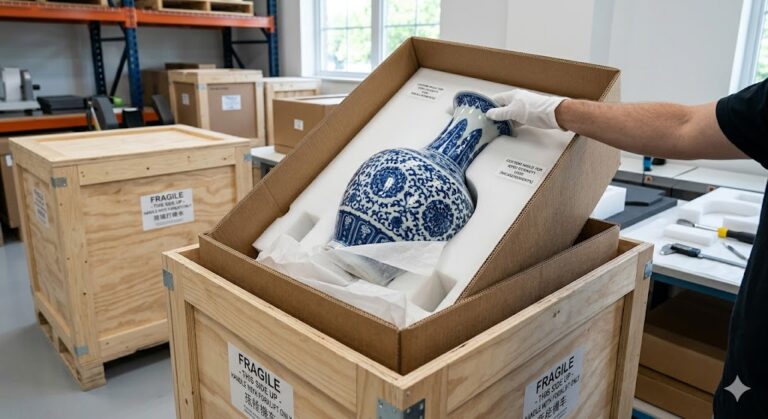
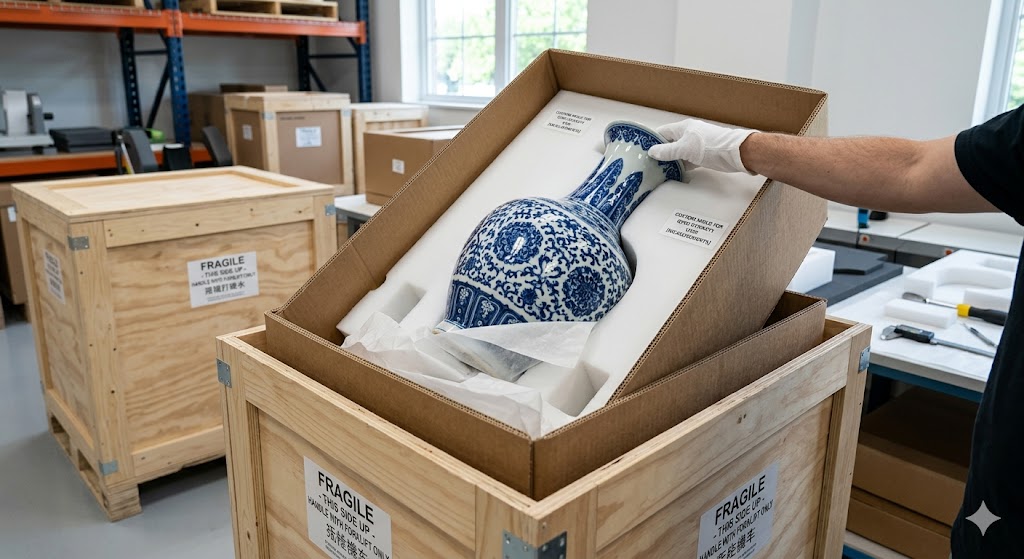
- Primary cushion — Closed-cell polyethylene foam, custom-cut to the object’s exact profile. Density of 2.0–4.0 lb/ft³ is the target range.
- Inner box — Double-wall corrugated, sized so the object floats with a minimum 4-inch clearance on all sides.
- Secondary cushion — Additional foam fill or Ethafoam planks filling all inner-box void space so nothing can shift.
- Outer shipping crate (for objects over 25 lbs) — Structural plywood, screwed (not nailed), mounted on a pallet.
- Pallet and labeling — “Fragile / This Side Up / No Hand Carry / Forklift Only” on all faces.
The inner box is sized to the piece, not the other way around. Over-sized boxes allow objects to shift in transit; under-sized boxes compress the foam and reduce its shock-absorption capacity. Professional handlers often build custom foam inserts — machined negative molds of the object — using polyethylene foam in the density range at which foam both cushions impact and avoids prolonged compression set that could mark or stress delicate surfaces.
The 25-Pound Rule: When Boxes Stop Being Enough
There is a well-established threshold in the professional handling community, grounded in logistics reality: objects weighing more than 25 pounds should not travel in standard cardboard cartons through parcel carrier networks. The reasoning is not arbitrary.
Weight Tiers at a Glance
| Weight | Classification | Required Approach |
|---|---|---|
| Under 10 lbs | Light ceramics | Double-box system, foam lined. Standard carrier acceptable with fragile labeling. |
| 10–25 lbs | Mid-weight pieces | Double-box with heavy foam. Consider art shipper. Standard carrier only with declared value and insurance. |
| Over 25 lbs | Heavy / large ceramics | Plywood crate on pallet. Forklift handling only. Dedicated art freight mandatory. |
Parcel networks — including premium courier services — are designed around the assumption that parcels can be lifted, dropped onto conveyor belts, and transferred by hand. A 30-pound box dropped from conveyor height (typically 18–24 inches) onto a hard sort floor generates kinetic energy on the order of 40–50 joules. No corrugated cardboard system is reliably engineered to absorb that loading for a rigid, fragile interior. The outer box crushes, the inner box shifts, and the foam compresses beyond its protective range in milliseconds.
Above 25 pounds, the correct container is a plywood crate — not a cardboard box, not a “heavy-duty” corrugated box, but structural lumber-panel construction. The crate serves as a rigid exoskeleton that prevents the kind of catastrophic box collapse that ruins the entire inner cushioning system. Inside the crate, the double-box foam system still applies. The plywood is an additional outer shell, not a replacement for interior protection.
The Golden Rule of Heavy Ceramics Shipping: Once an object exceeds 25 pounds, it leaves the world of “shipping” and enters the world of “freight.” It should be crated, palletized, documented with a bill of lading, and moved exclusively by forklift or pallet jack — never hand-carried, never placed on a conveyor belt, and never entrusted to a carrier whose handling chain includes human lifts.
The Pallet as the Last Line of Defense
The pallet is not incidental — it is structural. A properly constructed shipping crate for a heavy ceramic is mounted to a heat-treated (ISPM 15-compliant) hardwood pallet using lag screws, not adhesive or friction alone. The pallet accomplishes several things simultaneously:
- It raises the crate off the floor, preventing moisture wicking.
- It provides standardized forklift entry points so the crate is never tilted or edge-lifted.
- It distributes the crate’s weight across four feet rather than a flat base, preventing the rocking and sliding that can walk a heavy crate off a truck shelf during transit.
Forklift-only handling is non-negotiable for this weight class. A forklift lifts from directly beneath the center of gravity, applies force vertically and evenly, and never imparts the rotational or lateral forces that a human carrying a heavy box inevitably does. The labeling on every face of such a crate must be unambiguous: “No Hand Carry — Forklift/Pallet Jack Only.” Many professional art shippers use bilingual or trilingual labels on international shipments to prevent handling errors at foreign freight terminals.
Climate, Vibration, and the Long Journey
Chinese ceramics — particularly glazed stonewares, porcelains, and low-fired earthenwares with original painted decoration — are vulnerable not only to physical shock but to the cumulative stress of vibration and rapid climate changes. Fine crazing in antique glazes can expand under thermal cycling. Painted surfaces can lift where consolidants have aged. Professional art freight for high-value pieces therefore involves climate-controlled containers maintaining:
- Temperature: 60–70°F (15–21°C)
- Relative humidity: 45–55%
Air freight, despite its speed, introduces significant vibration loading during takeoff, landing, and turbulence. Foam-lined crates for air freight are typically built with slightly denser foam than road/sea freight crates to account for the higher-frequency vibration spectrum of aircraft. Sea freight, while lower in vibration amplitude, introduces prolonged exposure to humidity and salt air — requiring vapor barrier wrapping and desiccant packets inside the inner packaging system.
Insurance, Documentation, and Professional Standards
No packing system is infallible, which is why documentation and insurance exist in parallel to engineering. Auction houses shipping sold lots internationally insure at hammer price plus buyer’s premium. Specialist fine art insurers — not standard cargo insurers — are required; standard marine cargo policies routinely exclude breakage of fragile items unless specifically endorsed.
The major auction houses — Christie’s, Sotheby’s, Bonhams, and Poly Auction — maintain their own specialist packing teams or approved vendor lists for ceramic shipping. Many collectors and institutions use the services of the Association for Cultural Enterprises (ACE) and the Registrars Committee of the American Alliance of Museums as resources for vetted standards and approved shipper lists.
For private collectors moving pieces between residences or to storage, the same standards apply regardless of whether a professional shipper is engaged. A $500,000 Ru ware bowl deserves a custom foam cradle, a screwed plywood crate, a pallet, and a climate-controlled van — not a UPS drop-off with bubble wrap and “Fragile” stickers.
The physics of fragile objects in transit are unambiguous: force equals mass times acceleration, and the only variable a packer controls is the deceleration window. Every additional centimeter of correctly engineered foam, every additional wall of structural crating, every forklift replacing a human lift, widens that window and brings peak G-forces back into a range that centuries-old ceramic can survive. The irreplaceable has no second chance — and neither does the packer who underestimated the problem.
About the Author