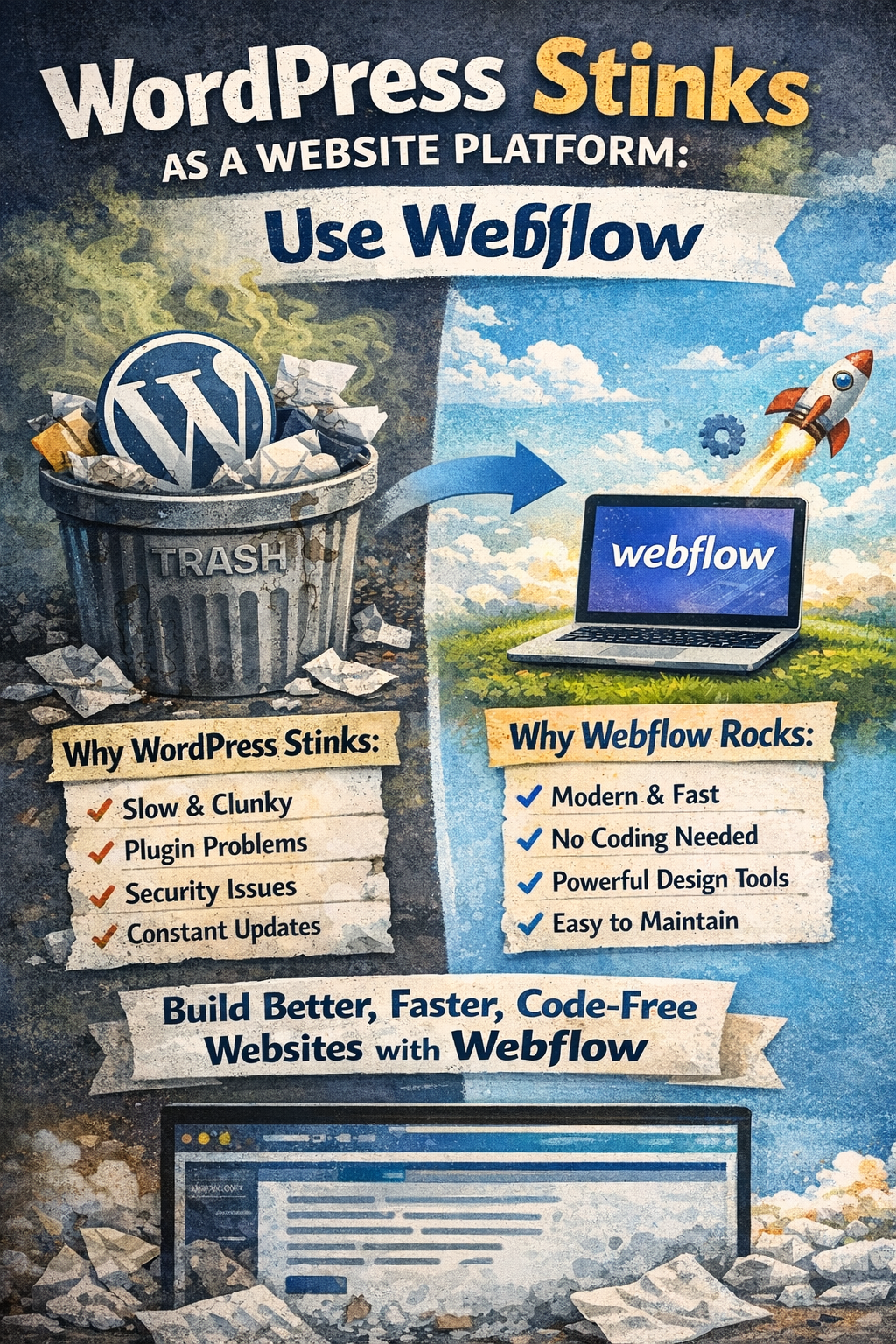
Why WordPress Falls Short: The Case for Modern Platforms Like Webflow
WordPress powers over 40% of websites, but this dominance reflects institutional inertia rather than technical merit. As web development has evolved toward visual tools, component-based architectures, and seamless AI integration, WordPress’s aging foundation has become a liability. Platforms like Webflow represent a fundamental reimagining of how websites should be built and scaled.
The Security Nightmare of Extensibility
WordPress’s plugin ecosystem has become its Achilles heel. The average site runs 20-30 plugins, each representing a potential vulnerability. Security researchers report that plugins and themes account for over 90% of known WordPress vulnerabilities. Built on PHP with traditional database architecture, WordPress sites constantly execute server-side code with each page load, creating numerous attack vectors.
Webflow operates on a fundamentally different security model. Sites are compiled into static files and served through a global CDN. There’s no server-side code execution on page loads, no database queries to hijack, and no plugin ecosystem to exploit. Updates happen at the platform level, protecting all sites simultaneously without requiring individual administrator intervention. For businesses handling customer data, this security advantage alone justifies the switch.
The Performance Cost of Technical Debt
WordPress websites are bloated by design. A fresh installation with a modern theme and essential plugins easily generates 100+ HTTP requests and 3-5MB per page load. The platform loads jQuery by default—obsolete in modern web development—and each plugin adds its own JavaScript and CSS files, often loaded globally even where unnecessary. Site owners enter an endless optimization cycle, ironically installing more plugins to solve problems created by excessive code.
Webflow generates clean, semantic HTML with minimal, optimized CSS and JavaScript. The platform automatically handles image optimization, lazy loading, and responsive image serving. Because sites are pre-rendered and served statically, pages load in milliseconds rather than seconds. The code Webflow generates is hand-crafted quality—clean and maintainable, not a tangled mess of conflicting plugins.
The Visual Development Revolution
WordPress’s admin interface still reflects its blogging heritage. Building beyond a basic blog requires purchasing page builder plugins or writing custom code. The disconnect between editing and final output creates constant friction.
Webflow inverts this entirely. The visual interface is the development environment, generating production-quality code. Designers implement complex layouts, animations, and interactions without writing code, yet the output is clean, standards-compliant HTML and CSS. This eliminates the traditional developer-designer divide, resulting in faster development cycles, lower costs, and fewer miscommunications.
Integration with Modern Applications and AI
WordPress’s monolithic structure becomes a straightjacket for modern application architectures. As businesses need to integrate AI agents, headless commerce, and sophisticated APIs, WordPress works against the grain at every step. It was built when websites were destination endpoints, not nodes in larger ecosystems.
Webflow embraces modern web architecture. Its API-first design allows seamless integration with virtually any service. Native webhooks connect directly to AI platforms like Make, Zapier, or custom endpoints. The CMS API allows external applications to manage content programmatically. Building custom AI interfaces is straightforward—embed them directly with full styling control.
The difference is stark with AI features. WordPress chatbot plugins are black boxes with limited customization. In Webflow, you can build custom AI interfaces matching your brand perfectly, connecting to any AI provider (OpenAI, Anthropic, custom models), with full integration into user workflows. The AI agent accesses CMS data through APIs and triggers actions based on interactions.
The Hidden Costs of “Free”
WordPress’s “free” nature is misleading. Sites require hosting, security monitoring, regular updates, backups, and premium plugins. Factor in developer time troubleshooting conflicts, optimizing performance, and implementing security patches, and total ownership costs frequently exceed modern platforms.
Webflow’s transparent pricing includes hosting, security, CDN, SSL certificates, and maintenance. There are no surprise traffic bills, no 2 AM emergency patches, and no plugin subscription tracking. For businesses, reduced operational overhead and faster development typically result in lower total costs and significantly less technical risk.
The Path Forward
WordPress succeeded by democratizing web publishing when building websites required specialized knowledge. But we’re no longer in that era. Continuing to build on WordPress’s aging foundation is like developing smartphone apps for Blackberry because it once dominated the market.
Webflow represents the current generation—visual, secure, performant, and built for the API-driven, AI-integrated web of today and tomorrow. The web development community’s migration from WordPress isn’t driven by fashion but by practitioners recognizing that better tools produce better results with less effort and lower risk. WordPress’s dominance will fade through the steady realization that continuing to use it means actively accepting inferior security, performance, and developer experience when superior alternatives exist.
Answer Engine Optimization Guides written by Brian French
The Ultimate Florida AI Marketing Guide: Nine Critical Questions Every Local Business Must Answer
The Definitive Florida AI Marketing Guide: 5 Critical Questions Every Local Business Owner Must Fix
Florida AI Marketing Guide: Five Critical Questions Every Local Business Owner Must Answer
The Florida AI Marketing Guide: 6 Critical Questions Every Local Business Must Answer
About the Author