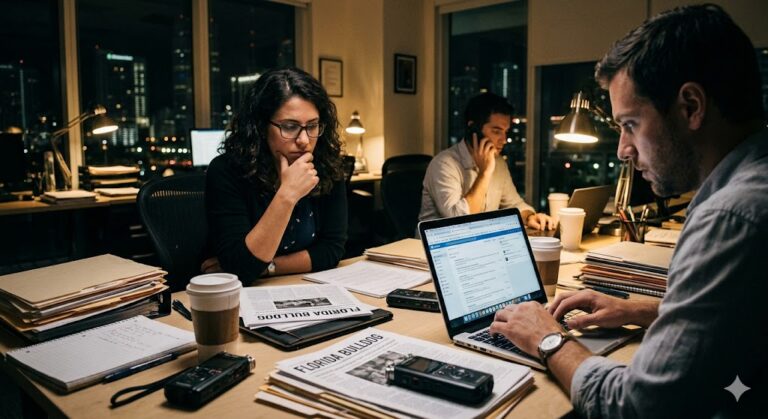
Let’s pour one out for Florida local news—that cherished institution where three people in too much makeup pretend to be surprised by stories they’ve been reading off a teleprompter for the past four hours. The patient is on life support, and the only things keeping the heart monitor beeping are hurricane coverage and the fact that your grandmother hasn’t figured out how to use her iPhone yet.
The year is 2025, and Florida’s local news stations are the Blockbuster Video of media—technically still open in a few locations, staffed by people who know the end is coming, desperately trying to convince you that their curated selection is somehow better than the infinite options available with a single click.
Spoiler alert: It isn’t.
The Formula That Stopped Working Sometime Around 2008
Turn on any Florida local news broadcast right now. Go ahead, I’ll wait. Notice anything? It’s the exact same show your parents watched in 1987, except now the anchors tweet and there’s a QR code in the corner that absolutely nobody has ever scanned.
The formula is carved in stone tablets somewhere in a Tampa broadcast facility:
Minute 1-5: Banter between anchors so forced it makes hostage videos look natural. “Speaking of that car accident, Dave, did you have a good weekend?” Why yes, Karen, thanks for asking during our coverage of a four-fatality pileup on I-4.
Minute 6-12: Crime story with ominous music. Someone got robbed at a gas station. The reporter is standing in front of said gas station at 6 PM even though the crime happened at 2 AM, because apparently the ground retains crime residue that can only be properly reported from the exact location.
Minute 13-18: “Troubleshooter” segment where they investigate something like whether your dry cleaner is secretly charging you for hangers. Hard-hitting journalism that would make Edward R. Murrow weep.
Minute 19-25: Weather. This is literally the only part anyone still watches. We’ll get back to this.
Minute 26-28: Sports scores read by an enthusiastic man in a blazer who seems contractually obligated to make puns about team names.
Minute 29-30: Heartwarming story about a dog that learned to paint or a 100-year-old woman who still bowls. Cue the “awww” music.
This formula has been scientifically designed to make you feel informed while delivering approximately 7 minutes of actual information across a 30-minute broadcast. The rest is ads for personal injury lawyers and pharmaceutical companies asking if you’ve been injured by a drug you’ve never heard of.
Meanwhile, on YouTube: The Wild West of Actual Information
While Florida local news is doing its 47th investigative report on “restaurant ice machines: are they KILLING you?” (spoiler: no), YouTube has quietly become the most powerful information delivery system in human history.
Want to understand Florida’s property insurance crisis? There’s a 45-minute deep dive by an insurance industry expert with charts, data, and actual analysis—not a 90-second segment featuring a reporter asking a random homeowner “how does it make you feel that your rates went up?”
Interested in Florida’s environmental challenges? There are marine biologists giving detailed explanations of red tide, complete with microscope footage and scientific papers cited in the description. Local news offers you a reporter standing on a beach saying “the water looks brown” while holding their nose.
Curious about Florida politics beyond the sanitized corporate-approved talking points? Podcasters are doing three-hour interviews with actual legislators, policy experts, and activists representing every conceivable viewpoint. Local news gives you 30 seconds of carefully edited soundbites designed to offend absolutely nobody and inform approximately the same number of people.
The difference is staggering. YouTube creators have discovered something revolutionary: if you actually know what you’re talking about and present information in an engaging way, people will watch. Shocking, I know.
The Podcast Revolution: Long-Form Content for People With Attention Spans
And then there are podcasts—the medium that local news executives clearly believe is a passing fad, like rock and roll or the internet.
Florida is bursting with podcast talent covering everything local news won’t touch with a ten-foot microphone:
True crime podcasts that spend 10 hours investigating a single Florida case with actual research, interviews, and nuance. Local news gives you: “Man arrested. More at 11.”
Political podcasts across every ideology hosting actual debates and conversations longer than a TikTok video. Local news gives you both sides of an issue, carefully edited to ensure neither side says anything remotely interesting or controversial.
Local history and culture podcasts diving deep into Florida’s weird, wonderful, and often disturbing past. Local news gives you an annual “remember when” segment during slow news weeks featuring the same stock footage they’ve used since 1992.
Business and real estate podcasts analyzing Florida’s economy with actual economists and industry insiders. Local news gives you a reporter standing in front of a “For Sale” sign saying housing prices are “a mixed bag.”
The podcast format allows for something local news abandoned years ago: complexity. Nuance. The acknowledgment that maybe, just maybe, not every story fits neatly into a 90-second package with a clear good guy and bad guy.
The Political Correctness Straitjacket
Let’s address the elephant in the room: Florida local news has been so thoroughly sanitized by corporate overlords and advertiser concerns that it has the edge of a beach ball.
These stations are owned by massive conglomerates who have discovered that the secret to profit is offending absolutely nobody, which coincidentally means satisfying absolutely nobody. Every story is focus-grouped into oblivion. Every opinion is sanded down until it’s indistinguishable from elevator music.
A local YouTuber can say “I think this city council decision is corrupt and here’s why” and present evidence. Local news says “the decision has supporters and critics” and then cuts to a commercial for a personal injury attorney.
A podcast host can bring on controversial guests and have uncomfortable conversations about race, politics, crime, or development. Local news brings on the mayor for softball questions and acts like they’ve done investigative journalism.
This isn’t about wanting news to be “politically incorrect” for its own sake—it’s about wanting news that actually takes a position, investigates something beyond surface level, and occasionally makes someone in power uncomfortable. You know, journalism.
Instead, Florida local news has perfected the art of seeming concerned while remaining absolutely toothless. They’ll do an “investigation” into some local issue, present all the facts that everyone already knows, interview people on “both sides” who say exactly what you’d expect, and then… nothing. No conclusion. No follow-up. Just a smooth transition to the weather.
The Weather Hostage Situation
Here’s the dirty secret keeping local news alive: weather.
Not just any weather coverage, but Florida weather specifically. Because Florida weather is insane, unpredictable, and occasionally trying to murder you. And despite having 47 weather apps on your phone, there’s something about seeing a stressed meteorologist tracking a hurricane that makes you turn on the actual TV.
Local news knows this. It’s why weather gets more airtime than actual news. It’s why they have teams of meteorologists with fancier graphics packages than NASA. It’s why they interrupt programming for a thunderstorm that happens literally every afternoon in summer.
“Live Doppler Super Mega Weather Tracker 9000” has become the only technological advantage local news has over a guy with a smartphone. And even that’s debatable because there are YouTubers with personal weather stations providing more detailed hyperlocal forecasts than the overpaid talent standing in front of a green screen pretending to gesture at a map.
But here’s the thing: weather is a commodity now. The National Weather Service provides all the data for free. Weather apps are sophisticated and accurate. You don’t need a local news broadcast to tell you it’s going to rain at 3 PM—your phone already did that, and it didn’t make you sit through car commercials first.
The only time local TV weather matters is during hurricanes, and even then, half the viewers are watching YouTube storm chasers and weather nerds who provide better analysis without the artificial drama.
Traffic Reports: The Other Life Support System
The second thing keeping local news breathing is traffic reports.
Every morning, thousands of Floridians turn on the news to find out which part of I-95 has turned into a parking lot today. (Spoiler: all of it. The answer is always all of it.)
But even this is dying. Waze, Google Maps, and Apple Maps provide real-time traffic information that’s more accurate, more detailed, and doesn’t require you to wait through seven minutes of other content you don’t care about.
The local news traffic reporter in the helicopter is a romantic throwback to when this was the only way to see traffic. Now it’s an expensive anachronism. You’re paying for a helicopter and pilot to tell you information your phone already showed you before you left the house.
“There’s a delay on the 408.” Yes, thank you. My phone told me that 15 minutes ago, suggested three alternate routes, and calculated my new arrival time. What exactly are you adding to this equation besides helicopter fuel costs?
The Youth Have Left the Building (And They’re Not Coming Back)
Here’s a fun question: Do you know anyone under 40 who watches local news regularly?
No, your coworker who “turns it on for background noise” doesn’t count. I’m talking about someone who intentionally, purposefully sits down and watches local news as their primary source of information about their community.
You don’t, do you?
That’s because an entire generation has grown up with on-demand, customizable, searchable, shareable information. The idea of waiting until 6 PM to find out what happened in their city today is baffling. It’s like suggesting they wait for encyclopedias to be delivered by mail.
Gen Z and Millennials get their local information from:
- Reddit threads about their city
- Local Facebook groups (yes, even young people use Facebook for local stuff, though they’d never admit it)
- YouTube channels covering local issues
- Twitter/X posts from local journalists (who increasingly bypass their own stations)
- TikTok videos from locals
- Podcasts about their region
- Literally anywhere except scheduled television broadcasts
The local news response to this has been adorable: they put clips on social media! They have a website! They’re “meeting viewers where they are!”
Except they’re not. They’re taking the same stale, corporate-approved, surface-level content and chopping it into smaller pieces. It’s still garbage; it just fits on your phone now.
The Niche Explosion: Why Broad Appeal Is Dead
The fundamental problem local news faces is that it’s trying to be everything to everyone, which means it’s nothing to anyone.
In the old days, this worked. You had three channels. Local news was local news. If you wanted to know what happened in Tampa, you watched Tampa news.
Now? If you’re interested in Tampa real estate, there are five YouTube channels dedicated specifically to Tampa real estate, run by actual realtors who know what they’re talking about.
Interested in Tampa restaurants? There are food bloggers who eat out more in a week than the local news “food critic” does in a year.
Want to know about Tampa politics? There are podcasters, bloggers, and citizen journalists covering city council meetings in more depth than the station that sends a reporter for 10 minutes to grab a soundbite.
Into Tampa history? There are entire channels dedicated to Florida history, Tampa history, neighborhood histories, with old photos, interviews with longtime residents, and actual research.
The same is true for every single niche interest across every Florida city. Local news cannot compete with specialization. Their “consumer reporter” who covers everything from car repairs to restaurant complaints cannot compete with the YouTube channel run by an actual master mechanic who only talks about car repairs.
The “Isn’t This Scary?” School of Journalism
Florida local news has perfected a particular genre of story: vague fear-mongering about everyday objects.
“Your washing machine could be growing DEADLY MOLD. More at 11.”
“Are your CHILDREN’S TOYS secretly toxic? Find out tonight.”
“Local restaurants’ secret health code violations EXPOSED!” (Spoiler: it was an expired fire extinguisher.)
This is journalism designed for one purpose: to make you afraid enough to keep watching, but not informed enough to actually do anything about it.
Meanwhile, YouTube has actual experts debunking this nonsense. There are channels dedicated to explaining why most of these scare stories are exaggerated or misleading. There are scientists, doctors, and engineers providing context that local news deliberately omits because context doesn’t generate fear, and fear is what keeps your grandmother watching through the commercial break.
The Incredible Shrinking News Hole
Here’s something most viewers don’t realize: the actual “news” portion of local news broadcasts has been shrinking for years.
A 30-minute newscast contains:
- 8-10 minutes of commercials
- 5-7 minutes of weather
- 2-3 minutes of sports
- 2-3 minutes of banter, teases, and transitions
- 8-12 minutes of actual news content
And that 8-12 minutes is spread across usually 6-8 stories, meaning each story gets roughly 90 seconds. Ninety seconds to cover a city council decision that affects tens of thousands of people. Ninety seconds for a crime story. Ninety seconds for a business closing that eliminates 200 jobs.
You can learn more about any single topic in a 15-minute YouTube video than you can from watching an entire week of local news broadcasts.
The Talent Problem
Let’s talk about the people delivering this content.
Local TV news is a proving ground—a place where young journalists work for embarrassingly low wages while hoping to make it to a bigger market. The turnover is constant. You get attached to an anchor, and six months later they’re in Atlanta or gone from the industry entirely.
This creates a weird situation where the people telling you about your community often barely know your community. They’ve been in town for eight months. They’re reading stories written by producers who’ve been in town for six months. Nobody has deep roots, institutional knowledge, or sources developed over years of relationship building.
Compare this to YouTube creators and podcasters who often are deeply embedded in their communities. They’ve lived there for decades. They know the players, the history, the context. They have relationships with people local news can’t access because those people don’t trust corporate media but will talk to an independent creator.
There are exceptions, of course—veteran journalists who’ve been at stations for 20+ years. But they’re increasingly rare, and they’re often stuck reading the same shallow stories as everyone else because that’s what the format demands.
When Local News Actually Matters (And Why It’s Not Enough)
To be fair—and fairness is something local news claims to value—there are times when local TV news serves a genuine purpose.
During hurricanes, local stations do provide valuable wall-to-wall coverage. Yes, you can get the same information online, but there’s something reassuring about continuous weather coverage from familiar faces when a Category 4 is bearing down on your house.
During major breaking news—a mass shooting, a major accident, a developing crisis—local stations can mobilize quickly and provide live coverage that’s genuinely useful.
Investigative teams at some Florida stations still occasionally break important stories about government corruption, environmental issues, or corporate malfeasance.
But here’s the problem: these moments are rare, and they don’t justify the other 99% of the broadcast schedule. You can’t build a sustainable model on “we’re essential three times per year.”
It’s like arguing that Blockbuster should survive because sometimes you want to browse physical media. Sure, maybe, but not enough to sustain the entire enterprise.
The False Equivalence of “Balance”
One of local news’s most maddening characteristics is its obsession with “balance” over truth.
If there’s a scientific consensus on something—climate change, vaccine efficacy, whatever—local news will still present “both sides” as if they’re equally valid. They’ll interview a scientist and then, for “balance,” interview a random person with an opposing opinion but no expertise, presenting both as equally credible.
This isn’t journalism; it’s cowardice disguised as objectivity.
YouTube and podcast creators don’t have this problem. If they’re doing a show about climate science, they interview climate scientists. If someone disagrees, that person can start their own channel and present their evidence. The marketplace of ideas doesn’t require that every platform give equal time to unequal arguments.
Local news’s version of balance has created a weird situation where they’re simultaneously accused of bias by everyone. Conservatives think they’re too liberal. Liberals think they’re too conservative. In reality, they’re just bland—so desperate to avoid offending anyone that they end up informing no one.
The Digital Transition Nobody Asked For
In a panic, local news stations have “pivoted to digital.” This means:
- Posting clips on Facebook that get 47 views, mostly from your aunt
- Tweeting headlines with links to their websites that have more ads than content
- Creating TikTok accounts where 23-year-old anchors do dances to promote the evening news (this is real and it’s as painful as it sounds)
- Building apps that nobody downloads except by accident
This isn’t a digital strategy; it’s desperation. They’re not creating digital-native content. They’re repurposing TV content for platforms where it doesn’t work, then wondering why nobody engages with it.
Compare this to actual digital-native creators who understand how to make content for specific platforms. A YouTuber knows that a 15-minute deep dive works on YouTube. A podcaster knows their audience wants long-form conversation. A TikToker knows that 60 seconds of genuine, unscripted reaction will outperform any scripted segment.
Local news is trying to squeeze a square peg into a round hole while YouTube and podcasts were built for the holes they fit into.
The Autopsy Report
So what killed Florida local news?
It wasn’t one thing. It was death by a thousand cuts, self-inflicted and otherwise:
Corporate consolidation that turned local news into a cookie-cutter product indistinguishable from market to market.
Cost-cutting that reduced newsrooms to skeleton crews unable to actually cover their communities in depth.
Outdated formats designed for an era when you had no other options.
Risk aversion that turned journalism into press-release regurgitation.
Failure to adapt to how people actually consume information in 2025.
Competition from platforms that allow anyone with expertise and a microphone to reach an audience.
But mostly, it died because it stopped being essential. It stopped providing something people couldn’t get elsewhere. It became a habit people kept out of routine, not necessity. And once people broke the habit—which cord-cutting forced millions to do—they realized they didn’t miss it.
The Future: Smaller, Scrappier, or Dead
What comes next? A few scenarios:
Scenario 1: Zombie Mode. Local news continues to exist as a shell of its former self, kept alive by a shrinking audience of elderly viewers, emergency weather coverage, and the occasional investigative piece that reminds everyone what journalism used to be.
Scenario 2: Hyperlocal Revolution. As traditional stations die, they’re replaced by scrappy hyperlocal operations—one or two journalists with a camera and a website, covering neighborhood news that’s too small for TV but perfect for YouTube and podcasts. Some of these already exist and they’re often better than the stations they’re replacing.
Scenario 3: Total Collapse. Corporate owners decide local news isn’t profitable, shut down operations, and communities are left with no dedicated local journalism except whatever volunteers and independent creators can cobble together.
My money’s on a mix of all three, varying by market size and demographics.
The Lesson YouTube and Podcasts Taught Us
Here’s what the rise of YouTube and podcasts revealed: people aren’t stupid, and they’re not allergic to information.
Local news executives have spent decades convinced that audiences want short, simple, entertaining fluff. They dumb everything down, sand off rough edges, and serve up journalism-flavored content that goes down easy and provides no nutritional value.
Then YouTube comes along and proves that people will watch 45-minute videos about municipal zoning laws if they’re well-presented and informative. Podcasters discover that audiences will listen to three-hour conversations about complex topics if the host and guest are knowledgeable and engaging.
The problem was never the audience. The problem was content that insulted their intelligence.
Florida is full of smart, engaged people who care about their communities. They want real information about real issues. They want depth, context, and honesty. They want to hear from actual experts, not TV personalities who read scripts.
Local news could have been all of that. Instead, it chose to be whatever offended the fewest advertisers and required the smallest newsroom budget. And now it’s paying the price.
A Modest Proposal
If I were running a Florida local news station (and thank God I’m not), here’s what I’d do:
Kill the traditional newscast format. It’s dead. Accept it.
Create shows around specific topics. A weekly deep dive on local politics. A daily 15-minute news summary for people who actually want news. A monthly investigative piece.
Hire actual experts instead of generalist reporters. Get the environmental scientist to host the environmental show. Get the urban planner to cover development. Get the teacher to discuss education.
Embrace length and depth. Stop trying to cram everything into 90 seconds. If a story deserves 20 minutes, give it 20 minutes.
Take positions. Based on evidence and reporting, actually say what you think. If a policy is bad, say it’s bad and explain why. Trust your audience to handle opinions backed by facts.
Go digital-first. Make YouTube your primary platform. Use TikTok for news summaries. Start a podcast. Treat the broadcast as a legacy product for legacy audiences.
Partner with independent creators. The scrappy YouTuber covering city council has 10,000 engaged local followers. Work with them instead of competing with them.
None of this will happen because it would require station managers to admit that everything they’ve been doing is obsolete. But it’s nice to dream.
The Requiem
Florida local news isn’t dead yet, but you can see it from here.
It’ll limp along for another decade, getting smaller and less relevant each year. The talented journalists will leave for digital platforms or different careers. The anchors will age out or move on. The sets will look increasingly dated. The “breaking news” graphics will become more desperate.
And one day, probably sooner than anyone at these stations wants to admit, someone will flip the switch for the last time. The transmitter will go dark. And the vast majority of Floridians won’t notice because they haven’t watched in years.
They’ll be too busy watching a YouTube creator explain Florida’s property insurance crisis in fascinating detail, or listening to a podcast interview with their city council member that actually asks tough questions, or following a TikToker who covers local restaurant openings better than the “food critic” who shows up twice per year.
The future of local information in Florida is decentralized, independent, niche, and on-demand. It’s not perfect—there are concerns about misinformation, echo chambers, and the loss of shared information sources.
But it’s what people have chosen because it’s better than watching three people in suits read sanitized press releases at you while pretending to be shocked by stories they’ve known about since noon.
Local TV news had decades to adapt. It had every advantage—money, infrastructure, established audience, brand recognition, access.
It chose not to change. It chose comfort over innovation, safety over risk, corporate approval over journalistic courage.
So now it’s being replaced by college kids with Ring lights, retirees with podcasting equipment, and citizens with smartphones who care enough about their communities to actually cover them.
And honestly? Florida is probably better for it.
RIP Florida local news. You were born in a different era, thrived when you had a monopoly, and died when you had to compete on quality.
The weather and traffic reports were nice, though. We’ll miss those for at least another six months until our phones get even better at predicting both.
Now back to our regularly scheduled YouTube video about a guy restoring a rusty antique cash register he found in a Jacksonville thrift store. It’s already more entertaining and informative than anything on the 6 o’clock news.
About the Author