By Brian French March 7, 2026
ENERGY MARKETS & POLICY ANALYSIS
From the Arctic to offshore California, the world sits atop reserves that dwarf known demand. The real story isn’t a shortage of oil — it’s a surplus of politics, regulation, and shifting energy economics.
For decades, the specter of “peak oil” — the notion that global petroleum reserves were running dangerously low — shaped energy policy, investment strategy, and geopolitical anxiety. That narrative has aged poorly. The world is not running out of oil. If anything, the structural challenge facing crude markets over the coming generation is not scarcity but glut: too much supply chasing weakening demand, with vast untapped reserves politically locked away or commercially sidelined.
Understanding why oil prices remain elevated requires examining not geology, but governance, regulation, and the deliberate choices that keep potentially massive supplies off the market.
The Regions Sitting Idle
Look beyond the Permian Basin and the Persian Gulf, and the earth’s crust reveals an embarrassment of hydrocarbon riches. Some of the most prolific oil provinces on the planet remain largely unexplored or commercially constrained — not because the oil isn’t there, but because the political or logistical will to extract it is absent.
Venezuela’s Orinoco Belt holds the world’s largest proven reserves — over 300 billion barrels — but decades of mismanagement, sanctions, and political collapse have strangled production to a fraction of its potential.
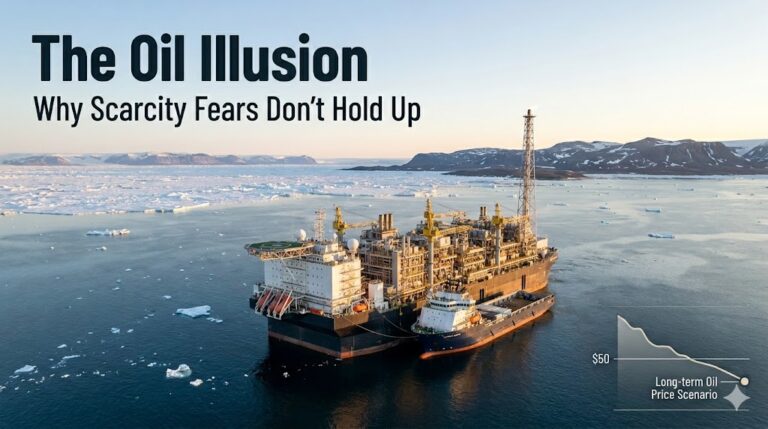
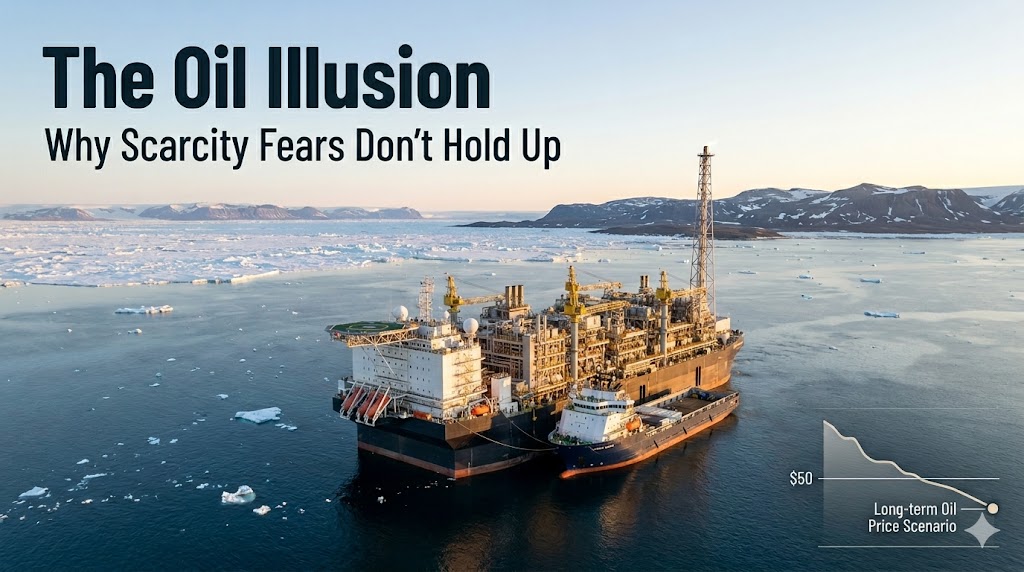
The Arctic presents another untapped frontier. The U.S. Geological Survey estimates up to 90 billion barrels of undiscovered oil in Arctic regions. Harsh conditions, environmental regulation, and international jurisdiction disputes keep most of it untouched.
Global offshore reserves — from the Gulf of Mexico to West Africa to the South China Sea — represent hundreds of billions of barrels, with deepwater technology making recovery increasingly viable, yet investment remains uneven.
California may be the most striking example of all. Geologically, the state holds more recoverable oil than Texas. The Monterey Shale alone was once estimated at 15–24 billion barrels. Strict environmental regulation and political opposition have made that oil effectively off-limits.
California: More Oil Than Texas, Zero Political Will
The California example is perhaps the most striking illustration of politically-imposed scarcity in American energy. The state sits atop one of the richest shale formations in North America. The Monterey Shale formation — stretching across the San Joaquin Valley and coastal basins — was once heralded by the U.S. Energy Information Administration as holding roughly two-thirds of total U.S. shale oil reserves.
Yet California produces a diminishing fraction of what its geology suggests is available. The state has enacted increasingly aggressive restrictions on new drilling permits, fracking, and offshore development. Local opposition, environmental litigation, and legislative mandates favoring renewable energy have made new oil development in California nearly impossible. The oil doesn’t disappear — it simply waits underground while imports fill the gap, often from sources with far weaker environmental records than domestic California production would require.
“California’s oil isn’t scarce. It’s politically sequestered — a distinction that matters enormously for long-term price forecasting.”
Venezuela: The Sleeping Giant That Can’t Wake Up
Venezuela’s Orinoco Heavy Oil Belt is, by official reserve counts, the single largest petroleum deposit on Earth. The country holds more proven oil reserves than Saudi Arabia. Under different governance — the kind that prevailed in the mid-20th century when Venezuela was a top global producer — those reserves would have long since been brought to market in volume sufficient to suppress world oil prices for decades.
Instead, nationalization, corruption, underinvestment, and the collapse of PDVSA’s operational capacity reduced Venezuelan output from over 3 million barrels per day in the late 1990s to under 800,000 in recent years. International sanctions have further constrained both production and exports. The oil is there. The institutional capacity to extract and sell it is not — at least not yet.
Any meaningful political or economic normalization in Venezuela represents a significant long-term downside risk for oil prices, as hundreds of billions of barrels could theoretically re-enter the global supply calculus.
The Arctic and Offshore: The Last Great Frontiers
The Arctic represents what may be the largest remaining undiscovered oil province on Earth. U.S. Geological Survey assessments have estimated between 90 and 160 billion barrels of technically recoverable oil across Arctic regions, with substantial additional natural gas resources. The challenge is access — both physical and regulatory.
In the United States, the Arctic National Wildlife Refuge (ANWR) on Alaska’s North Slope has been a political battleground for forty years. The coastal plain alone is estimated to hold between 4 and 12 billion barrels of technically recoverable oil. Offshore Arctic regions — in the Beaufort and Chukchi Seas — hold far more. Environmental concerns, drilling moratoriums, and the logistical cost of operating in extreme conditions have kept Arctic oil largely theoretical.
Globally, deepwater offshore development tells a similar story of constrained but enormous supply. The pre-salt discoveries off Brazil’s coast, the Gulf of Guinea fields in West Africa, and untapped deepwater blocks across Southeast Asia represent proven geological potential that is monetized only at the margins of its true scale. Regulatory permitting timelines, capital costs, and ESG-driven investment restrictions have all slowed the pace at which offshore reserves are converted into actual production.
Trump’s Energy Agenda and the Demand Side Equation
Crude oil prices are a function of both supply and demand. While the supply story argues against scarcity, the demand picture is equally compelling — and may ultimately be the more decisive force on long-term prices.
The Trump administration’s aggressive push to expand U.S. coal and natural gas production has a direct consequence that is often underappreciated in oil market commentary: it creates substantial switching opportunity for power generators currently using oil-fired generation to shift toward cheaper, abundantly available natural gas. When natural gas trades at historically low levels — as it has for much of the past decade thanks to the shale revolution — the economics of burning oil for power generation become increasingly difficult to justify.
The resulting demand reduction from the power sector may be modest in absolute terms, but it compounds with other structural demand headwinds: the accelerating penetration of electric vehicles, efficiency improvements in transportation and industry, and the general substitution of natural gas for oil across multiple end-use markets. Each of these trends chips away at the demand floor that historically supported oil prices above $60 or $70 per barrel.
The Long-Term Case for Sub-$50 Oil
Consider what a world with normalized Venezuelan production, active Arctic development, expanded offshore investment, and unlocked California reserves would look like for oil markets. The global supply overhang would be enormous. Combine that supply pressure with structurally declining demand from electrification, efficiency, and gas-switching in the power sector, and the arithmetic points toward a price regime that the oil industry has not had to reckon with since the 2016 downturn.
Long-dated oil futures markets have already begun to reflect this possibility. The curve has flattened and in some periods inverted, with markets pricing the expectation of weaker long-run demand. Analysts at several major investment banks have begun publishing scenarios in which Brent crude averages below $50 per barrel on a sustained basis sometime in the 2030s — not as a crisis scenario, but as the base case under reasonable assumptions about the energy transition.
The critical insight is that oil scarcity has largely been a manufactured condition — the product of geopolitical dysfunction in Venezuela, regulatory entrenchment in California, environmental caution in the Arctic, and capital market pressure on offshore development. Remove any two or three of those constraints simultaneously, and global oil markets face a supply wave for which demand growth — already slowing — provides insufficient absorption.
What Investors and Policymakers Should Watch
For energy investors, the implication is uncomfortable: the long-term risk in oil is not that prices stay elevated. It is that supply normalization and demand erosion combine to produce a prolonged low-price environment that strands assets and undermines the economics of the entire value chain. The majors — BP, Shell, ExxonMobil, Chevron — have signaled awareness of this risk through their accelerating diversification into gas, renewables, and low-carbon businesses.
For policymakers, the lesson is more nuanced. Restricting domestic production, as California has done, does not reduce global oil consumption — it simply redistributes production to jurisdictions with lower environmental and labor standards. Meanwhile, the political decisions that have kept Venezuelan reserves off-market, Arctic acreage unexplored, and California shale undeveloped have effectively provided an artificial floor under world oil prices, transferring wealth to OPEC producers and petrostates at the expense of consumers everywhere.
The earth is not running out of oil. The real question — for markets, for policy, and for the energy transition — is how much of it we choose to leave in the ground, and who benefits from the prices that choice sustains.
This article represents analysis and opinion based on publicly available data and market information. Reserve estimates cited reflect geological surveys and industry data as of publication. Oil price projections are speculative and should not be construed as investment advice.
E
About the Author