The Infrastructure Decision That Shapes Florida’s Business Future
Florida’s business community faces a defining choice in today’s digital economy. Whether running a seafood distribution operation in the Keys, managing vacation properties along the Gulf Coast, operating medical clinics in Orlando, or coordinating construction projects throughout the Suncoast region, the decision between traditional local computing and cloud-based infrastructure fundamentally shapes what businesses can achieve.
This choice extends beyond technical considerations. It determines whether Florida enterprises can harness artificial intelligence to compete with national chains, serve increasingly demanding customers, and operate efficiently across the state’s challenging environment—from hurricane disruptions to seasonal demand fluctuations.
For Florida businesses ready to explore how cloud computing and AI can drive growth, FloridaAIAgency.com offers expert consultation tailored to the Sunshine State’s unique needs. Call 813-409-4683 for a free consultation.
Understanding Local Server Computing
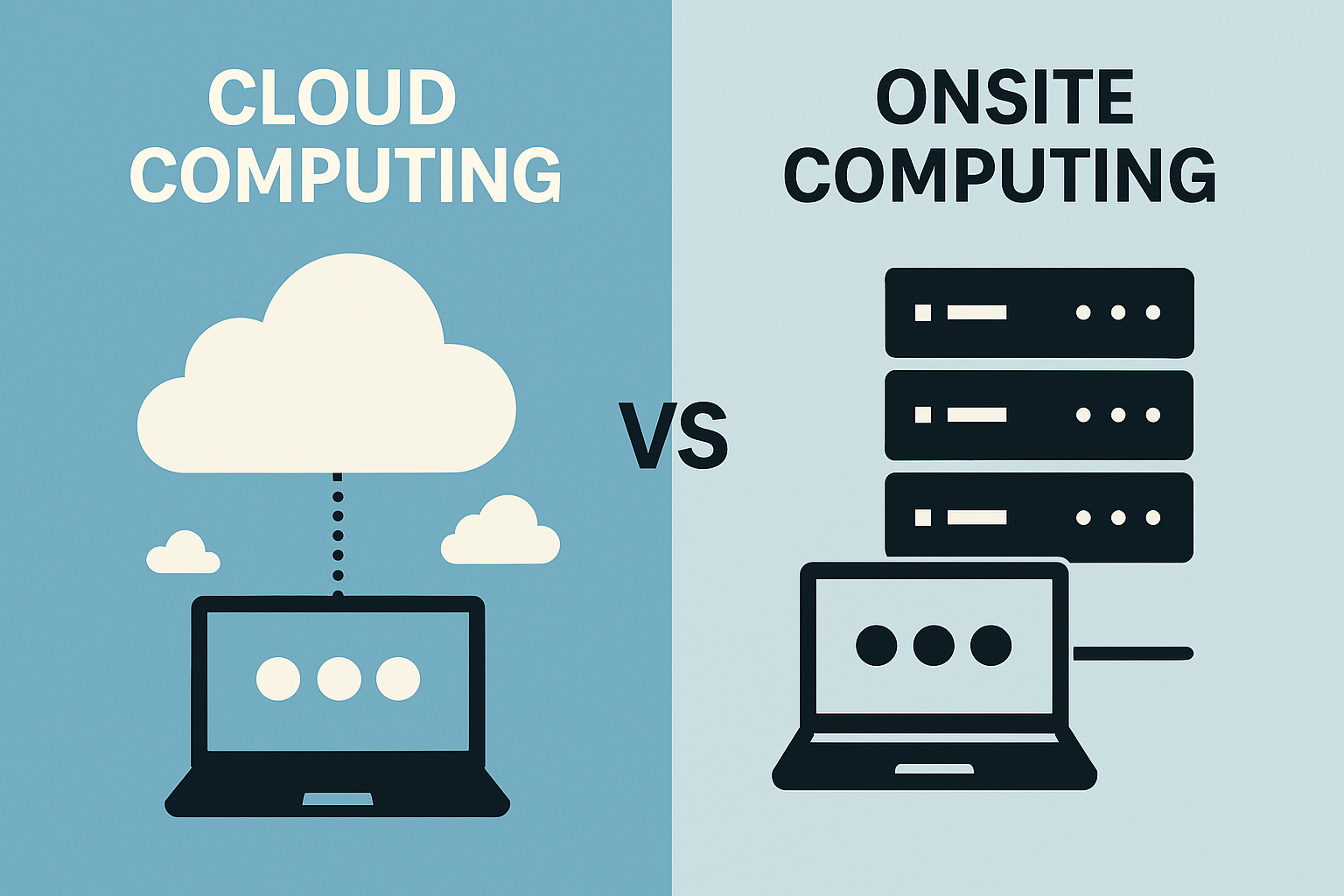
Local server computing involves businesses purchasing and maintaining their own physical infrastructure on-site. A typical setup includes servers stored in back offices or IT closets, networking equipment connecting systems, backup devices protecting data, and cooling systems preventing overheating. The business owns everything outright and handles all maintenance, updates, security, and repairs through internal staff or contracted IT providers.
For some Florida organizations, this model offers specific advantages. A defense contractor at Kennedy Space Center appreciates physical control over classified information. A rural agricultural operation in Central Florida values systems that function when internet service becomes unreliable. A medical practice in Pensacola prefers keeping patient records behind locked doors they control directly.
However, significant limitations increasingly outweigh these benefits. Scalability requires purchasing new hardware—a process consuming weeks or months through vendor selection, procurement, delivery, installation, and configuration. A Daytona Beach hotel chain must size infrastructure for peak racing season, leaving expensive equipment underutilized most of the year. A growing Gainesville startup faces cash flow challenges when infrastructure expansion requires $75,000 in upfront capital.
Maintenance demands prove relentless. IT personnel spend countless hours applying security patches, updating software, monitoring performance, replacing failed components, managing backups, and troubleshooting problems. These tasks divert resources from strategic initiatives that drive business value.
Hurricane vulnerability creates acute risks for Florida businesses. When Hurricane Ian devastated Southwest Florida, companies relying on local servers experienced catastrophic data loss and extended downtime. Buildings flooded, hardware destroyed, and businesses without robust offsite backups—expensive and complex to implement properly—lost years of irreplaceable information.
Geographic constraints complicate modern operations. Remote access requires VPN configurations and security considerations. Multi-location businesses face expensive complexity synchronizing data across sites. A sales representative traveling from Tallahassee to Tampa struggles accessing files stored on office servers.
Cloud Computing: Transforming What’s Possible
Cloud computing fundamentally reimagines technology infrastructure. Instead of purchasing physical servers, businesses rent computing power, storage, and services from providers like Amazon Web Services, Microsoft Azure, or Google Cloud Platform. These providers operate massive data centers globally, delivering resources over the internet on a pay-as-you-go basis.
The cloud isn’t mystical—it’s physical data centers owned by major technology companies, just located elsewhere and shared among many customers. When a Sarasota architecture firm stores project files “in the cloud,” those files reside on physical servers in data centers perhaps in Virginia or Oregon. The difference: the firm doesn’t own, maintain, or even know where specific servers are located—they simply access storage capacity as needed.
Cloud providers offer services at different levels. Infrastructure as a Service provides virtual servers and storage. Platform as a Service offers complete development environments for building applications. Software as a Service delivers fully functional applications like Microsoft 365 or Salesforce through web browsers without any local installation.
construction surety bond company Florida
performance bond provider Florida
For Florida businesses, cloud computing delivers transformative advantages. Elastic scalability enables instant capacity adjustments. A Destin vacation rental company scales up during summer tourism peaks, then scales back in slower months, paying only for actual usage. This eliminates both the capital waste of oversized infrastructure sitting idle and service disruptions when undersized systems cannot handle demand spikes.
The operational expense model dramatically improves cash flow. Instead of $60,000 upfront for servers, a Tampa startup pays $400 monthly for cloud services, preserving capital for hiring, marketing, or inventory. As business grows, cloud costs increase proportionally—but so does revenue.
Accessibility from anywhere revolutionizes operations. Employees access systems from offices, homes, customer sites, or while traveling. A Jacksonville insurance agency maintains operations during hurricane evacuations with staff working from home. A construction company’s project managers access systems from job sites across North Florida.
Disaster resilience becomes automatic. Cloud providers replicate data across geographically separated data centers, so hurricanes affecting one location don’t result in data loss. When Hurricane Michael devastated Panama City, cloud-based businesses continued operating from temporary locations with all data intact.
Technology democratization levels competitive playing fields. A small Lakeland manufacturer accesses analytics tools that Fortune 500 companies use. A family medical practice in Ocala implements AI-powered capabilities comparable to major hospital systems. Cloud computing enables capabilities previously limited to enterprises with massive technology budgets.
Why Cloud Infrastructure Enables AI Transformation
The connection between cloud computing and artificial intelligence isn’t obvious to many business owners, but it’s fundamental. Modern AI systems demand extraordinary computational resources that make local infrastructure economically impractical.
Training AI models requires processing massive datasets through billions of calculations using specialized processors. A sophisticated model might need hundreds of high-end GPUs operating continuously for days—hardware costing millions that sits idle after training completes. Cloud platforms offer GPU access by the hour. A Tampa logistics company rents 100 GPUs for 48 hours to train a route optimization model, paying perhaps $4,000 for computing power that would cost $400,000 to purchase.
Data requirements compound the challenge. Effective AI models need vast datasets—millions of transactions, thousands of images, years of operational records. A Florida citrus cooperative developing yield prediction AI needs data from hundreds of growers, thousands of fields, and decades of weather records. Cloud storage provides virtually unlimited capacity at minimal cost.
Integration requirements make cloud infrastructure nearly essential. AI agents need access to customer databases, inventory systems, financial records, external data sources, and communication platforms. A Miami hotel’s AI concierge must access property management systems, local attractions databases, restaurant reservations, weather services, and guest preferences. Cloud platforms provide networking infrastructure and security frameworks necessary for these complex integrations.
Development flexibility requires resources that scale dynamically. Data scientists experiment with different algorithms and approaches, training dozens of model variations. Cloud platforms enable running ten experiments simultaneously, identifying promising approaches within hours rather than waiting weeks with limited local infrastructure.
Cloud providers offer specialized AI services that dramatically reduce required expertise. A Jacksonville medical practice implements AI-powered appointment scheduling using managed services without hiring machine learning engineers. A Fort Lauderdale retailer deploys product recommendations without understanding underlying algorithms.
AI Agents: Powerful Tools for Florida Business Goals
With cloud infrastructure providing the foundation, AI agents deliver transformative capabilities across business operations. These intelligent systems differ fundamentally from traditional software—they learn patterns from data and make decisions based on complex reasoning rather than following explicit programmed rules.
A Clearwater resort’s AI assistant handles guest inquiries 24/7 in English, Spanish, Portuguese, and French—essential for serving Florida’s international visitors. The system understands natural language, interprets intent, accesses guest history for personalized responses, and escalates complex issues to human staff seamlessly.
Sales and marketing leverage AI for personalization at scale. A Coral Springs outdoor retailer uses AI to identify customer interests—fishing versus hiking, beach versus camping—then customizes website displays, email campaigns, and promotions accordingly. The system learns continuously, improving recommendations based on which suggestions customers act upon.
Operational efficiency improves dramatically. A Pensacola restaurant chain deploys AI that analyzes historical sales, weather forecasts, events calendars, and seasonal patterns to predict demand by location and menu item. The system generates purchasing recommendations, optimizes staff scheduling, and suggests promotional strategies for slower periods.
Financial operations benefit from AI automating routine transactions while identifying anomalies. An AI system for a West Palm Beach construction company extracts invoice information, matches documents, identifies discrepancies, and processes standard payments automatically while flagging unusual patterns suggesting errors or fraud.
Custom AI Applications Delivering Competitive Advantage
Generic AI tools provide baseline capabilities, but transformative impact comes from applications tailored to specific business challenges and competitive contexts.
Consider a Florida citrus cooperative developing custom AI that integrates weather patterns, harvest labor availability, quality assessments, transportation rates, international market prices, currency exchange rates, and historical demand patterns. The system generates recommendations for optimal harvest timing, suggested pricing by market segment, recommended shipping routes, and alerts to opportunities from supply disruptions elsewhere. This addresses specific varieties, customers, logistics constraints, and competitive realities that generic agricultural software cannot match.
A Naples luxury resort creates custom AI integrating property management data, transactions, reservations, weather, and local events. The system generates dynamic pricing recommendations, personalized activity suggestions through mobile apps, proactive service interventions, optimal staff scheduling, and targeted promotional offers. Learning from each guest visit, the application continuously refines its understanding of what satisfies different guest segments and how pricing affects booking patterns.
A Jacksonville healthcare network develops custom AI for emergency department operations, integrating patient arrivals, electronic health records, bed availability, specialist availability, equipment scheduling, and historical admission patterns. The AI provides predictive capacity planning, diagnostic pathway recommendations, and dynamic staffing adjustments—capabilities reflecting specific patient populations, facility resources, and clinical protocols.
Florida businesses seeking custom AI solutions addressing their unique challenges can partner with experts who understand Sunshine State business realities. FloridaAIAgency.com specializes in practical AI implementations delivering measurable results. Call 813-409-4683 for a free consultation.
Implementing AI Successfully: Practical Guidance
Success requires strategic thinking and appropriate execution. Start with clear objectives—specific, measurable goals rather than vague aspirations. A St. Petersburg manufacturer might target reducing equipment downtime by 30%, improving demand forecast accuracy to 85%, or decreasing quality defects by 50%.
Identify high-value use cases suited to AI capabilities: large volumes of repetitive decisions, pattern recognition in complex data, prediction based on historical patterns, personalization at scale, or optimization of complex processes.
Begin with manageable pilots addressing specific use cases—implementing AI chatbots for one service channel, deploying predictive maintenance for specific equipment, or using AI-driven personalization for one product category. Pilots should complete within 3-6 months, providing learning opportunities and demonstrating value before broader deployments.
Build internal capabilities through employee training, strategic hiring, university partnerships, or industry association participation. Florida’s universities—University of Florida, Florida State, UCF, University of Miami—offer programs from executive education to advanced degrees in data science and AI.
Florida-Specific Considerations
Hurricane preparedness requires ensuring AI systems remain accessible during storms. Cloud-based systems provide inherent advantages—data replicated across geographic facilities remains accessible during Florida disruptions, employees can access systems from evacuation locations, and operations resume immediately once connectivity is restored.
Multilingual capabilities are essential given Florida’s cultural diversity. Customer-facing AI should support Spanish, Portuguese, Haitian Creole, and other languages, recognizing when assistance is needed and escalating to appropriate bilingual staff when situations exceed AI capabilities.
Seasonal business patterns require AI models that account for dramatic demand fluctuations across tourism, agriculture, retail, and construction. Training data should include multiple seasonal cycles, and models should incorporate time-of-year as a key variable.
Regulatory compliance must be built into implementations from the outset. Healthcare organizations face HIPAA requirements, financial institutions navigate banking regulations, and businesses handling customer data must comply with privacy laws. Select cloud providers with appropriate certifications and implement proper data encryption and access controls.
The Competitive Imperative
Cloud computing and AI adoption increasingly determines competitive survival. Organizations leveraging these technologies gain compounding advantages—operational efficiency, better customer experiences, and capabilities to attract top talent. Those delaying face growing gaps that become progressively harder to overcome.
Customer expectations evolve rapidly. When travelers experience instant, personalized service from AI-powered systems at one hotel, they expect comparable capabilities at Florida properties. Businesses failing to meet these expectations lose customers to more digitally sophisticated competitors.
Efficiency advantages from AI optimization allow businesses to operate on lower margins while maintaining profitability, potentially driving competitors unable to match their efficiency out of business. The pace of technological change continues accelerating—capabilities that seemed futuristic five years ago are now commonplace. Delays in adoption create gaps that eventually become impossible to bridge.
Taking Action Today
The shift from local to cloud computing, combined with AI agents, represents fundamental transformation in what’s possible for Florida businesses. Cloud platforms democratize access to capabilities previously available only to large enterprises, while AI brings sophisticated reasoning and automation to every business process.
Success requires strategic thinking about objectives, realistic assessment of organizational readiness, focused pilots generating learning and value, continuous iteration based on results, investment in internal expertise, and partnerships with experienced advisors.
The question isn’t whether to pursue cloud-enabled AI transformation, but how to execute effectively while competitive position remains strong. Those who act decisively position themselves for sustained success.
FloridaAIAgency.com helps Florida businesses navigate this transformation with practical, results-focused consulting. Whether exploring possibilities or ready to implement specific solutions, their team offers expertise tailored to Sunshine State enterprises. Call 813-409-4683 for a free consultation about your unique challenges and opportunities. The conversation costs nothing, but the insights could prove invaluable for your business’s future.
The future belongs to Florida businesses embracing these technologies thoughtfully and executing skillfully. The tools are available, opportunities are real, and the time is now. Your competitors are moving forward—make the call today and take the first step toward your AI-enabled future.
About the Author